 | |
| Type | Stew |
|---|---|
| Place of origin | Netherlands, Germany |
| Main ingredients | Rabbit or hare, onions, wine |
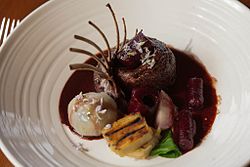
Hasenpfeffer is a traditional stew in Dutch and German cuisine made from marinated hare or rabbit meat,12 cut into stewing-meat sized pieces and braised with onions and a marinade made from wine and vinegar.3
Description
In German Hase means "hare" and Pfeffer means "pepper".4
In Dutch the term "Hazenpeper" was first attested in 1599 and also mentioned in 1778, both meaning 'a dish made with the meat of a hare'.5
In the Netherlands the dish is often made with the spiced cake called ontbijtkoek (also referred to as "peperkoek") to give it extra flavour and texture. In Germany ginger cookies called "Pfeffernüsse" are generally used.2
References
References
- Sheraton, M. (2010). The German Cookbook: A Complete Guide to Mastering Authentic German Cooking. Random House Publishing Group. p. pt380. ISBN 978-0-307-75457-8. Retrieved January 12, 2017.
- "Hazenpeper | Traditional Stew from Netherlands". TasteAtlas.com. EU: AtlasMedia Ltd. Retrieved October 11, 2023.
- "Hasenpfeffer (German Rabbit Stew)". Wide Open Eats. 2 June 2020. Retrieved 9 July 2020.
{{cite web}}: CS1 maint: deprecated archival service (link) - South Dakota Conservation Digest. Vol. 29–31. South Dakota Department of Game, Fish and Parks. 1962. p. 20. Retrieved January 12, 2017 – via Google Books.
- "Zoekresultaten - Hazenpeper" [Search results - Hazenpeper]. Etymologie Bank.nl (in Dutch). Archived from the original on March 8, 2022.
External links
External links
- "Hasenpfeffer recipe". AllRecipes.com.
- "Hasenpfeffer recipe". BonAppetit.com. 13 March 2012.