| Hamulinidae Temporal range: Cretaceous,
| |
|---|---|
| |
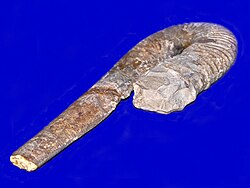
| Hamulina astieri from southern Alps, on display at Galerie de paléontologie et d'anatomie comparée, Paris | |
Scientific classification 
| |
| Kingdom: | Animalia |
| Phylum: | Mollusca |
| Class: | Cephalopoda |
| Subclass: | †Ammonoidea |
| Order: | †Ammonitida |
| Suborder: | †Ancyloceratina |
| Superfamily: | †Ancyloceratoidea |
| Family: | †Hamulinidae Gill, 1871 |
Hamulinidae is an extinct ammonoid cephalopod family belonging to the order Ammonitida.1 These cephalopod were fast-moving nektonic carnivores. They lived during the Lower Cretaceous period (Lower Barremian - Upper Barremian).
Description
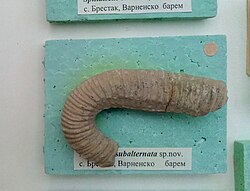
The long main shaft is followed by a hook and a shorter, close, parallel or slightly divergent final shaft. The ammonitic suture is with a subtrifid L. The U is usually reduced or indifferentiated in adults.
Genera
Notes
Notes
- Wright, C. W. with Callomon, J.H. and Howarth, M.K. (1996), Mollusca 4 Revised, Cretaceous Ammonoidea, vol. 4, in Treatise on Invertebrate Paleontology, Part L (Roger L. Kaesler et el. eds.), Boulder, Colorado: The Geological Society of America & Lawrence, Kansas: University of Kansas Press, pp. 230-232.
References
References
- "Hamulinidae". The Paleobiology Database. Retrieved 25 July 2026.
- "Hamulinidae". mindat.org. Retrieved 13 June 2022.
- Wright C.W. with J.H. Callomon and M.K. Howarth (1996). "Mollusca 4 Revised: Cretaceous Ammonoidea". In Roger L. Kaesler (ed.). Treatise on Invertebrate Paleontology Part L. Vol. 4. Boulder, Colorado and Lawrence, Kansas: The Geological Society of America & University of Kansas Press. p. 230-232 – via Internet Archive.