| Hampea | |
|---|---|
| |
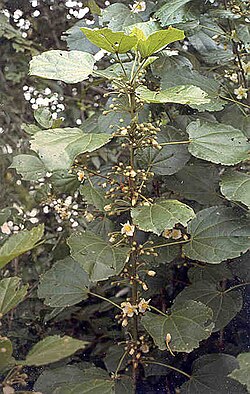
| Hampea trilobata in flower | |
Scientific classification 
| |
| Kingdom: | Plantae |
| Clade: | Embryophytes |
| Clade: | Tracheophytes |
| Clade: | Spermatophytes |
| Clade: | Angiosperms |
| Clade: | Eudicots |
| Clade: | Rosids |
| Order: | Malvales |
| Family: | Malvaceae |
| Subfamily: | Malvoideae |
| Tribe: | Gossypieae |
| Genus: | Hampea Schltdl.1 |
| Species | |
|
See text | |
Hampea is a genus of flowering plants in the family Malvaceae. They are trees native to Mexico, Central America, and Colombia. There are about 21 species.2
Species
21 species are accepted.3
- Hampea albipetala Cuatrec.
- Hampea appendiculata (Donn.Sm.) Standl.
- Hampea bracteolata Lundell
- Hampea breedlovei Fryxell
- Hampea integerrima Schltdl.
- Hampea lanceolata F.Areces
- Hampea longipes Miranda
- Hampea mexicana Fryxell
- Hampea micrantha A.Robyns
- Hampea montebellensis Fryxell
- Hampea nutricia Fryxell
- Hampea ovatifolia Lundell
- Hampea platanifolia Standl.
- Hampea punctulata Cuatrec.
- Hampea reynae Fryxell – majagua
- Hampea rovirosae Standl.
- Hampea sphaerocarpa Fryxell
- Hampea stipitata S.Watson
- Hampea thespesioides Triana & Planch.
- Hampea tomentosa (C.Presl) Standl.
- Hampea trilobata Standl.
Ecology
Lepidoptera whose caterpillars feed on Hampea include Macrosoma conifera and one or two taxa of the two-barred flasher (Astraptes fulgerator) cryptic species complex.45
References
References
- "genus Hampea". Germplasm Resources Information Network (GRIN) online database. Retrieved 25 April 2017.
- Jones, R. W., Fryxell, P. A., & Baro, D. M. (1997). Phylogenetic analysis of the genus Hampea (Malvales: Malvaceae: Gossypieae). Archived 2015-06-16 at the Wayback Machine Anales del Instituto de Biología. Serie Botánica, 68(1), 21-42.
- "Hampea Schltdl". Plants of the World Online. Royal Botanic Gardens, Kew. Retrieved 3 November 2025.
- Brower, Andrew V.Z. (2006): Problems with DNA barcodes for species delimitation: ‘ten species’ of Astraptes fulgerator reassessed (Lepidoptera: Hesperiidae). Systematics and Biodiversity 4(2): 127–132. doi:10.1017/S147720000500191X PDF fulltext Archived 2008-12-17 at the Wayback Machine
- Hébert, Paul D.N.; Penton, Erin H.; Burns, John M.; Janzen, Daniel H. & Hallwachs, Winnie (2004): Ten species in one: DNA barcoding reveals cryptic species in the semitropical skipper butterfly Astraptes fulgerator. PNAS 101(41): 14812-14817. doi:10.1073/pnas.0406166101 PDF fulltext Supporting Appendices these were recorded on H. appendiculata.