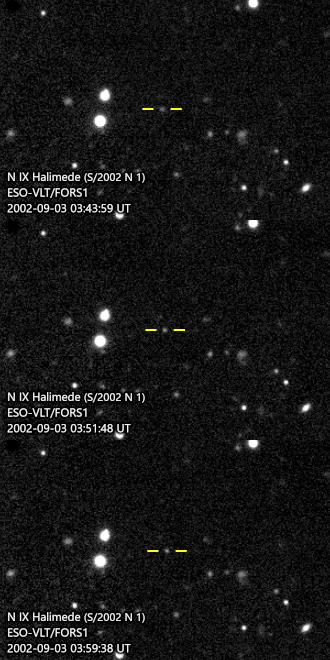
 Halimede imaged by the Very Large Telescope on 3 September 2002 | |
| Discoverya | |
|---|---|
| Discovered by |
|
| Discovery site | Cerro Tololo Obs. |
| Discovery date | 14 August 2002 |
| Designations | |
Designation | Neptune IX |
| Pronunciation | /hæləˈmiːdiː/4 |
Named after | Ἁλιμήδη (Halimèdè)5 |
| S/2002 N 1 | |
| Orbital characteristics (range)b | |
| Observation arc | 22.14 years (8,088 d)7 |
| Earliest precovery date | 18 July 19997 |
| 16,553,800 to 16,632,500 km (0.110655 to 0.111181 AU) | |
| Eccentricity | 0.19 to 0.90 |
| 5.13 to 5.16 years (1,873 to 1,886 d) | |
| Inclination | 111° to 145° (to ecliptic) |
| Satellite of | Neptune |
| Group | None known6 |
| Proper orbital elements (average)8 | |
Proper semi-major axis | 16,590,500 km (0.110901 AU) |
Proper eccentricity | 0.521 |
Proper inclination | 119.6° (to ecliptic) |
Proper orbital period | 5.14 years (1,879 d) |
Precession of perihelion long. | 240.222428 arcsec / yr |
Precession of asc. node | 251.357642 arcsec / yr |
| Physical characteristics | |
| 42 to 62 kmc | |
Spectral type | |
Halimede (/hæləˈmiːdiː/), also known as Neptune IX and previously as S/2002 N 1, is an irregular moon of Neptune. It was discovered on 14 August 2002 by Matthew Holman, JJ Kavelaars, Tommy Grav, Wesley Fraser, and Dan Milisavljevic at Cerro Tololo Inter-American Observatory in Chile. Named after one of the Nereids from Greek mythology, Halimede follows a distant, highly eccentric, and highly inclined orbit with an average orbital period of about 5.1 Earth years. Like the majority of irregular moons, Halimede's orbit is retrograde, meaning it revolves around Neptune in the opposite direction to the planet's orbit around the Sun. It is the second-innermost known retrograde moon of Neptune, after Triton.
The orbit of Halimede varies substantially over thousands of years, because it is significantly perturbed by the Sun's gravity. Over billions of years, Halimede has a high chance of colliding with Neptune's large moon Nereid. Telescope observations indicate that Halimede is a gray, non-spherical object with a diameter between 42 and 62 km (26 and 39 mi). Its color is similar to that of Nereid, which has led some astronomers to hypothesize that Halimede may be a collisional fragment of Nereid.
Discovery
Halimede was discovered by astronomers Matthew Holman, JJ Kavelaars, Tommy Grav, Wesley Fraser, and Dan Milisavljevic during a search for distant moons of Neptune.1 Led by Holman, the search began in 2001 and employed large optical telescopes on Earth to obtain numerous long-exposure images of the sky around Neptune.1516: 865 The team used the shift-and-add technique to align and combine the images according to Neptune's motion across the sky, which enhanced the faint moons as points of light.1516: 865–866 Through this technique,16 they discovered Halimede alongside two other Neptunian moons—Sao and Neso—in images taken on 14 August 2002 by the 4-meter Víctor M. Blanco Telescope at Cerro Tololo Inter-American Observatory, Chile.3 Halimede was among the first Neptunian moons discovered from a ground-based telescope since Nereid in 1949.115
To determine Halimede's orbit around Neptune, astronomers conducted follow-up observations at several observatories, with the help of orbit predictions by Brian G. Marsden and Robert A. Jacobson.15 A team led by Brett Gladman observed Halimede on 3 and 4 September 2002 using the 8.2-m Very Large Telescope at Cerro Paranal Observatory,17 while other teams observed it with the 2.5-m Nordic Optical Telescope at La Palma Observatory and the 5-m Hale Telescope at Palomar Observatory.1815 Earlier observations of Halimede were found by Holman in Blanco Telescope images from 10 August 2001.17 The discovery of Halimede, alongside the Neptunian moons Sao and Laomedeia, was announced by the Minor Planet Center on 13 January 2003.1718 The announcement raised Neptune's number of known moons to 11.19
Following the announcement of Halimede's discovery, its discoverers conducted additional observations in 2003 and 2004 to refine calculations of the moon's orbit.16: 866 During this work, they identified precovery images of Halimede from 18 July 1999,7 taken by an earlier survey for Neptunian moons with the Canada–France–Hawaii Telescope at Maunakea Observatory.16: 866 These constitute the earliest known observations of the moon.7 The additional observations extended Halimede's observation arc to cover almost its entire orbital period, which allowed the discoverers to accurately determine the moon's orbit at an early stage.16: 866 As of 2026, Halimede's observation arc spans more than 22 years, covering over four times its orbital period.7
-
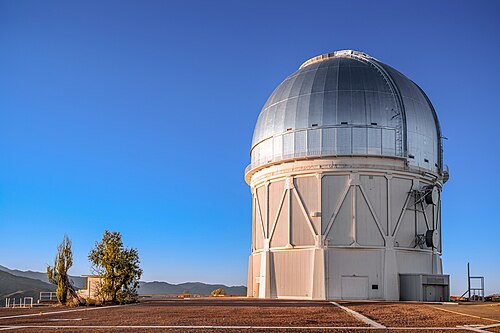 The Víctor M. Blanco Telescope was used for the discovery of Halimede in 2002.
 -
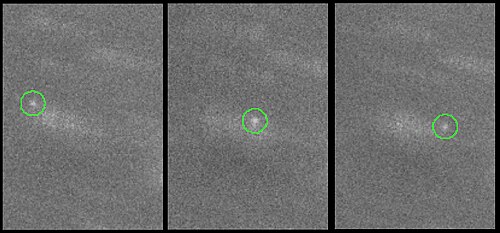 Discovery images of Halimede from the Blanco Telescope. The images were shifted-and-added to reveal Halimede as a single dot against trailed background stars.
Name
When the discovery of Halimede was announced, it was given the temporary provisional designation "S/2002 N 1" by the Minor Planet Center.17 It was later named and given the Roman numeral designation Neptune IX by the International Astronomical Union's (IAU's) Working Group for Planetary System Nomenclature on 3 February 2007.20 In accordance with the IAU's naming convention for Neptunian irregular moons, it was named after Halimede, one of the fifty Nereids or daughters of Nereus and Doris from Greek mythology.121 The moon was given a name ending with "e" to indicate its retrograde orbit, in a similar fashion to the naming convention for Jupiter's irregular moons.22: 414
Orbit
Halimede is an irregular moon of Neptune, meaning it follows a distant, highly eccentric, and highly inclined orbit around the planet.23d Like the majority of irregular moons, Halimede's orbit is retrograde, revolving around Neptune in the opposite direction to the planet's orbit around the Sun.24: 1 Due to its great distance from Neptune, Halimede is strongly affected by the Sun's gravity, which causes gradual but substantial variations in its orbit over thousands of years.24: 4 For this reason, Halimede's orbit is better described by proper orbital elements, which are calculated by averaging out its perturbed orbit over an extended period of time.24: 4
Over a 10,000-year time span, Halimede's semi-major axis from Neptune varies from 16.55 to 16.63 million km (10.28 to 10.33 million mi; 0.1106 to 0.1112 AU), averaging about 16.59 million km (10.31 million mi; 0.1109 AU).b In terms of average semi-major axis, Halimede is the second-innermost known retrograde moon of Neptune, after Triton.8 On average, Halimede takes about 5.14 years (1,879 days) to complete one orbit around Neptune,8 though perturbations by the Sun can vary the orbital period from 5.13 to 5.16 years (1,873 to 1,886 days).b While Halimede's orbit has an average eccentricity of 0.52 and an average inclination of 120° with respect to the ecliptic, both values vary substantially due to the Sun's perturbations.24 The moon's eccentricity ranges from 0.19 to 0.90, while its inclination ranges from 111° to 145°.b
Among all known retrograde irregular moons in the Solar System as of 2026, Halimede has the lowest value for its average inclination.25 Since retrograde orbits are defined as having inclinations greater than 90°,13 Halimede's low inclination value means its orbit is actually highly inclined.23: 7 When disregarding Halimede's orbital direction, the moon's average orbit is inclined 60° from the ecliptic.e For comparison, the most inclined known prograde irregular moon, Margaret, has an average inclination of 60.5° with respect to the ecliptic.25
Halimede does not appear to experience any orbital resonances,23 nor does it share orbit similarities with other Neptunian irregular moons.6: 9 Its orbit exhibits both apsidal and nodal precession with periods of 5,395 and 5,156 years, respectively.8 Due to apsidal precession, the moon's argument of pericenter circulates from 0° to 360°.23: 7 Halimede's longitude of pericenter circulates regularly in the direction of its retrograde orbit.23: 7

Relation to Nereid and origin
Due to Halimede's extreme eccentricity variation, its orbital path can bring it close to Nereid, one of Neptune's largest irregular moons.16 At maximum eccentricity and minimum semi-major axis, Halimede can come as close as 1.66 million km (1.03 million mi; 0.0111 AU) to Neptune at periapsis,f allowing it to cross the orbit of Nereid with a nonzero chance of colliding.16 A 2004 study led by Holman and collaborators estimated that Halimede has a 41% chance of impacting Nereid over a period of 4.5 billion years.1624: 11 During this time interval, Halimede is expected to make repeated close approaches to Nereid, leading to gravitational scattering of Halimede's orbit.16: 866 However, these close encounters do not occur often, as Halimede and Nereid do not approach within 180,000 km (110,000 mi) of each other over a period of 30,000 years.24: 11
Due to Halimede's high chance of colliding with Nereid over the lifetime of the Solar System, Holman and collaborators speculated in 2004 that Halimede might be a fragment ejected by a collision on Nereid.1624: 11 This hypothesis was supported by another study published in the same year, which found that Halimede shares a similar color and possibly similar surface composition as Nereid.1610 In a 2005 study, Ćuk and Gladman commented that it is only plausible for Halimede to form as a fragment of Nereid if both moons were pieces of circumplanetary debris ejected and mixed by Triton during its capture by Neptune.27 Alternatively, if Halimede did not form as a fragment of Nereid, it could be one of Neptune's original irregular moons, gravitationally captured by the planet during the Solar System's early history.166: 15
-
 Evolution of Halimede's orbital eccentricity (blue), inclination (orange), argument of pericenter (green), and periapsis distance from Neptune (red) from 1600 to 2400. Halimede's eccentricity and inclination gradually decrease over time, while exhibiting short-period oscillations.
 -
 Sped-up simulation of Halimede's orbit around Neptune, viewed at an oblique angle. Beginning in 1600, Halimede had a highly eccentric orbit grazing Nereid's orbit, but it gradually circularizes by 2400.
Physical characteristics
Little is known about Halimede's physical characteristics.1 Like most of Neptune's irregular moons, Halimede is extremely faint and difficult to observe due to its small size and great distance from the Sun.15 In visible light (V band), Halimede has an apparent magnitude of about 24.10: L78 With apparent magnitudes this dim, Halimede and most of Neptune's irregular moons can only be observed through long-exposure imaging with large optical telescopes.1524: 12
The diameter of Halimede has not been directly measured, although it can be indirectly estimated from its brightness and an assumed geometric albedo.9: 173–174 Assuming a low geometric albedo of 0.04, Halimede's diameter would be about 62 km (39 mi).9: 174 For an albedo of 0.06, Halimede would have a diameter of 54 km (34 mi).16: 866 For an albedo of 0.1, Halimede would have a diameter of 42 km (26 mi).6: 15 Halimede appears to be similar in size to the parent bodies that formed the Sao and Neso groups of Neptunian irregular moons.6: 12
Telescope observations from 2003 found that Halimede changes brightness significantly between days, with its V-band absolute magnitude dropping from 9.01±0.07 to 9.74±0.08 between July 27–28 and August 1.10 This brightness change suggests that Halimede is rotating with a non-spherical shape.10 The observations also showed that Halimede has a neutral (gray11) color similar to that of Nereid, suggesting that they share a surface composition rich in water ice.10 The colors of Halimede and other Neptunian irregular moons indicate that they lack the "ultrared" material commonly seen on the surfaces of Kuiper belt objects, suggesting that their surfaces have been altered by collisions or sublimation of volatiles.12
See also
See also
- Other Neptunian irregular moons discovered in 2002:
- Sao
- Laomedeia
- Neso
- S/2002 N 5 (lost in 2002, confirmed much later in 2024)
Notes
Notes
- This is the exact order of discoverers listed by NASA, the International Astronomical Union, and the United States Geological Survey.123
- Sheppard et al. (2024) give the mean, minimum, and maximum values for Halimede's osculating orbital elements in Table 6: semi-major axis 16590500+42000
−36700 km, eccentricity 0.52+0.38
−0.33, inclination 120°+25°
−9° with respect to the ecliptic, and orbital period 1879+7
−6.6: 11 The error bars represent the difference between the minimum/maximum value and the average value over a 10,000-year period.6: 11 - The 42 km diameter estimate comes from Sheppard et al. (2024) who assume a geometric albedo of 0.1,6 while the 61 km diameter estimate comes from Sheppard et al. (2006) who assume a geometric albedo of 0.04.9
- Neptune's moons Triton and Nereid are sometimes considered irregular moons, though researchers often discuss them separately due to their unusual orbital characteristics and disproportionately large sizes.9: 173 24: 1
- Subtracting Halimede's average orbital inclination of 120° from 180° gives 60°.
- Periapsis (q) and apoapsis (Q) distances are calculated from semi-major axis (a) and eccentricity (e) according to the equations and .26 A 2005 study by Matija Ćuk and Brett Gladman calculated a minimum periapsis distance of 1.3 million km (0.81 million mi) for Halimede, but this estimate was made when there was less observational data available for calculating the moon's orbit.27: L116
References
References
- "Halimede". NASA. 3 November 2024. Archived from the original on 2 April 2026. Retrieved 6 July 2026.
- "Planetary Satellite Discovery Circumstances". JPL Solar System Dynamics. NASA. Archived from the original on 27 September 2021. Retrieved 6 July 2026.
- "Planet and Satellite Names and Discoverers". Gazetteer of Planetary Nomenclature. USGS Astrogeology Science Center. Archived from the original on 18 June 2026. Retrieved 6 July 2026.
- Noah Webster (1884) A Practical Dictionary of the English Language
- "Ἁλιμήδη". Logeion (ΛΟΓΕΙΟΝ). University of Chicago. Archived from the original on 6 July 2026. Retrieved 6 July 2026.
- Sheppard, Scott S.; Tholen, David J.; Brozović, Marina; Jacobson, Robert A.; Trujillo, Chadwick A.; Lykawka, Patryk Sofia (December 2024). "New Moons of Uranus and Neptune from Ultradeep Pencil-beam Surveys". The Astronomical Journal. 168 (6): 258. arXiv:2410.00108. Bibcode:2024AJ....168..258S. doi:10.3847/1538-3881/ad7fed. S2CID 273022766.
- "MPC Explorer - Neptune 9". Minor Planet Center. Retrieved 6 July 2026.
{{cite web}}: CS1 maint: url-status (link) - "Planetary Satellite Mean Elements". JPL Solar System Dynamics. NASA. Archived from the original on 6 June 2026. Retrieved 6 July 2026.
- Sheppard, Scott S; Jewitt, David C.; Kleyna, Jan (July 2006). "A Survey for "Normal" Irregular Satellites around Neptune: Limits to Completeness". The Astronomical Journal. 132 (1): 171–176. arXiv:astro-ph/0604552. Bibcode:2006AJ....132..171S. doi:10.1086/504799. S2CID 154011.
- Grav, Tommy; Holman, Matthew J.; Fraser, Wesley C. (September 2004). "Photometry of Irregular Satellites of Uranus and Neptune". The Astrophysical Journal. 613 (1): L77–L80. arXiv:astro-ph/0405605. Bibcode:2004ApJ...613L..77G. doi:10.1086/424997. S2CID 15706906.
- Seligman, Courtney. "Halimede". cseligman.com. Archived from the original on 1 November 2010. Retrieved 10 July 2026.
- Graykowski, Ariel; Jewitt, David (April 2018). "Colors and Shapes of the Irregular Planetary Satellites". The Astronomical Journal. 155 (4): 10. arXiv:1803.01907. Bibcode:2018AJ....155..184G. doi:10.3847/1538-3881/aab49b. 184.
- Sheppard, Scott S. "Moons of Neptune". Earth & Planets Laboratory. Carnegie Institution for Science. Archived from the original on 23 January 2026. Retrieved 6 July 2026.
- "Natural Satellites Ephemeris Service". Minor Planet Center. Archived from the original on 4 October 2022. Retrieved 6 July 2026. Check "Just the following Neptunian outer irregular satellites", then check "Neptune 9 (Halimede)", then go to "Output Format(s) Required" and check "I require Orbital Elements", and then click the gray "Get Information" button.
- Gladman, Brett J. (15 January 2003). "Discovery of 3 satellites of Neptune". University of British Columbia. Archived from the original on 15 April 2003. Retrieved 6 July 2026.
- Holman, Matthew J.; Kavelaars, J. J.; Grav, Tommy; Gladman, Brett J.; Fraser, Wesley C.; Milisavljevic, Dan; et al. (August 2004). "Discovery of five irregular moons of Neptune" (PDF). Nature. 430 (7002): 865–867. Bibcode:2004Natur.430..865H. doi:10.1038/nature02832. PMID 15318214. S2CID 4412380.
- Marsden, Brian G. (13 January 2003). "MPEC 2003-A75 : S/2002 N 1, 2002 N 2, 2002 N3". Minor Planet Electronic Circulars. Minor Planet Center. Archived from the original on 6 February 2026. Retrieved 6 July 2026.
- Holman, M.; Kavelaars, J.; Grav, T.; Fraser, W.; Milisavljevic, D.; et al. (13 January 2003). Green, Daniel W. E. (ed.). "IAUC 8047: Sats OF NEPTUNE; N IN NGC 185; 2003H". IAU Circular (8047). Central Bureau of Astronomical Telegrams: 1. Bibcode:2003IAUC.8047....1H. Archived from the original on 7 December 2025. Retrieved 6 July 2026.
- Whitehouse, David (14 January 2003). "New moons for Neptune". BBC News. Archived from the original on 3 December 2003.
- Green, Daniel W. E., ed. (3 February 2007). "IAUC 8802: P/2006 XG_16; Sats OF NEPTUNE; C/2006 P1". IAU Circular (8802). Central Bureau of Astronomical Telegrams: 2. Bibcode:2007IAUC.8802....2G. Archived from the original on 15 March 2026. Retrieved 6 July 2026.
- Blunck, Jürgen (2010). "The Satellites of Neptune". Solar System Moons: Discovery and Mythology. Springer Berlin, Heidelberg. p. 123. doi:10.1007/978-3-540-68853-2. ISBN 978-3-540-68853-2.
- Nicholson, Philip D.; Ćuk, Matija; Sheppard, Scott S.; Nesvorný, David; Johnson, Torrence V. (2008). "Irregular Satellites of the Giant Planets" (PDF). The Solar System Beyond Neptune. University of Arizona Press. pp. 411–424. Bibcode:2008ssbn.book..411N. ISBN 9780816527557. Archived (PDF) from the original on 12 September 2025. Retrieved 22 June 2026.
- Brozović, Marina; Jacobson, Robert A.; Sheppard, Scott S. (April 2011). "The Orbits of Neptune's Outer Satellites". The Astronomical Journal. 141 (4): 135. Bibcode:2011AJ....141..135B. doi:10.1088/0004-6256/141/4/135.
- Brozović, Marina; Jacobson, Robert A. (May 2022). "Orbits of the Irregular Satellites of Uranus and Neptune". The Astronomical Journal. 163 (5): 241. Bibcode:2022AJ....163..241B. doi:10.3847/1538-3881/ac617f. S2CID 248458067.
- "Planetary Satellite Mean Elements (Sortable)". JPL Solar System Dynamics. NASA. Archived from the original on 19 May 2026. Retrieved 10 July 2026.
- Lakdawalla, Emily (16 February 2012). "Figuring out orbital positions from orbital elements". The Planetary Society. Retrieved 10 July 2026.
- Ćuk, Matija; Gladman, Brett J. (June 2005). "Constraints on the Orbital Evolution of Triton". The Astrophysical Journal. 626 (2): L113–L116. arXiv:astro-ph/0505235. Bibcode:2005ApJ...626L.113C. doi:10.1086/431743.
External links
External links
- "Five new moons for planet Neptune". BBC News. 18 August 2004. Archived from the original on 27 August 2004.
- Whitehouse, David (14 January 2003). "New moons for Neptune". BBC News. Archived from the original on 3 December 2003.
- Marsden, Brian G. (3 September 2003). "MPEC 2003-R18 : S/2002 N 1 (2003 recovery of Halimede)". Minor Planet Electronic Circulars. Minor Planet Center.
- Holman, Matthew (13 January 2003). "New Moons Found Around Neptune (Halimede Discovery Image)". Harvard-Smithsonian Center for Astrophysics. Archived from the original on 22 January 2003.
- "Neptune Moons – Halimede". NASA Science. 3 November 2024.
- Sheppard, Scott S. "Moons of Neptune". Carnegie Institution for Science.