| Gymnostachys | |
|---|---|
| |
Scientific classification 
| |
| Kingdom: | Plantae |
| Clade: | Embryophytes |
| Clade: | Tracheophytes |
| Clade: | Spermatophytes |
| Clade: | Angiosperms |
| Clade: | Monocots |
| Order: | Alismatales |
| Family: | Araceae |
| Subfamily: | Gymnostachydoideae Bogner & Nicolson4 |
| Genus: | Gymnostachys R.Br. |
| Species: | G. anceps
|
| Binomial name | |
| Gymnostachys anceps | |
| Synonyms3 | |
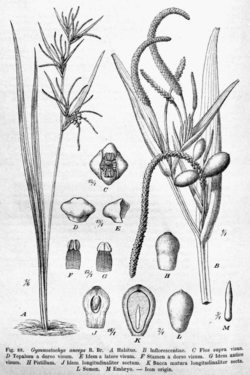
Gymnostachys is a monotypic genus (i.e. a genus which contains only one species) in the arum plant family Araceae. The sole described species is Gymnostachys anceps,23 commonly known as settler's flax, settler's twine or boorgay.1 It is native to coastal and sub-coastal parts of eastern Australia, from near Ulladulla, New South Wales, to around Rossville at the base of Cape York Peninsula.56
Gymnostachys is placed in the subfamily Gymnostachydoideae4 due to its unique characteristics that include an unusually structured flowering shoot and linear leaves with parallel venation.
Gallery
-
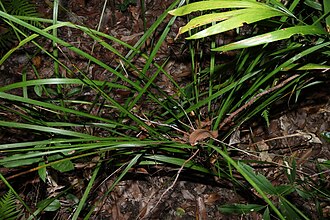 Habit
Habit -
 Flowers
 -
 Flower detail
 -
 Fruit
Fruit
References
References
- "Species profile—Gymnostachys anceps". Queensland Department of Environment and Science. Queensland Government. 2024. Retrieved 1 April 2025.
- "Gymnostachys anceps". Australian Plant Name Index (APNI). Centre for Australian National Biodiversity Research, Australian Government. Retrieved 1 April 2025.
- "Gymnostachys anceps R.Br". Plants of the World Online. Royal Botanic Gardens, Kew. 2025. Retrieved 1 April 2025.
- Bogner, Josef; Nicolson, Dan H. (1991). "A Revised Classification of Araceae with Dichotomous Keys". Willdenowia. 21 (1/2): 37. JSTOR 3996587.
- F.A.Zich; B.Hyland; T.Whiffen; R.A.Kerrigan. "Gymnostachys anceps". Australian Tropical Rainforest Plants (RFK8). Centre for Plant Biodiversity Research, Australian Government. Retrieved 27 May 2021.
- Hay, A. (1993). "PlantNET - FloraOnline". PlantNET (The NSW Plant Information Network System). Royal Botanic Gardens and Domain Trust, Sydney. Retrieved 1 April 2025.
External links
External links
- View a map of herbarium records of this species at the Australasian Virtual Herbarium
- View observations of this species on iNaturalist
- See images of this species on Flickriver.com