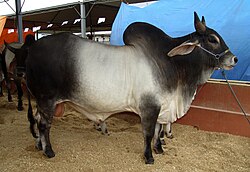
 Bull in Avaré | |
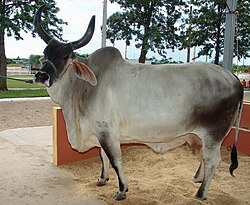 Cow in Avaré | |
| Conservation status | |
|---|---|
| Other names |
|
| Country of origin | Brazil |
| Distribution |
|
| Use |
|
| Traits | |
| Weight | |
| Height | |
| Skin colour | black2 |
| Coat | usually grey or white3: 193 |
| Horn status |
|
| |
The Guzerá or Guzerat is a Brazilian breed of taurindicine cattle. It derives from cross-breeding of Indian Kankrej cattle, imported to Brazil from 1870 onwards, with local taurine Crioulo cattle of European origin.3: 193 The name is a Portuguese spelling of that of the western Indian state of Gujarat.3: 193
History
From about 1870 Kankrej bulls from the Indian state of Gujarat were imported to the Cerrado region of the Brazilian state of Minas Gerais, where they were cross-bred with local cows of Crioulo type, giving rise to the Guzerá; the name is a Portuguese spelling of 'Gujarat'. Some Kankrej cows were also imported, and zebuine mitochondrial DNA is carried by roughly 70% of modern Guzerá cattle.3: 193 The cattle spread to Uberaba and to northern São Paulo State, and later to the states of Goiás and Rio de Janeiro and to states in the Nordeste region.3: 193
The herd-book for the breed was started in 1938; in it, three separate lines are distinguished: the beef type, a dual-purpose meat and dairy line (Guzerá Leiteiro) and a polled variant (Guzerá Mocho).3: 193 4: 866 In 2010 there were approximately 92000 head registered, constituting some 3.5% of the total number of indicine cattle in Brazil; there were about 17500 new registrations in that year.3: 193 The total number reported for the breed for 2022 was just under 40000.2
The Guzerá was one of the principal breeds from which the American Brahman was developed in the twentieth century,3: 137 and has contributed to the development of several other Brazilian breeds. Among these are the Guzolando, from cross-breeding with Holandesa (Friesian) stock; the Indu-Brasil, from crosses with Brazilian Gir and Nellore;3: 193 the Lavinia, from crossing with the Schwyz;5: 711 the Normanzu, from crosses with the Normande;5: 153 and the Pitangueiras, from cross-breeding with the Red Poll.3: 193
References
References
- Barbara Rischkowsky, Dafydd Pilling (editors) (2007). List of breeds documented in the Global Databank for Animal Genetic Resources, annex to: The State of the World's Animal Genetic Resources for Food and Agriculture. Rome: Commission on Genetic Resources for Food and Agriculture, Food and Agriculture Organization of the United Nations. ISBN 9789251057629. Archived 23 June 2020.
- Breed data sheet: Guzerá / Brazil (Cattle). Domestic Animal Diversity Information System of the Food and Agriculture Organization of the United Nations. Accessed August 2025.
- Valerie Porter, Lawrence Alderson, Stephen J.G. Hall, D. Phillip Sponenberg (2016). Mason's World Encyclopedia of Livestock Breeds and Breeding (sixth edition). Wallingford: CABI. ISBN 9781780647944.
- Marleen Felius (2025). Cattle Breeds: An Encyclopedia. Leiden: Brill. ISBN 9789004449015.
- Marleen Felius (1995). Cattle Breeds: An Encyclopedia. Doetinchem, Netherlands: Misset. ISBN 9789054390176.