| Guraleus singletoni Temporal range:
| |
|---|---|
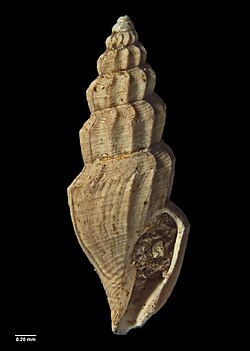
| |
| Holotype from Auckland War Memorial Museum | |
Scientific classification 
| |
| Kingdom: | Animalia |
| Phylum: | Mollusca |
| Class: | Gastropoda |
| Subclass: | Caenogastropoda |
| Order: | Neogastropoda |
| Family: | Mangeliidae |
| Genus: | Guraleus |
| Species: | †G. singletoni
|
| Binomial name | |
| †Guraleus singletoni A. W. B. Powell, 1944
| |
Guraleus singletoni is an extinct species of sea snail, a marine gastropod mollusc, in the family Mangeliidae.1 Fossils of the species date to early Pliocene strata of the St Vincent Basin of South Australia and the Otway Basin of South Australia and Victoria, including the Grange Burn Formation near Hamilton, Victoria.
Description
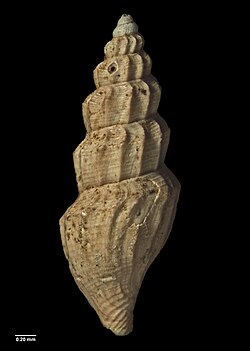
In the original description, Powell described the species as follows:
Fusiform, with tall turreted spire. Whorls sharply angled at about two-thirds whorl height. Axials narrow, 11 per whorl, weak over shoulder, vertical on spire-whorls but arcuate and irregular over body-whorl; extending from upper suture completely over base. Spiral sculpture consisting of 4 or 5 weak threads on the shoulder and 7 weak, slightly irregular cords from the shoulder angle to lower suture. On the body-whorl the spiral cords are numerous, linear-spaced but weak, the most distinct being 12 on the anterior end. Protoconch polygyrate, conic, of 3 smooth whorls, followed by a half whorl of fine brephic axials.2
The holotype of the species measures 6.5 mm (0.26 in) in length and has a diameter of 2.5 mm (0.098 in).2
Taxonomy
The species was first described by A. W. B. Powell in 1944.2 The holotype was collected at an unknown date prior to 1945 from the Grange Burn Formation near Hamilton, Victoria. It is held in the collections of Auckland War Memorial Museum.34
Distribution
This extinct marine species occurs in early Pliocene strata of the Otway Basin of South Australia and Victoria, including the Grange Burn Formation of Victoria.35
References
References
- Guraleus singletoni A. W. B. Powell, 1944 †. Retrieved through: World Register of Marine Species on 12 January 2026.
- Powell, A. W. B. (1944). "The Australian Tertiary Mollusca of the Family Turridae". Records of the Auckland Institute and Museum. 3: 3–68. ISSN 0067-0464. JSTOR 42905993. Wikidata Q58676624. This article incorporates text from this source, which is under a CC BY 4.0 license.
- Blom, Wilma M. (2025). "Annotated Catalogue of Fossil and Extant Molluscan Types in the Auckland War Memorial Museum". Bulletin of the Auckland Museum. 22. doi:10.32912/BULLETIN/22. ISSN 1176-3213. OCLC 1550165130. Wikidata Q135397912.
- "Guraleus singletoni". Collections Online. Auckland War Memorial Museum. Retrieved 12 January 2026.
- Darragh, Thomas A. (August 2024). "A checklist of Australian marine Cenozoic Mollusca". Memoirs of Museum Victoria. 83: 37–206. doi:10.24199/J.MMV.2024.83.02. ISSN 1447-2546. Wikidata Q136396722.