| Guenons1 | |
|---|---|
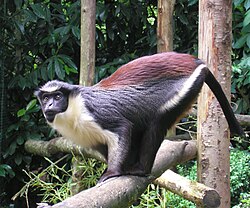
| |
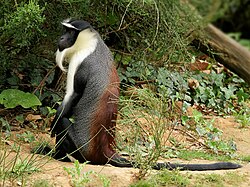
| Diana monkey (C. diana) | |
Scientific classification 
| |
| Kingdom: | Animalia |
| Phylum: | Chordata |
| Class: | Mammalia |
| Infraclass: | Placentalia |
| Order: | Primates |
| Family: | Cercopithecidae |
| Subfamily: | Cercopithecinae |
| Tribe: | Cercopithecini |
| Genus: | Cercopithecus Linnaeus, 1758 |
| Type species | |
| Simia diana | |
| Species | |
|
See text | |
The guenons (UK: /ɡəˈnɒnz/, US: /ˈɡwɛn.ənz/) are Old World monkeys of the genus Cercopithecus (/ˌsɜːrkəˈpɪθəkəs/). Not all members of this genus have the word "guenon" in their common names — blue monkeys, De Brazza's monkeys, and Diana monkeys are all guenons.
Members of the genus are endemic to sub-Saharan Africa, and most are forest monkeys. Many of the species are quite local in their ranges, and some have even more local subspecies. Many are threatened or endangered because of habitat loss.
Guenons are sexually dimorphic, with males nearly twice the size of females. Most animals live in one-male groups, though males may live alone or spread out in bachelor groups.2
Classification
The genus name Cercopithecus comes from Ancient Greek κέρκος (kérkos), meaning "tail", and πίθηκος (píthēkos), meaning "ape". It was named by Carl Linnaeus in 1758.
Because of changes in scientific classification, some monkeys previously included in this genus are no longer. Vervet monkeys and green monkeys, for example, were formerly considered as a single species in this genus (Cercopithecus aethiops) but are currently in the genus Chlorocebus.
In the English language, the word "guenon" is apparently of French origin.3 In French, guenon was the common name for all species and individuals, both males and females, from the genus Cercopithecus. In all other monkey and apes species, the French word guenon designates only the females.4 The three species such as the L'hoest's monkey, Preuss's monkey and the sun-tailed monkey were formerly included in the genus and now listed in a different genus Allochrocebus.156
Species list
| Common name | Scientific name and subspecies | Range | Size and ecology | IUCN status and estimated population |
|---|---|---|---|---|
| Blue monkey
|
C. mitis Wolf, 1822 Sixteen subspecies
|
Sub-Saharan Africa
|
Size: 31–70 cm (12–28 in) long, plus 55–109 cm (22–43 in) tail7 Habitat: Forest8 Diet: Fruit and leaves, as well as invertebrates9 |
LC
|
| Campbell's mona monkey
|
C. campbelli Waterhouse, 1838 |
Western Africa
|
Size: 36–55 cm (14–22 in) long, plus 49–85 cm (19–33 in) tail10 Habitat: Forest, savanna, and shrubland11 Diet: Fruit, leaves, seeds and grains, as well as birds, bird eggs, small reptiles, and insects10 |
NT
|
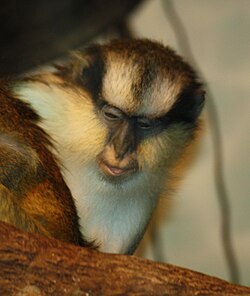
| Crested mona monkey
|
C. pogonias Bennett, 1833 Three subspecies
|
Central Africa
|
Size: 34–55 cm (13–22 in) long, plus 48–87 cm (19–34 in) tail12 Habitat: Forest13 Diet: Fruit and seeds, as well as leaves, flowers and insects13 |
NT
|
| De Brazza's monkey
|
C. neglectus Schlegel, 1876 |
Central Africa
|
Size: 39–60 cm (15–24 in) long, plus 47–79 cm (19–31 in) tail14 Habitat: Inland wetlands and forest15 Diet: Fruit, as well as leaves, flowers, mushrooms, beetles, termites, and worms16 |
LC
|
| Dent's mona monkey
|
C. denti Thomas, 1907 |
Central Africa
|
Size: 40–70 cm (16–28 in) long, plus 70–90 cm (28–35 in) tail17 Habitat: Forest18 Diet: Fruit and arthropods, as well as flowers, caterpillars, shoots, and leaves18 |
LC
|
| Diana monkey
|
C. diana (Linnaeus, 1758) |
Western Africa
|
Size: 40–55 cm (16–22 in) long, plus 50–75 cm (20–30 in) tail19 Habitat: Forest20 Diet: Fruit, flowers, leaves, insects, and other invertebrates19 |
EN
|
| Greater spot-nosed monkey
|
C. nictitans (Linnaeus, 1766) Five subspecies
|
Western Africa
|
Size: 40–57 cm (16–22 in) long, plus 56–100 cm (22–39 in) tail21 Habitat: Forest22 Diet: Fruits and seeds, as well as leaves and insects23 |
NT
|
| Hamlyn's monkey
|
C. hamlyni Pocock, 1907 Two subspecies
|
Central Africa
|
Size: 43–63 cm (17–25 in) long, plus 49–63 cm (19–25 in) tail24 Habitat: Forest25 Diet: Shoots, leaves, plants, and herbs, as well as fruit and seeds26 |
VU
|
| Lesser spot-nosed monkey
|
C. petaurista (Schreber, 1774) Two subspecies
|
Western Africa
|
Size: 29–53 cm (11–21 in) long, plus 57–78 cm (22–31 in) tail27 Habitat: Forest28 Diet: Fruit as well as insects27 |
NT
|
| Lesula
|
C. lomamiensis Hart et al., 2012 |
Central Africa
|
Size: 40–65 cm (16–26 in) long, plus 40–65 cm (16–26 in) tail29 Habitat: Forest30 Diet: Leaves, fruits and flowers31 |
VU
|
| Lowe's mona monkey
|
C. lowei Thomas, 1923 |
Western Africa (in green)
|
Size: 36–55 cm (14–22 in) long, plus 54–85 cm (21–33 in) tail32 Habitat: Forest and savanna33 Diet: Fruit and insects32 |
VU
|
| Mona monkey
|
C. mona (Schreber, 1774) |
Western Africa
|
Size: 32–53 cm (13–21 in) long, plus 67–90 cm (26–35 in) tail34 Habitat: Forest35 Diet: Fruit, sprouts, leaves, and invertebrates34 |
NT
|
| Moustached guenon
|
C. cephus (Linnaeus, 1758) Three subspecies
|
Western Africa
|
Size: 44–60 cm (17–24 in) long, plus 66–99 cm (26–39 in) tail36 Habitat: Forest37 Diet: Fruit, as well as seeds, leaves, insects, and eggs38 |
LC
|
| Red-eared guenon
|
C. erythrotis Waterhouse, 1838 Two subspecies
|
Western Africa
|
Size: 36–55 cm (14–22 in) long, plus 46–77 cm (18–30 in) tail39 Habitat: Forest40 Diet: Fruit, as well as leaves, shoots and arthropods40 |
VU
|
| Red-tailed monkey
|
C. ascanius (Audebert, 1799) Five subspecies
|
Central Africa
|
Size: 34–55 cm (13–22 in) long, plus 67–92 cm (26–36 in) tail41 Habitat: Forest42 Diet: Fruit, as well as leaves, insects, flowers, buds, and tree gum43 |
LC
|
| Roloway monkey
|
C. roloway (Schreber, 1774) |
Western Africa
|
Size: 44–62 cm (17–24 in) long, plus 70–91 cm (28–36 in) tail44 Habitat: Forest45 Diet: Insects, as well as seeds, fruit, and leaves44 |
CR
|
| Sclater's guenon
|
C. sclateri Pocock, 1904 |
Western Africa
|
Size: 32–38 cm (13–15 in) long, plus 61–85 cm (24–33 in) tail46 Habitat: Forest47 Diet: Fruit, as well as insects, flowers and leaves48 |
EN
|
| White-throated guenon
|
C. erythrogaster Gray, 1866 Two subspecies
|
Western Africa
|
Size: 38–46 cm (15–18 in) long, plus 58–70 cm (23–28 in) tail27 Habitat: Forest and inland wetlands49 Diet: Fruit49 |
EN
|
| Wolf's mona monkey
|
C. wolfi Meyer, 1891 Three subspecies
|
Central Africa | Size: 44–52 cm (17–20 in) long, plus 69–83 cm (27–33 in) tail50 Habitat: Forest51 Diet: Fruit, leaves, seeds, and flowers50 |
NT
|










Hybrids
The red-tailed monkey (Cercopithecus ascanius) is known to hybridize with the blue monkey (C. mitis) in several locations in the wild in Africa.52
References
References
- Groves, C. P. (2005). "GENUS Cercopithecus". In Wilson, D. E.; Reeder, D. M (eds.). Mammal Species of the World: A Taxonomic and Geographic Reference (3rd ed.). Johns Hopkins University Press. pp. 154–158. ISBN 978-0-8018-8221-0. OCLC 62265494.
- Rowell, T. E. (March 1988). "Beyond the One-Male Group". Behaviour. 104 (3/4): 189–201 – via JSTOR.
- guenon /gəˈnoʊn/ n. M19. [Fr., of uncertain origin.] (The New Shorter Oxford English Dictionary, Clarendon Press, Oxford, Vol. 1 A-M, 1993 edition, see page 1,157)
- guenon [gənɔ̃] n. f. - 1505; o. i.; p.-ê même rad. que guenille 1. vx Cercopithèque, mâle ou femelle. 2. MOD. Singe femelle. [...] (Le Petit Robert, grand format, Dictionnaires Le Robert, Paris, first edition: 1967, Nouveau Petit Robert edition: 1993, grand format edition: 1996, ISBN 2-85036-469-X, see page 1,056)
- "Allochrocebus". ITIS. Retrieved 2019-07-18.
- "Allochrocebus". Mammal Diversity Database. Retrieved 2019-07-18.
- Kingdon 2015, p. 175
- Butynski, T. M.; de Jong, Y. A. (2021) [errata version of 2019 assessment]. "Cercopithecus mitis". IUCN Red List of Threatened Species. 2019 e.T4221A196007901. doi:10.2305/IUCN.UK.2019-3.RLTS.T4221A196007901.en.
- Strawder, Nicole (2001). "Cercopithecus mitis". Animal Diversity Web. University of Michigan. Archived from the original on August 12, 2023. Retrieved July 24, 2023.
- Leinberger, Kaitlynn (2022). "Cercopithecus campbelli". Animal Diversity Web. University of Michigan. Archived from the original on August 12, 2023. Retrieved July 24, 2023.
- Matsuda Goodwin, R.; Gonedelé Bi, S.; Koné, I. (2020). "Cercopithecus campbelli". IUCN Red List of Threatened Species. 2020 e.T136930A92374066. doi:10.2305/IUCN.UK.2020-2.RLTS.T136930A92374066.en.
- Kingdon 2015, p. 168
- Maisels, F.; Cronin, D. T.; Hart, J.; Etiendem, D.; Oates, J. F.; Butynski, T. M.; Linder, J. (2021) [errata version of 2020 assessment]. "Cercopithecus pogonias". IUCN Red List of Threatened Species. 2020 e.T92411527A197301301. doi:10.2305/IUCN.UK.2020-1.RLTS.T92411527A197301301.en.
- Kingdon 2015, p. 161
- Mwenja, I.; Maisels, F.; Hart, J. A. (2019). "Cercopithecus neglectus". IUCN Red List of Threatened Species. 2019 e.T4223A17947167. doi:10.2305/IUCN.UK.2019-3.RLTS.T4223A17947167.en.
- Stein, Joshua (2002). "Cercopithecus neglectus". Animal Diversity Web. University of Michigan. Archived from the original on June 26, 2023. Retrieved August 16, 2023.
- Kingdon 2015, p. 166
- Detwiler, K. M.; Hart, J. A.; Hicks, T. C. (2020). "Cercopithecus denti". IUCN Red List of Threatened Species. 2020 e.T136885A92413658. doi:10.2305/IUCN.UK.2020-2.RLTS.T136885A92413658.en.
- Kennedy, Karen (2023). "Cercopithecus diana". Animal Diversity Web. University of Michigan. Archived from the original on March 6, 2016. Retrieved July 24, 2023.
- Koné, I.; McGraw, S.; Gonedelé Bi, S.; Oates, J. F. (2019). "Cercopithecus diana". IUCN Red List of Threatened Species. 2019 e.T4245A92384250. doi:10.2305/IUCN.UK.2019-3.RLTS.T4245A92384250.en.
- Kingdon 2015, p. 174
- Cronin, D. T.; Maisels, F.; Gadsby, E. L.; Gonedelé Bi, S.; Ikemeh, R.; Imong, I. (2022) [errata version of 2020 assessment]. "Cercopithecus nictitans". IUCN Red List of Threatened Species. 2020 e.T4224A222904443. doi:10.2305/IUCN.UK.2020-1.RLTS.T4224A222904443.en.
- Neinast, Alexandra (2012). "Cercopithecus nictitans". Animal Diversity Web. University of Michigan. Archived from the original on July 26, 2023. Retrieved August 16, 2023.
- Kingdon 2015, p. 170
- Hart, J.; Maisels, F. (2020) [amended version of 2019 assessment]. "Cercopithecus hamlyni". IUCN Red List of Threatened Species. 2020 e.T4219A166615690. doi:10.2305/IUCN.UK.2020-1.RLTS.T4219A166615690.en.
- Bharti, Nita (2000). "Cercopithecus hamlyni". Animal Diversity Web. University of Michigan. Archived from the original on July 24, 2023. Retrieved July 24, 2023.
- Kingdon 2015, p. 179
- Matsuda Goodwin, R.; Segniagbeto, G.; Wiafe, E.; Osei, D.; Koné, I.; Gonedelé Bi, S.; Oates, J. F. (2020). "Cercopithecus petaurista". IUCN Red List of Threatened Species. 2020 e.T4225A17945536. doi:10.2305/IUCN.UK.2020-2.RLTS.T4225A17945536.en.
- Kingdon 2015, p. 171
- Detwiler, K. M.; Hart, J. A. (2020). "Cercopithecus lomamiensis". IUCN Red List of Threatened Species. 2020 e.T92401376A92401776. doi:10.2305/IUCN.UK.2020-2.RLTS.T92401376A92401776.en.
- Antosh, Bonnie (2013). "Cercopithecus lomamiensis". Animal Diversity Web. University of Michigan. Archived from the original on August 16, 2023. Retrieved August 16, 2023.
- Kingdon 2015, p. 165
- Wiafe, E.; Oates, J. F.; Gonedelé Bi, S.; Koné, I.; Matsuda Goodwin, R.; Osei, D. (2019). "Cercopithecus lowei". IUCN Red List of Threatened Species. 2019 e.T136931A92373680. doi:10.2305/IUCN.UK.2019-1.RLTS.T136931A92373680.en.
- Liu, Sonia (2000). "Cercopithecus mona". Animal Diversity Web. University of Michigan. Archived from the original on February 20, 2023. Retrieved July 24, 2023.
- Matsuda Goodwin, R.; Segniagbeto, G.; Nobimè, G.; Imong, I. (2020). "Cercopithecus mona". IUCN Red List of Threatened Species. 2020 e.T4222A17946672. doi:10.2305/IUCN.UK.2020-2.RLTS.T4222A17946672.en.
- Kingdon 2015, p. 181
- Abernethy, K.; Maisels, F. (2020) [amended version of 2019 assessment]. "Cercopithecus cephus". IUCN Red List of Threatened Species. 2020 e.T4214A166614362. doi:10.2305/IUCN.UK.2020-1.RLTS.T4214A166614362.en.
- Miretti, Juan (2006). "Cercopithecus cephus". Animal Diversity Web. University of Michigan. Archived from the original on July 24, 2023. Retrieved July 24, 2023.
- Kingdon 2015, p. 182
- Hofner, A.; Cronin, D. T.; Imong, I.; Gadsby, E. L.; Ndeloh, D. (2020). "Cercopithecus erythrotis". IUCN Red List of Threatened Species. 2020 e.T4218A17946043. doi:10.2305/IUCN.UK.2020-2.RLTS.T4218A17946043.en.
- Kingdon 2015, p. 183
- de Jong, Y. A.; Butynski, T. M. (2019). "Cercopithecus ascanius". IUCN Red List of Threatened Species. 2019 e.T4212A17947340. doi:10.2305/IUCN.UK.2019-3.RLTS.T4212A17947340.en.
- Davis, Sarah (2002). "Cercopithecus ascanius". Animal Diversity Web. University of Michigan. Archived from the original on April 1, 2023. Retrieved July 24, 2023.
- Johnson, Kelsey (2015). "Cercopithecus roloway". Animal Diversity Web. University of Michigan. Archived from the original on June 18, 2021. Retrieved July 24, 2023.
- Koné, I.; Oates, J. F.; Dempsey, A.; Gonedelé Bi, S.; McGraw, S.; Wiafe, E. (2019). "Cercopithecus roloway". IUCN Red List of Threatened Species. 2019 e.T4232A92384429. doi:10.2305/IUCN.UK.2019-1.RLTS.T4232A92384429.en.
- Kingdon 2015, p. 180
- Baker, L.; Oates, J. F.; Ikemeh, R.; Gadsby, E. (2019). "Cercopithecus sclateri". IUCN Red List of Threatened Species. 2019 e.T4229A17945814. doi:10.2305/IUCN.UK.2019-1.RLTS.T4229A17945814.en.
- Law, Jason (2004). "Cercopithecus sclateri". Animal Diversity Web. University of Michigan. Archived from the original on July 26, 2023. Retrieved August 16, 2023.
- Matsuda Goodwin, R.; Oates, J. F.; Nobimè, G.; Segniagbeto, G. H.; Ikemeh, R.; Mittermeier, R. A. (2020). "Cercopithecus erythrogaster". IUCN Red List of Threatened Species. 2020 e.T4217A17946182. doi:10.2305/IUCN.UK.2020-2.RLTS.T4217A17946182.en.
- Platter, Branden (2008). "Cercopithecus wolfi". Animal Diversity Web. University of Michigan. Archived from the original on July 24, 2023. Retrieved July 24, 2023.
- Hart, J. A.; Detwiler, K. M.; Maisels, F. (2020) [amended version of 2019 assessment]. "Cercopithecus wolfi". IUCN Red List of Threatened Species. 2020 e.T92466239A166601223. doi:10.2305/IUCN.UK.2020-1.RLTS.T92466239A166601223.en.
- Rowe, N. (1996). The Pictorial Guide to the Living Primates. Pogonias Press. pp. 139, 143, 154, 185, 223. ISBN 0-9648825-0-7.
Sources
Sources
- Kingdon, Jonathan (2015). The Kingdon Field Guide to African Mammals (Second ed.). Bloomsbury Publishing. ISBN 978-1-4729-2531-2.