| Guató | |
|---|---|
| go-t͡ʃéuvɨ́ i-ótɨ́ | |
| Pronunciation | [go-t͡ʃéuvɨ́ i-ótɨ́] |
| Native to | Brazil, Bolivia |
| Region | Mato Grosso do Sul state: Paraguay River banks and up São Lourenço River, along Bolivian border;1 also Santa Cruz Department (Bolivia): Uberaba Lake2 |
| Ethnicity | 419 Guató people (2014)3 |
Native speakers | 2 (2023)4 |
| Language codes | |
| ISO 639-3 | gta |
| Glottolog | guat1253 |
| ELP | Guató |
 | |
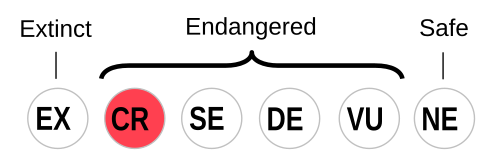 Guató is classified as Critically Endangered by the UNESCO Atlas of the World's Languages in Danger. | |
Guató (Guató: go-t͡ʃéuvɨ́ i-ótɨ́)5 is a language isolate4 spoken by two of the Guató people of Brazil. It has variously been claimed to be of Macro-Jê or isolate affiliation. Guató is a VSO language, has agglutination, and has ergative alignment.3
Classification
Terrence Kaufman (1990) provisionally classified Guató as a branch of the Macro-Jê languages, as did Aryon Rodrigues (1999)6 and Martins (2011),7 but no evidence for this was found by Eduardo Ribeiro and Hein van der Voort (2010).8 Andrey Nikulin (2020) excludes this possibility.9
History
Documentation
The Guató language is first documented in a number of wordlists, beginning with François-Louis Laporte, comte de Castelnau's 1851 publication, and followed by others through 1959. The only substantial grammar of Guató was written by Adair Pimentel Palácio and published in 1984.10
Language contact
Marcelo Jolkesky (2016) identifies lexical similarities with the Bororo, Tupi, and Karib language families, which, according to him, are due to contact.11
Geographical distribution
Today, the Guató mainly reside in Guató Indigenous Territory and Baía dos Guató Indigenous Territory. All residents speak only Portuguese, and the two remaining speakers live elsewhere.4
Loukotka (1968) reported that as of 1964, in Mato Grosso do Sul, Brazil, Guató was spoken on the banks of the Paraguay River and up the São Lourenço River, along the Bolivian border.1 It was also spoken at Uberaba Lake in Santa Cruz Department, Bolivia.2
Phonology
Vowels
The Guató vowel system, like that of the Macro-Jê languages, collapses a three-way distinction of height in oral vowels to two in nasal vowels.1012 Eight oral and five nasal vowels are present in Guató.4
| Oral | Nasal | |||||
|---|---|---|---|---|---|---|
| Front | Central | Back | Front | Central | Back | |
| Close | i | ɨ | u | ĩ | ɨ̃ | ũ |
| Mid | e | o | ||||
| Open-mid | ɛ | ɔ | ɛ̃ | |||
| Open | a | ã | ||||
Consonants
17 consonants are present in the language.4
| Labial | Denti- alveolar |
Post- alveolar |
Velar | Labio- velar |
Glottal | ||
|---|---|---|---|---|---|---|---|
| Plosive | voiceless | p | t | k | kʷ | ||
| voiced | b | d | ɡ | ɡʷ | |||
| Affricate | voiceless | tʃ | |||||
| voiced | dʒ | ||||||
| Fricative | voiceless | f | h | ||||
| voiced | v | ||||||
| Nasal | m | n | |||||
| Vibrant | ɾ | ||||||
| Glide | j | ||||||
Tone
Guató is a tonal language, possessing a high and low tone.3
Morphology
Typologically, Guató is agglutinative, and has ergative alignment.3
Syntax
Guató is a VSO language.3
Vocabulary
For more extensive vocabulary lists of Guató by Palácio (1984)107 and Postigo (2009),12 see the corresponding Portuguese article.
Numerals
Guató uses a quinary (base-5) system up to 20, where a decimal system is used for large numbers.3
Loanwords
A number of Portuguese loanwords are present in Guató:4
| gloss | Guató | Portuguese |
|---|---|---|
| papaya | omamõ | mamão |
| lemon | oɾimão | limão |
| cow | vaka | vaca |
| key | tʃave | chave |
| soldier, policeman | soɾodave | soldado |
Loanwords undergo a phonetic adaptation in Guató.4
References
References
- Guató at Ethnologue (25th ed., 2022)

- Loukotka, Čestmír (1968). Classification of South American Indian languages. Los Angeles: UCLA Latin American Center.
- "Guató - Indigenous Peoples in Brazil". pib.socioambiental.org. Retrieved 26 September 2025.
- Epps, Patience; Michael, Lev, eds. (2023). Amazonian Languages: Language Isolates. Volume I: Aikanã to Kandozi-Chapra. Berlin: Walter de Gruyter. doi:10.1515/9783110419405. ISBN 978-3-11-041940-5.
- Schmidt, Max (2018). Guató: A língua (Schmidt 2018) - Biblioteca Digital Curt Nimuendajú. Série Monografias. Translated by Kristina Balykova, preface by Gustavo Godoy and Kristina Balykova. ISBN 978-0-9846008-4-7. ISSN 1946-7095. Retrieved 29 September 2025.
{{cite book}}:|journal=ignored (help) - Dixon, Robert M. W.; Aĭkhenvalʹd, A. I︠U︡, eds. (1999). The Amazonian languages (PDF). Cambridge language surveys. Cambridge, UK ; New York: Cambridge University Press. ISBN 978-0-521-57021-3.
- Martins, Andérbio Márcio Silva. 2011. Uma avaliação da hipótese de relações genéticas entre o Guató e o tronco Macro-Jê. Doutorado em Linguística. Universidade de Brasília.
- Ribeiro, Eduardo Rivail (October 2010). "Nimuendajú was right: The inclusion of the jabutí language family in the Macro-Jê stock" (PDF). International Journal of American Linguistics. 76 (4): 517–570. doi:10.1086/658056. ISSN 0020-7071.
- Nikulin, Andrey (2020). Proto-Macro-Jê: um estudo reconstrutivo (PDF) (Thesis). Brasília: Universidade de Brasília.
- Palácio, Adair Pimentel (1984). Guató: a língua dos índios canoeiros do rio Paraguai (PhD thesis) (in Portuguese). Campinas: Universidade Estadual de Campinas.
- Jolkesky, Marcelo Pinho de Valhery (2016). Estudo arqueo-ecolinguístico das terras tropicais sul-americanas (Ph.D. dissertation) (2 ed.). Brasília: University of Brasília.
- Postigo, Adriana Viana (2009). Fonologia da língua Guató (MA thesis) (in Portuguese). Três Lagoas: Universidade Federal de Mato Grosso do Sul.
Further reading
Further reading
- Fabre, Alain (16 December 2020) [2005]. "Diccionario etnolingüístico y guía bibliográfica de los pueblos indígenas sudamericanos: GUATÓ" (PDF). Archived from the original (PDF) on 7 October 2023.