| Gruimorphae | |
|---|---|
| |
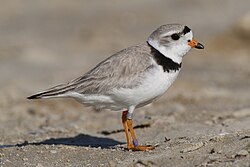
| Piping plover (Charadrius melodus) | |
| |
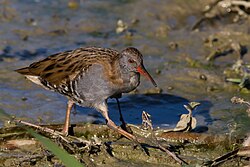
| Water rail (Rallus aquaticus) | |
Scientific classification 
| |
| Kingdom: | Animalia |
| Phylum: | Chordata |
| Class: | Aves |
| Infraclass: | Neognathae |
| Clade: | Neoaves |
| Clade: | Elementaves |
| (unranked): | Gruae |
| Clade: | Gruimorphae Bonaparte, 1854 |
| Orders | |
| Synonyms | |
| |
Gruimorphae4 is a taxon of birds that contains the orders Charadriiformes (plovers, gulls, and allies) and Gruiformes (cranes and rails) identified by molecular analysis.53 This grouping has had historical support, as various charadriiform families such as the families Pedionomidae and Turnicidae were classified as gruiforms.678 It may also have support from the fossil record since the discovery of Nahmavis from the Early Eocene of North America. 9
The relationship between these birds is due to similar anatomical and behavioral characteristics. A morphological study went further to suggest that the gruiforms might be paraphyletic in respect to the shorebirds, with the rails being closely related to the buttonquails.1011
References
References
- Mourer-Chaviré C. (1995) The Messelornithidae (Aves: Gruiformes) from the Paleogene of France. - Cour. Forsch.-Inst. Senckenberg, 181: 95–105
- Mayr, Gerald (2016). Avian evolution: the fossil record of birds and its paleobiological significance. Topics in Paleobiology. Wiley-Blackwell. p. 306. ISBN 978-1-119-02076-9.
- Kuhl, H.; Frankl-Vilches, C.; Bakker, A.; Mayr, G.; Nikolaus, G.; Boerno, S. T.; Klages, S.; Timmermann, B.; Gahr, M. (2020). "An unbiased molecular approach using 3'UTRs resolves the avian family-level tree of life". Molecular Biology and Evolution. 38: 108–127. doi:10.1093/molbev/msaa191. PMC 7783168. PMID 32781465.
- "TiF Checklist: GRUAE I: Opisthocomiformes & Gruiformes". www.jboyd.net. Retrieved 10 April 2018.
- Jarvis, E.D.; et al. (2014). "Whole-genome analyses resolve early branches in the tree of life of modern birds". Science. 346 (6215): 1320–1331. Bibcode:2014Sci...346.1320J. doi:10.1126/science.1253451. PMC 4405904. PMID 25504713.
- Huxley T.H. On the classification of birds; and on the taxonomic value of the modifications of certain of the cranial bones observable in that class. Proceedings of the Zoological Society of London. 1867;1867:415–472.
- Lowe P.R. An anatomical review of the ‘waders’ (Telmatomorphæ), with special reference to the families, subfamilies, and genera within the suborders Limicolæ, Grui-Limicolæ and Lari-Limicolæ. Ibis. 1931b; 73: 712–771
- Lowe P.R. On the relations of the Gruimorphæ to the Charadriimorphæ and Rallimorphæ, with special reference to the taxonomic position of Rostratulidæ, Jacanidæ, and Burhinidæ. Ibis. 1931a; 73: 491–534
- Musser, G. & Clarke, J.A. (2020). "An Exceptionally Preserved Specimen From the Green River Formation Elucidates Complex Phenotypic Evolution in Gruiformes and Charadriiformes". Frontiers in Ecology and Evolution. 8. doi:10.3389/fevo.2020.559929.
- Livezey, B. C.; Zusi, R. L. (2007). "Higher-order phylogeny of modern birds (Theropoda, Aves: Neornithes) based on comparative anatomy. II. Analysis and discussion". Zoological Journal of the Linnean Society. 149 (1): 1–95. doi:10.1111/j.1096-3642.2006.00293.x. PMC 2517308. PMID 18784798.
- "Neognathia". www.helsinki.fi. Retrieved 10 April 2018.