 HMAS Swan in 1945 | |
| Class overview | |
|---|---|
| Builders | |
| Operators |
|
| Preceded by | Shoreham class |
| Succeeded by | Kingfisher class |
| Cost | £220,000 for Australian ships |
| Built | 1933–1940 |
| In commission | 1934–1966 |
| Completed | 13 |
| Lost | 4 |
| Preserved | 1 |
| General characteristics RN Ships1 | |
| Displacement | |
| Length | 266 ft 3 in (81.15 m) o/a |
| Beam | 36 ft (11.0 m) |
| Draught | RN ships : 9 ft 11 in (3.02 m) – 10 ft 1 in (3.07 m) |
| Installed power |
|
| Propulsion | 2 shafts; geared steam turbines |
| Speed | 16.5 knots (30.6 km/h; 19.0 mph) |
| Complement | 100 |
| Armament |
|


The Grimsby class were a class of 13 sloops laid down between 1933 and 1940. Of these, eight were built in the United Kingdom for the Royal Navy, four in Australia for the Royal Australian Navy and one for the Royal Indian Navy. Main armament was initially two 4.7-inch (120 mm) guns for RN ships and three 4-inch (100 mm) for Australian ships, but armament varied considerably between ships, and was increased later.
Losses during World War II were Grimsby, Indus, Yarra, and Parramatta. Some survivors of this class served into the 1960s. One ship, Wellington, is preserved as the headquarters of the Honourable Company of Master Mariners.
Design
The Royal Navy started to build replacements for the Flower-class and Hunt-class sloops of the First World War, when the two vessels of the Bridgewater class were laid down in 1928, with the similar four-ship Hastings class laid down in 1929 and the eight ships of the Shoreham class being laid down in 1929–31. All of these ships were designed to combine the convoy-escort role of the Flower class with the minesweeping duties of the Hunt class, being fitted with equipment for both roles. By 1932, however, it became clear that what was needed was ships dedicated to a single role. Development therefore began of the Halcyon-class minesweepers as a cheaper mass-production minesweeper, while a new class of sloops would be built that was more closely matched to the escort role.23
The new class of escort sloops, the Grimsby class, had a heavier gun armament than its predecessors, with two 4.7-inch (120 mm) Mark IX guns mounted fore and aft replacing the 4-inch (102 mm) guns of the earlier ships. As the 4.7-inch guns were low-angle guns, not suited to anti aircraft use, a single QF 3-inch 20 cwt anti-aircraft gun was mounted in "B" position. Four 3-pounder saluting guns completed the ships' gun armament.14 The ship was powered by two geared steam turbines driving two shafts, fed by two Admiralty 3-drum boilers. This machinery produced 2,000 shaft horsepower (1,500 kW) and could propel the ships to a speed of 16.5 knots (30.6 km/h; 19.0 mph).1
Eight ships of the class were built for the Royal Navy, being laid down between 1933 and 1935 and completing between 1934 and 1936. The last two ships built for the Royal Navy, HMS Aberdeen and HMS Fleetwood had differing armaments, with Aberdeen replacing the 4.7 and 3-inch guns with two 4-inch anti-aircraft guns, and adding a quadruple .50-inch anti-aircraft machine gun mount, while Fleetwood had a main gun armament of two twin 4-inch anti-aircraft mounts, with a short-range anti-aircraft armament of four .50 in machine guns.5
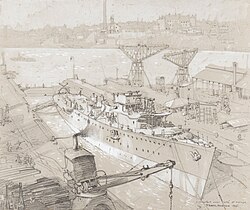
The Royal Australian Navy also adopted the Grimsby class, with two ships being laid down in 1934–35 and completed in 1935–36, with two more ships laid down in 1938–39 and completed in 1940. The first two ships were armed with three single 4-inch anti-aircraft guns, while the third and fourth ships having one twin and one-single 4-inch mount, with short-range armament a quadruple machine gun mount in all four ships.6
The armament of most of the class was reinforced during the Second World War, with several gaining additional 4-inch guns, with the close in anti aircraft armament being supplemented by the addition of Oerlikon 20 mm cannon. The ships' depth charge complement increased from 15 at the start of the war to 40 for Australian ships and up to 90 for Royal Navy ships, while several ships were also refitted with a Hedgehog anti-submarine projector.1
Ships
| Name | Builder | Ordered | Laid down | Launched | Commissioned | Fate |
|---|---|---|---|---|---|---|
| Royal Navy | ||||||
| Group 1 | ||||||
| Grimsby | HM Dockyard, Devonport | 1 November 19327 | 23 January 19335 | 19 July 19335 | 17 May 19345 | Sunk in air attack by Italian and German dive bombers off Tobruk, 25 May 194189 |
| Leith | HM Dockyard, Devonport | 1 November 19327 | 6 February 19335 | 9 September 19335 | 12 July 19345 | Sold into mercantile service, 25 November 1946 Royal Danish Navy survey ship Galathea 1949 Scrapped 195510 |
| Lowestoft | HM Dockyard, Devonport | 1 May 19337 | 21 August 19335 | 11 April 19345 | 22 November 19345 | Sold into mercantile service, 1946 Scrapped 195511 |
| Wellington | HM Dockyard, Devonport | 1 May 19337 | 25 September 19335 | 29 May 19345 | 24 January 19355 | Sold to Honourable Company of Master Mariners as Headquarters, 194712 |
| Londonderry | HM Dockyard, Devonport | 1 March 19347 | 11 June 19345 | 16 January 19355 | 20 September 19355 | Broken up at Llanelly, 194813 |
| Deptford | HM Dockyard, Chatham | 1 May 193314 | 30 April 19345 | 5 February 19355 | 20 August 19355 | Broken up at Milford Haven, 194815 |
| Group 2 | ||||||
| Aberdeen | HM Dockyard, Devonport | 1 March 19357 | 12 June 19355 | 22 January 19365 | 17 September 19365 | Broken up at Hayle, 194916 |
| Fleetwood | HM Dockyard, Devonport | 1 March 19357 | 14 August 19355 | 24 March 19365 | 19 November 19365 | Broken up at Gateshead, 195917 |
| Royal Australian Navy | ||||||
| Yarra | Cockatoo Island Dockyard, Sydney | 22 December 193318 | 24 May 19346 | 28 March 19356 | 19 December 19356 | Sunk in surface action off Java, 4 March 194219 |
| Swan | Cockatoo Island Dockyard, Sydney | 2 January 193518 | 1 May 19356 | 28 March 19366 | 10 December 19366 | Broken up at Sydney, 196420 |
| Parramatta | Cockatoo Island Dockyard, Sydney | July 1938 | 9 November 19386 | 18 June 19396 | 8 April 19406 | Sunk in torpedo attack off Tobruk, 27 November 194120 |
| Warrego | Cockatoo Island Dockyard, Sydney | December 1938 | 10 May 19396 | 10 February 19406 | 21 August 19406 | Broken up at Sydney, 196521 |
| Royal Indian Navy | ||||||
| Indus | Hawthorn Leslie and Company, Hebburn | 14 August 193318 | 8 December 193319 | 24 August 193419 | 15 March 193519 | Sunk in air attack off Akyab, 6 April 194222 |
See also
See also
Notes
Notes
- Campbell 1980, p. 56
- Campbell 1980, pp. 55–56
- Hague 1993, pp. 10–13
- Hague 1993, p. 13
- Hague 1993, p. 42
- Hague 1993, p. 55
- Hague 1993, p. 6
- Hague 1993, pp. 47–48
- Shores et al. 2012, p. 199
- Hague 1993, pp. 50–51
- Hague 1993, pp. 52–53
- Hague 1993, pp. 53–55
- Hague 1993, pp. 51–52
- Mason, Geoffrey P. (2005). "HMS Deptford (L 53) - Grimsby-class Sloop". Service Histories of Royal Navy Warships in World War 2. Naval-History.net. Retrieved 22 November 2014.
- Hague 1993, p. 45
- Hague 1993, pp. 43–44
- Hague 1993, pp. 46–47
- Friedman 2008, p. 332
- Hague 1993, p. 60
- Hague 1993, p. 56
- Hague 1993, p. 58
- Hague 1993, p. 61
References
References
- Campbell, N. J. M. (1980). "Great Britain (including Empire Forces)". In Chesneau, Roger (ed.). Conway's All the World's Fighting Ships 1922–1946. Greenwich, UK: Conway Maritime Press. pp. 2–85. ISBN 0-85177-146-7.
- Friedman, Norman (2008). British Destroyers & Frigates: The Second World War and After. Barnsley, UK: Seaforth Publishing. ISBN 978-1-84832-015-4.
- Gillet, Ross (1977). Warships of Australia. Graham, Colin (illus.). Adelaide, Australia: Rigby Limited. ISBN 0-7270-0472-7.
- Hague, Arnold (1993). Sloops: A History of the 71 Sloops Built in Britain and Australia for the British, Australian and Indian Navies 1926–1946. Kendal, UK: World Ship Society. ISBN 0-905617-67-3.
- Lenton, H. T. (1998). British & Empire Warships of the Second World War. Annapolis, Maryland: Naval Institute Press. ISBN 1-55750-048-7.
- Rohwer, Jürgen (2005). Chronology of the War at Sea 1939–1945: The Naval History of World War Two (Third Revised ed.). Annapolis, Maryland: Naval Institute Press. ISBN 1-59114-119-2.
- Shores, Christopher; Massimello, Giovanni; Guest, Russell (2012). A History of the Mediterranean Air War 1940–1945: Volume One: North Africa: June 1940 – January 1942. London: Grub Street. ISBN 978-1-908117-07-6.