| Greifensteinite | |
|---|---|
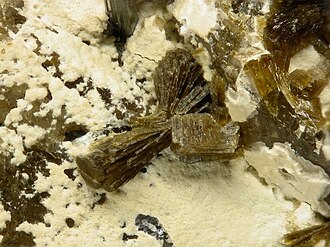 Greifensteinite (picture size: 3 mm) | |
| General | |
| Category | Phosphate mineral Roscherite group |
| Formula | Ca2Fe2+5Be4(PO4)6(OH)4·6H2O |
| IMA symbol | Gfs1 |
| Strunz classification | 8.DA.10 |
| Dana classification | 42.7.7.4 |
| Crystal system | Monoclinic |
| Crystal class | Prismatic (2/m) (same H-M symbol) |
| Space group | C2/c |
| Unit cell | a = 15.903, b = 11.885 c = 6.677 [Å]; β = 94.68°; Z = 2 |
| Identification | |
| Color | Yellow green, olive green, light brown |
| Crystal habit | Prismatic |
| Cleavage | Good on {100} (or parting on {100})2 |
| Fracture | Uneven |
| Tenacity | brittle |
| Mohs scale hardness | 4.5 |
| Luster | Vitreous |
| Streak | White, greenish |
| Diaphaneity | Transparent to translucent |
| Specific gravity | 2.93 |
| Optical properties | Biaxial (-) |
| Refractive index | nα: 1.624 nβ: 1.634 nγ: 1.638 |
| Birefringence | 0.014 |
| 2V angle | 80° |
| References | 234 |
Greifensteinite is beryllium phosphate mineral with formula: Ca2Fe2+5Be4(PO4)6(OH)4·6H2O. It is the Fe2+ dominant member of the roscherite group.5 It crystallizes in the monoclinic crystal system and typically forms prismatic dark olive green crystals.2
It was first described in Germany at Greifenstein Rocks, Ehrenfriedersdorf, and was named for the location. At the type locality, it occurs within a lithium-rich pegmatite in miarolitic cavities. It was approved by the International Mineralogical Association in 2002.2
References
References
- Warr, L.N. (2021). "IMA–CNMNC approved mineral symbols". Mineralogical Magazine. 85 (3): 291–320. Bibcode:2021MinM...85..291W. doi:10.1180/mgm.2021.43. S2CID 235729616.
- Greifensteinite data on Webmineral
- Mindat.org
- Mineralienatlas
- Roscherite group on Mindat.org
- Rastsvetaeva R K, Gurbanova O A, Chukanov N V (2006) Crystal structure of greifensteinite Ca2Fe2+☐Mg2Fe2+2Be4(PO4)6(OH)4·6H2O. Doklady Chemistry 41, 18-25 [1] Archived 2013-04-02 at the Wayback Machine