| Graphomya maculata | |
|---|---|
| |
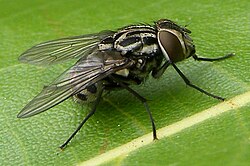
| Female Graphomya maculata | |
Scientific classification 
| |
| Kingdom: | Animalia |
| Phylum: | Arthropoda |
| Clade: | Pancrustacea |
| Class: | Insecta |
| Order: | Diptera |
| Family: | Muscidae |
| Genus: | Graphomya |
| Species: | G. maculata
|
| Binomial name | |
| Graphomya maculata (Scopoli, 1763)
| |
| Synonyms | |
Graphomya maculata is a species of fly. It is widespread and common in most parts of Europe12 and also occurs in North Africa including the Canary Islands.3 The thorax bears the same black and white pattern in both sexes. Females also have a black and white abdomen, while the male has orange colouration on the abdomen as seen in the picture.4
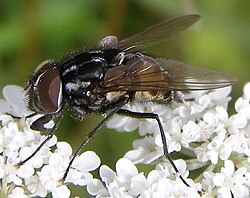
While adults are not predatory and can be found nectaring on flowers in meadows, hedge rows, and roadside vegetation, the larvae are predatory, feeding in muddy pools and damp leaf litter.5
References
References
- D'Assis Fonseca; E. C. M. (1968). Diptera Cyclorrhapha Calyptrata: Muscidae. Handbooks for the Identification of British Insects. Vol. 10. London: Royal Entomological Society of London. pp. 118pp.
- Gregor, F.; Rozkosny, R.; Bartak, M.; Vanhara, J. (2002). The Muscidae (Diptera) of Central Europe. Scientiarum Naturalium Universitatis Masarykianae Brunensis. Vol. 107. Masaryk: Masaryk University. pp. 280pp.
- "Graphomya maculata (Scopoli, 1763)". Fauna Europaea. Fauna Europaea Secretariat, Museum für Naturkunde, Berlin. Retrieved 10 August 2020.
- Collins Complete Guide to British Insects by Michael Chinery (2005), page 316.
- "Graphomya maculata | NatureSpot". Nature Spot. Retrieved 3 May 2023.