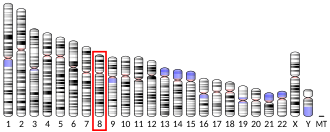
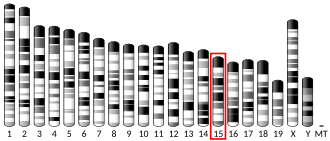
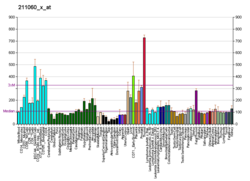
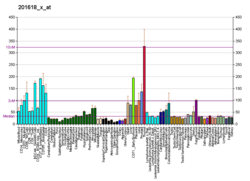
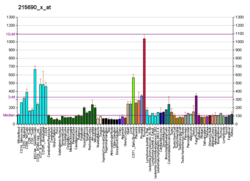
Glycosylphosphatidylinositol anchor attachment 1 protein is a protein that in humans is encoded by the GPAA1 gene.56
Posttranslational glycosylphosphatidylinositol (GPI) anchor attachment serves as a general mechanism for linking proteins to the cell surface membrane. The protein encoded by this gene presumably functions in GPI anchoring at the GPI transfer step. The mRNA transcript is ubiquitously expressed in both fetal and adult tissues. The anchor attachment protein 1 contains an N-terminal signal sequence, 1 cAMP- and cGMP-dependent protein kinase phosphorylation site, 1 leucine zipper pattern, 2 potential N-glycosylation sites, and 8 putative transmembrane domains.6
Interactions
GPAA1 has been shown to interact with PIGT78 and PIGK.89
References
References
- GRCh38: Ensembl release 89: ENSG00000197858 – Ensembl, May 2017
- GRCm38: Ensembl release 89: ENSMUSG00000022561 – Ensembl, May 2017
- "Human PubMed Reference:". National Center for Biotechnology Information, U.S. National Library of Medicine.
- "Mouse PubMed Reference:". National Center for Biotechnology Information, U.S. National Library of Medicine.
- Hiroi Y, Komuro I, Matsushita I, Aburatani H, Hosoda T, Nakahori Y, et al. (December 1998). "Assignment of the human GPAA1 gene, which encodes a product required for the attachment of glycosylphosphatidylinositols to proteins, at 8q24". Genomics. 54 (2): 354–5. doi:10.1006/geno.1998.5490. PMID 9828142.
- "Entrez Gene: GPAA1 glycosylphosphatidylinositol anchor attachment protein 1 homolog (yeast)".
- Ohishi K, Inoue N, Kinoshita T (August 2001). "PIG-S and PIG-T, essential for GPI anchor attachment to proteins, form a complex with GAA1 and GPI8". The EMBO Journal. 20 (15): 4088–98. doi:10.1093/emboj/20.15.4088. PMC 149153. PMID 11483512.
- Vainauskas S, Maeda Y, Kurniawan H, Kinoshita T, Menon AK (August 2002). "Structural requirements for the recruitment of Gaa1 into a functional glycosylphosphatidylinositol transamidase complex". The Journal of Biological Chemistry. 277 (34): 30535–42. doi:10.1074/jbc.M205402200. PMID 12052837.
- Ohishi K, Inoue N, Maeda Y, Takeda J, Riezman H, Kinoshita T (May 2000). "Gaa1p and gpi8p are components of a glycosylphosphatidylinositol (GPI) transamidase that mediates attachment of GPI to proteins". Molecular Biology of the Cell. 11 (5): 1523–33. doi:10.1091/mbc.11.5.1523. PMC 14864. PMID 10793132.
Further reading
Further reading
- Hiroi Y, Komuro I, Chen R, Hosoda T, Mizuno T, Kudoh S, et al. (January 1998). "Molecular cloning of human homolog of yeast GAA1 which is required for attachment of glycosylphosphatidylinositols to proteins". FEBS Letters. 421 (3): 252–8. doi:10.1016/S0014-5793(97)01576-7. PMID 9468317. S2CID 30327972.
- Inoue N, Ohishi K, Endo Y, Fujita T, Takeda J, Kinoshita T (1999). "Human and mouse GPAA1 (Glycosylphosphatidylinositol anchor attachment 1) genes: genomic structures, chromosome loci and the presence of a minor class intron". Cytogenetics and Cell Genetics. 84 (3–4): 199–205. doi:10.1159/000015258. PMID 10393431. S2CID 23878595.
- Ohishi K, Inoue N, Maeda Y, Takeda J, Riezman H, Kinoshita T (May 2000). "Gaa1p and gpi8p are components of a glycosylphosphatidylinositol (GPI) transamidase that mediates attachment of GPI to proteins". Molecular Biology of the Cell. 11 (5): 1523–33. doi:10.1091/mbc.11.5.1523. PMC 14864. PMID 10793132.
- Ohishi K, Inoue N, Kinoshita T (August 2001). "PIG-S and PIG-T, essential for GPI anchor attachment to proteins, form a complex with GAA1 and GPI8". The EMBO Journal. 20 (15): 4088–98. doi:10.1093/emboj/20.15.4088. PMC 149153. PMID 11483512.
- Vainauskas S, Maeda Y, Kurniawan H, Kinoshita T, Menon AK (August 2002). "Structural requirements for the recruitment of Gaa1 into a functional glycosylphosphatidylinositol transamidase complex". The Journal of Biological Chemistry. 277 (34): 30535–42. doi:10.1074/jbc.M205402200. PMID 12052837.
- Ohishi K, Nagamune K, Maeda Y, Kinoshita T (April 2003). "Two subunits of glycosylphosphatidylinositol transamidase, GPI8 and PIG-T, form a functionally important intermolecular disulfide bridge". The Journal of Biological Chemistry. 278 (16): 13959–67. doi:10.1074/jbc.M300586200. PMID 12582175.
- Hong Y, Ohishi K, Kang JY, Tanaka S, Inoue N, Nishimura J, et al. (May 2003). "Human PIG-U and yeast Cdc91p are the fifth subunit of GPI transamidase that attaches GPI-anchors to proteins". Molecular Biology of the Cell. 14 (5): 1780–9. doi:10.1091/mbc.E02-12-0794. PMC 165076. PMID 12802054.
- Vainauskas S, Menon AK (February 2004). "A conserved proline in the last transmembrane segment of Gaa1 is required for glycosylphosphatidylinositol (GPI) recognition by GPI transamidase". The Journal of Biological Chemistry. 279 (8): 6540–5. doi:10.1074/jbc.M312191200. PMID 14660601.
- Vainauskas S, Menon AK (April 2005). "Endoplasmic reticulum localization of Gaa1 and PIG-T, subunits of the glycosylphosphatidylinositol transamidase complex". The Journal of Biological Chemistry. 280 (16): 16402–9. doi:10.1074/jbc.M414253200. PMID 15713669.
- Ho JC, Cheung ST, Patil M, Chen X, Fan ST (September 2006). "Increased expression of glycosyl-phosphatidylinositol anchor attachment protein 1 (GPAA1) is associated with gene amplification in hepatocellular carcinoma". International Journal of Cancer. 119 (6): 1330–7. doi:10.1002/ijc.22005. PMID 16642471. S2CID 33616131.