| Google Antigravity | |
|---|---|
 | |
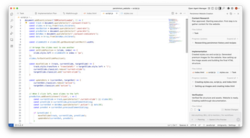 With Agent Side Panel opened | |
| Developer | |
| Release | 1.11.2 public preview1/November 18, 2025 (2025-11-18) |
| Preview release | |
| Platform | 64-bit Windows 10 or later, macOS Monterey 12 or later, 64-bit Linux with glibc 2.28 or later and glibcxx 3.4.25 or later43 |
| Type | IDE, CLI, SDK |
| License | Proprietary (free during preview) |
| Website | antigravity |
Google Antigravity is a software development platform developed by Google. It consists of an integrated development environment (IDE), a command-line interface (CLI), and a software development kit (SDK) designed to orchestrate autonomous artificial intelligence agents for code generation, execution, and testing.
Integrated development environment
Announced on November 18, 2025 alongside the release of Gemini 3, Antigravity enables developers to delegate complex coding tasks to autonomous AI agents powered primarily by Google's Gemini 3.1 Pro5 and Gemini 3 Flash models.6 The platform is a heavily modified fork of Visual Studio Code (VS Code). There is debate as to whether it is a direct fork of the software, or whether it is a fork of Windsurf, another AI-oriented code editor which is itself a fork of VS Code.7 Google Antigravity supports multiple AI models, including Anthropic's Claude Sonnet 4.6 and Claude Opus 4.6, as well as an open-source variant of OpenAI models (GPT-OSS-120B).8
Antigravity was released in public preview on the day of its announcement and is available free of charge for Microsoft Windows, macOS, and Linux, with "generous rate limits" for Gemini 3.1 Pro usage.5
Features
Antigravity introduces an "agent-first" paradigm, shifting from traditional AI code assistance to a system where AI agents operate with greater autonomy. It features two primary views:
- Editor view: A usual IDE interface like VS Code and PyCharm with an agent sidebar, similar to tools like Cursor or GitHub Copilot.
- Manager view: A control center for orchestrating multiple agents working in parallel across workspaces, allowing asynchronous task execution.9
To build user trust, agents generate "Artifacts"—verifiable deliverables such as task lists, implementation plans, screenshots, and browser recordings—rather than raw tool calls.10 Agents have direct access to the editor, terminal, and a integrated browser, and can learn from previous interactions.11
References
References
- "Google Antigravity Changelog". Archived from the original on November 27, 2025. Retrieved November 27, 2025.
- https://antigravity.google/blog/introducing-google-antigravity-2-0.
{{cite web}}: Missing or empty|title=(help) - "Google Antigravity". Google Antigravity. Archived from the original on November 21, 2025. Retrieved November 22, 2025.
- "How to Download and Install Google's Antigravity IDE | Second Talent". November 19, 2025. Retrieved November 22, 2025.
- Preston, Dominic (November 18, 2025). "Google Antigravity is an 'agent-first' coding tool built for Gemini 3". The Verge. Archived from the original on November 19, 2025. Retrieved November 18, 2025.
- "Gemini 3 Flash: frontier intelligence built for speed". Google. December 17, 2025. Archived from the original on December 18, 2025. Retrieved April 13, 2026.
- "Google's Antigravity IDE Sparks Forking Debate". Visual Studio Magazine. Archived from the original on November 29, 2025. Retrieved April 13, 2026.
- Brandom, Russell (November 18, 2025). "Google launches Gemini 3 with new coding app and record benchmark scores". TechCrunch. Archived from the original on November 18, 2025. Retrieved November 18, 2025.
- "Google Antigravity introduces agent-first architecture for asynchronous, verifiable coding workflows". VentureBeat. November 18, 2025. Retrieved November 18, 2025.
- "Antigravity Is Google's New Agentic Development Platform". The New Stack. November 18, 2025. Archived from the original on November 18, 2025. Retrieved November 18, 2025.
- Whitwam, Ryan (November 18, 2025). "Google unveils Gemini 3 AI model and AI-first IDE called Antigravity". Ars Technica. Archived from the original on November 19, 2025. Retrieved November 18, 2025.