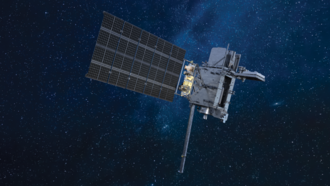
 Artistic rendering of GOES-U once deployed | |
| Names | Geostationary Operational Environmental Satellite-U |
|---|---|
| Mission type | Earth weather forecasting |
| Operator | NOAA / NASA |
| COSPAR ID | 2024-119A |
| SATCAT no. | 60133 |
| Mission duration | 15 years (planned) 709 days, 4 hours, 20 minutes (in progress) |
| Spacecraft properties | |
| Bus | A2100 |
| Manufacturer | Lockheed Martin |
| Launch mass | 5,000 kg (11,023 lb) |
| Dry mass | 2,925 kg (6,449 lb) |
| Start of mission | |
| Launch date | 25 June 2024, 21:26 (2024-06-25UTC21:26Z) UTC2 (5:26 pm EDT) |
| Rocket | Falcon Heavy |
| Launch site | Kennedy Space Center, LC-39A |
| Contractor | SpaceX |
| Entered service | 7 April 20251 |
| Orbital parameters | |
| Reference system | Geocentric orbit |
| Regime | Geostationary orbit |
| Longitude | 75.2° west (planned)3 |
| Semi-major axis | 41,845 km (26,001 mi)4 |
| Eccentricity | 0.00450314 |
| Perigee altitude | 35,286.4 km (21,926.0 mi)4 |
| Apogee altitude | 35,663.3 km (22,160.1 mi)4 |
| Inclination | 0.1204°2 |
| Period | 24 hours4 |
| Epoch | July 12, 2024 |
 GOES-U mission insignia | |
GOES-19 (designated GOES-U prior to reaching geostationary orbit) is a weather satellite, the fourth and last of the GOES-R series of satellites operated by the National Oceanic and Atmospheric Administration (NOAA). The GOES-R series will extend the availability of the Geostationary Operational Environmental Satellite (GOES) system until 2036. The satellite is built by Lockheed Martin, based on the A2100 platform.56 The satellite was placed into service as the GOES-East position and GOES-16 was stored as backup on April 7, 2025.7
Launch
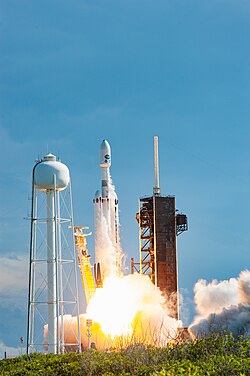
The satellite was successfully launched into space atop a SpaceX Falcon Heavy rocket on 25 June 2024 at 21:26 UTC (5:26 pm EDT local time at the launch site),2 from the Kennedy Space Center in Florida, United States. The redesign of the loop heat pipe to prevent an anomaly, as seen in GOES-17, was not expected to delay the launch as with GOES-T.8 GOES-19 has a dry mass of 2,925 kg (6,449 lb) and a fueled mass of 5,000 kg (11,023 lb).9
GOES-19 also carries a copy of the Naval Research Laboratory's Compact CORonagraph (CCOR) instrument designated as CCOR-1 which, along with the CCOR carried onboard Space weather Observations at L1 to Advance Readiness - 1 (SOLAR-1), will allow continued monitoring of solar wind after the retirement of the NASA-ESA SOHO satellite in 2025.1011 CCOR-1 on GOES-19 provides a field of view of 3.7 to 18.7 solar radii, partially comparable to LASCO C3's field of view onboard SOHO, with a 33 arcsecond spatial resolution.12
Comet discoveries through CCOR-1
The CCOR instrument carried aboard GOES-19 has allowed for the discovery of several sungrazer comets by researchers analyzing CCOR imagery. As of 11 July 2025, GOES-19's CCOR-1 has found 70 comets.13
The faint comet 3I/ATLAS was observable from 18–24 October 2025 with GOES-19 as the satellite can see objects down to magnitude 12.14
References
References
- "OSPO Administrative Message declaring GOES 19 Operational". NOAA Office of Satellites And Product Operations Satellite Alert Messages. 7 April 2025. Retrieved 7 April 2025.
- Garofalo, Meredith (25 June 2024). "Powerful GOES-U weather satellite launches to orbit atop SpaceX Falcon Heavy rocket". space.com.
- "NOAA's GOES-U Reaches Geostationary Orbit, Now Designated GOES-19". NESDIS. NOAA. 8 July 2024. Retrieved 14 July 2024. This article incorporates text from this source, which is in the public domain.
- "GOES-19 (GOES-U)". n2yo.com. Retrieved 14 July 2024.
- "GOES-R, S, T, U Spacecraft Overview". Spaceflight101. Archived from the original on 5 June 2024. Retrieved 17 January 2024.
- Andrews, Hillary (27 March 2024). "GOES-U weather satellite to launch June 25 after leak causes delay". FOX Weather. Retrieved 8 April 2024.
- "NOAA's GOES-19 satellite now operational, providing critical new data to forecasters". NOAA.gov. National Oceanic and Atmospheric Administration. Retrieved 8 April 2025.
- Werner, Debra (9 January 2019). "Lockheed Martin halts work on GOES-T to wait for instrument fix". SpaceNews. Retrieved 26 May 2019.
- "GOES-R Series Spacecraft Overview". GOES-R Series. Retrieved 17 January 2024.
- Vargas, Marco (7 January 2019). "The NOAA Space Weather Follow-On Program to Ensure Continuity of CME Imagery and Solar Wind Space-Based Observations". American Meteorilogical Society 99th Annual Meeting. AMS. Retrieved 24 March 2020.
- "Space Weather Follow On-Lagrange 1". NESDIS. NOAA. Retrieved 24 March 2020. This article incorporates text from this source, which is in the public domain.
- "SWFO Instruments". NESDIS. NOAA. Retrieved 22 February 2026.
- "Jun 1 through Jul 11 2025 Confirmations".
- Worachate Boonplod on Comets-ML