A glue trap (also known as sticky trap, adhesive trap, or glue board) is a flat panel or enclosed structure, often baited, that ensnares insects, birds, or other animals with a non-drying adhesive substance. Trapped animals become unable to move, dying a prolonged death by starvation, dehydration, or suffocation. Glue traps have been utilitzed for thousands of years, including in ancient Rome, Greece, Egypt1 and Israel.2 They are currently commonly used in agricultural and indoor pest monitoring, but criticized as inhumane and indiscriminate, trapping a range of animals in addition to the target species. They are banned or partially banned in England, Iceland, Ireland, New Zealand, Scotland, Norway, and in individual municipalities in the United States.
Description
Glue traps are flat panels or enclosed structures, often baited, that are used to ensnare insects, birds, or other animals with a non-drying adhesive substance. The goal is to prevent the animal from moving, unlike traps that kill directly using poison, spring-loaded bars, or electricity. The trapped animal becomes further ensnared as it tries to free itself, and, unable to move typically die of starvation, dehydration, or suffocation. Baitless glue traps are nicknamed "blunder" traps, as insects or animals might accidentally stumble into them.3 Baited shelter traps such as "Roach Motels", which take advantage of an insect's tendencies to seek shelter in loose bark, crevices, or other sheltered places, often have adhesive material inside to trap insects.4
Glue traps are widely used in agricultural and indoor pest monitoring.56
Criticism and legality
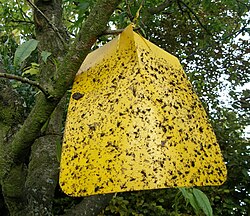
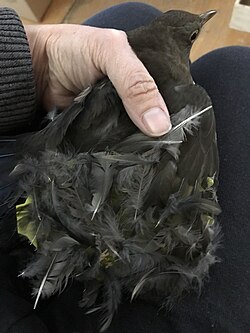
Animal welfare and public health advocates regard glue traps as both indiscriminate and inhumane.7
The traps are typically deployed to catch one kind of insect or animal, such as cockroaches, spotted lanternflies, or rats, but also ensnare a wide range of other insects and animals, including native and beneficial wildlife like birds, bats, hedgehogs, chipmunks, foxes, lizards, rabbits, and squirrels.89 Traps placed on trees to catch lanternflies, for example, easily trap birds or pull off their feathers or skin.710
The ensnared animals die a prolonged death, sometimes chewing off their own limbs to try to escape.9
Glue traps can also be harmful to humans due to the panicked activity of trapped animals. According to the United States Centers for Disease Control, trapped rodents urinate when they get scared, which can spread diseases like hantavirus.1112 The time it takes to die also means a build-up of waste.7
Many retailers have stopped selling the traps, including Target, Dollar General, Dollar Tree, Rite Aid, Walgreens, and Wellness Forever.1314
Several countries ban or restrict use of the traps. In England, they are illegal to use without a license under the Glue Traps (Offences) Act 2022, although selling them in shops remains legal.9 They are prohibited from use against vertebrates in Scotland except when given authorization for public health reasons, and completely banned in Wales.1516 Iceland bans glue traps as part of its animal welfare law, prohibiting "methods which cause unnecessary entrapment or pain".17 They are also banned in Ireland, New Zealand, and Norway.18 In India, restrictions have been placed by 32 states and union territories.14 In the United States, there have been national, state, and local laws proposed or enacted to prohibit use of glue traps. At the national level, Representative Ted Lieu of California introduced the Glue Trap Prohibition Act of 2024 (HR 7018).19 A similar law was proposed in New York the same year.1220 New Hampshire considered a ban, House Bill 152, in 2025.13 West Hollywood, California and Ojai, California banned use of glue traps in 2023 and 2024, respectively.212223
References
References
- "A historical review of animal entrapment using adhesives". Retrieved June 22, 2026.
- "Chullin 52a". Sefaria. Retrieved June 22, 2026.
- Harmon, James D. (1993). Integrated Pest Management in Museum, Library, and Archival Facilities. Harmon Preservation Pest Management. p. 78. ISBN 978-0-9638161-0-8.
They have earned the nickname "blunder traps" because the insects blunder into them and get stuck. Blunder traps are good for monitoring ingress of crawling pests into a room or building.
- Robert Arnold Wardle, Philip Buckle (1929). The Principles of Insect Control. Manchester University Press. p. 212.
- Nancy D. Epsky; Wendell L. Morrill; Richard W. Mankin (2008). "Traps for Capturing Insects" (PDF). In Capinera, John L. (ed.). Encyclopedia of Entomology. Dordrecht: Springer. pp. 3887–3901. ISBN 978-1-4020-6242-1.
- "What is a sticky trap?". Retrieved January 26, 2015.
- "NYC lawmakers push to ban glue traps, pest control debate". www.amny.com. March 22, 2024. Retrieved January 19, 2026.
- "Ojai becomes 2nd U.S. city to ban 'horrible, indiscriminate killing devices': glue traps". Los Angeles Times. March 4, 2024. Retrieved January 19, 2026.
- "Investigation finds shops tell customers how to illegally use glue traps". The Independent. August 3, 2025. Retrieved January 19, 2026.
- "Meant to Catch Spotted Lanternflies, Glue Traps Are a Horrifying Hazard for Birds | Audubon". www.audubon.org. March 29, 2023. Retrieved January 19, 2026.
- CDC (April 18, 2024). "How to Trap Up to Remove Rodents". Healthy Pets, Healthy People. Retrieved January 19, 2026.
- "Are Glue Traps Too Cruel to Use in the Fight Against Mice and Rats? (Published 2024)". March 28, 2024. Archived from the original on October 18, 2025. Retrieved January 19, 2026.
- Sullivan, Claire (February 28, 2025). "Glue traps called '19th-century solution' as lawmakers push for NH to become first state to ban them • New Hampshire Bulletin". New Hampshire Bulletin. Retrieved January 19, 2026.
- "Mumbai: Wellness Forever Stops the Sale of Cruel Glue Traps After Activists Write to Authorities". The Times of India. November 4, 2025. ISSN 0971-8257. Retrieved January 19, 2026.
- Agriculture (Wales) Act 2023. Retrieved May 31, 2026.
- Wildlife Management and Muirburn (Scotland) Act 2024. Retrieved May 31, 2026.
- "Glue Traps And Bucket Traps For Mice Banned In Iceland". The Reykjavik Grapevine. December 14, 2021. Retrieved January 19, 2026.
- "Here's why rodent glue trap sales could be banned in the U.S." Animals. January 19, 2026. Retrieved January 19, 2026.
- "H.R.7018 - Glue Trap Prohibition Act of 2024". United States Congress.
- N; P; R (April 2, 2024). "New York considers banning glue traps used to catch mice and rats". NPR. Retrieved January 19, 2026.
- "Ojai becomes 2nd U.S. city to ban 'horrible, indiscriminate killing devices': glue traps". Los Angeles Times. March 4, 2024. Retrieved January 19, 2026.
- "West Hollywood is first American city to ban rodent glue traps". Los Angeles Times. April 20, 2023. Retrieved January 19, 2026.
- "WeHo bans glue traps for rodent control - CBS Los Angeles". www.cbsnews.com. April 19, 2023. Retrieved January 19, 2026.