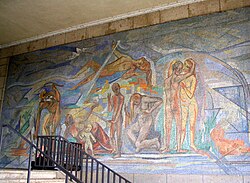
The GeSoLei (German: Große Ausstellung Düsseldorf 1926 für Gesundheitspflege, soziale Fürsorge und Leibesübungen) was the largest trade fair in Germany during the Weimar Republic. It attracted 7.5 million visitors. The name was constructed from an abbreviation of abbreviations of the German words for public health (Ge), social welfare (So), physical exercise (Lei).
Surviving features of the event include the Tonhalle which at the time of its completion was the largest planetarium in the world, built by Wilhelm Kreis.1
Publication
As part of its "social hygiene" activities, the GeSoLei engaged in extensive publishing efforts. From the summer of 1925 to the summer of 1926, a daily newspaper and a magazine titled Gesolei were published, featuring numerous articles focused primarily on social policy. In 1925–1926, film director and experimental filmmaker Walter Ruttmann, in collaboration with Lotte Lendesdorff2 and Julius Pinschewer,3 created a three-minute animated film for the exhibition titled Der Aufstieg (The Ascent). The film propagated the renewal of the Deutscher Michel (German Michael).4
References
References
- "TH Portrait 2008" (PDF). Archived from the original (PDF) on 2016-03-03. Retrieved 2015-06-26.
- "Der Aufstieg". animations-filme.de. Retrieved 2026-04-03.
- "Filmography of Julius Pinschewer". IMDb. Retrieved 2026-04-03.
- Goergen, Jeanpaul (1989). Walter Ruttmann. Eine Dokumentation. Berlin: Friends of the German Kinemathek. p. 112. ISBN 3-927876-00-3.
Cited in: Huber, Nicole. "From 'Berlin' to 'Germania'. Cinema and the Implementation of National Politics in Regional Planning (1926–1939)". In: Zimmermann, Clemens. Zentralität und Raumgefüge der deutschen Großstädte im 20. Jahrhundert. Franz Steiner Verlag, Stuttgart 2006, ISBN 3-515-08898-9, p. 161.
Links
- Contemporary footage with German commentary
- Der Aufstieg (The Climb) a short film by Walter Ruttmann and Julius Pinschewer advertising the GeSoLei