In artificial neural networks, the gated recurrent unit (GRU) is a gating mechanism used in recurrent neural networks, introduced in 2014 by Kyunghyun Cho et al.1 The GRU is like a long short-term memory (LSTM) with a gating mechanism to input or forget certain features,2 but lacks a context vector or output gate, resulting in fewer parameters than LSTM.3 GRU's performance on certain tasks of polyphonic music modeling, speech signal modeling and natural language processing was found to be similar to that of LSTM.45 GRUs showed that gating is indeed helpful in general, and Bengio's team came to no concrete conclusion on which of the two gating units was better.67
Architecture
There are several variations on the full gated unit, with gating done using the previous hidden state and the bias in various combinations, and a simplified form called minimal gated unit.8
In the following, the operator denotes the Hadamard product.
Fully gated unit
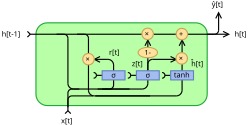
Initially, for , the output vector is .
Variables ( denotes the number of input features and the number of output features):
- : input vector
- : output vector
- : candidate activation vector
- : update gate vector
- : reset gate vector
- , and : parameter matrices and vector which need to be learned during training
- : The original is a logistic function.
- : The original is a hyperbolic tangent.
Alternative activation functions are possible, provided that .
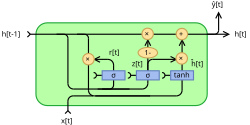
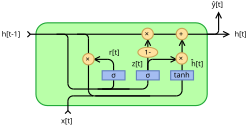
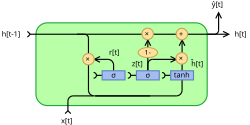
Alternate forms can be created by changing and 9
- Type 1: each gate depends only on the previous hidden state and the bias.
- Type 2: each gate depends only on the previous hidden state.
- Type 3: each gate is computed using only the bias.
Minimal gated unit
The minimal gated unit (MGU) is similar to the fully gated unit, except the update and reset gate vector is merged into a forget gate. This also implies that the equation for the output vector must be changed:10
Variables
- : input vector
- : output vector
- : candidate activation vector
- : forget vector
- , and : parameter matrices and vector
Light gated recurrent unit
The light gated recurrent unit (LiGRU)4 removes the reset gate altogether, replaces tanh with the ReLU activation, and applies batch normalization (BN):
LiGRU has been studied from a Bayesian perspective.11 This analysis yielded a variant called light Bayesian recurrent unit (LiBRU), which showed slight improvements over the LiGRU on speech recognition tasks.
References
References
- Cho, Kyunghyun; van Merrienboer, Bart; Gulcehre, Caglar; Bahdanau, Dzmitry; Bougares, Fethi; Schwenk, Holger; Bengio, Yoshua (2014). "Learning Phrase Representations using RNN Encoder-Decoder for Statistical Machine Translation". Proceedings of the 2014 Conference on Empirical Methods in Natural Language Processing (EMNLP): 1724–1734. arXiv:1406.1078. doi:10.3115/v1/D14-1179.
- Felix Gers; Jürgen Schmidhuber; Fred Cummins (1999). "Learning to forget: Continual prediction with LSTM". 9th International Conference on Artificial Neural Networks: ICANN '99. Vol. 1999. pp. 850–855. doi:10.1049/cp:19991218. ISBN 0-85296-721-7.
- "Recurrent Neural Network Tutorial, Part 4 – Implementing a GRU/LSTM RNN with Python and Theano – WildML". Wildml.com. 2015-10-27. Archived from the original on 2021-11-10. Retrieved May 18, 2016.
- Ravanelli, Mirco; Brakel, Philemon; Omologo, Maurizio; Bengio, Yoshua (2018). "Light Gated Recurrent Units for Speech Recognition". IEEE Transactions on Emerging Topics in Computational Intelligence. 2 (2): 92–102. arXiv:1803.10225. Bibcode:2018ITECI...2...92R. doi:10.1109/TETCI.2017.2762739. S2CID 4402991.
- Su, Yuahang; Kuo, Jay (2019). "On extended long short-term memory and dependent bidirectional recurrent neural network". Neurocomputing. 356: 151–161. arXiv:1803.01686. doi:10.1016/j.neucom.2019.04.044. S2CID 3675055.
- Chung, Junyoung; Gulcehre, Caglar; Cho, KyungHyun; Bengio, Yoshua (2014). "Empirical Evaluation of Gated Recurrent Neural Networks on Sequence Modeling". arXiv:1412.3555 [cs.NE].
- Gruber, N.; Jockisch, A. (2020), "Are GRU cells more specific and LSTM cells more sensitive in motive classification of text?", Frontiers in Artificial Intelligence, 3 40, doi:10.3389/frai.2020.00040, PMC 7861254, PMID 33733157, S2CID 220252321
- Chung, Junyoung; Gulcehre, Caglar; Cho, KyungHyun; Bengio, Yoshua (2014). "Empirical Evaluation of Gated Recurrent Neural Networks on Sequence Modeling". arXiv:1412.3555 [cs.NE].
- Dey, Rahul; Salem, Fathi M. (2017-01-20). "Gate-Variants of Gated Recurrent Unit (GRU) Neural Networks". arXiv:1701.05923 [cs.NE].
- Heck, Joel; Salem, Fathi M. (2017-01-12). "Simplified Minimal Gated Unit Variations for Recurrent Neural Networks". arXiv:1701.03452 [cs.NE].
- Bittar, Alexandre; Garner, Philip N. (May 2021). "A Bayesian Interpretation of the Light Gated Recurrent Unit". ICASSP 2021. 2021 IEEE International Conference on Acoustics, Speech and Signal Processing (ICASSP). Toronto, ON, Canada: IEEE. pp. 2965–2969. 10.1109/ICASSP39728.2021.9414259.