  | |
| Observation data Epoch J2000.0 Equinox J2000.0 (ICRS) | |
|---|---|
| Constellation | Sextans |
| Right ascension | 09h 52m 30.43727s1 |
| Declination | −08° 06′ 18.1269″1 |
| Apparent magnitude (V) | 5.052 (5.6 + 6.0)3 |
| Characteristics | |
| Evolutionary stage | main sequence4 |
| Spectral type | A0/1 V5 (A1 V + A4 V)6 |
| U−B color index | +0.062 |
| B−V color index | +0.042 |
| Astrometry | |
| Radial velocity (Rv) | +127 km/s |
| Proper motion (μ) | RA: −57.281 mas/yr Dec.: −49.261 mas/yr |
| Parallax (π) | 11.75±0.63 mas1 |
| Distance | 280 ± 10 ly (85 ± 5 pc) |
| Absolute magnitude (MV) | +0.438 |
| Orbit9 | |
| Period (P) | 77.61±0.59 yr |
| Semi-major axis (a) | 0.380±0.013″ |
| Eccentricity (e) | 0.741±0.019 |
| Inclination (i) | 143.2±3.4° |
| Longitude of the node (Ω) | 198.5±5.2° |
| Periastron epoch (T) | 1956.84±0.69 |
| Argument of periastron (ω) (secondary) | 306.2±6.5° |
| Details | |
| Mass | 2.6010 M☉ |
| Radius | 3.211 R☉ |
| Luminosity | 694 L☉ |
| Surface gravity (log g) | 4.18±0.1410 cgs |
| Temperature | 9,825±33410 K |
| Rotational velocity (v sin i) | 134.6±1.412 km/s |
| Age | 40110 Myr |
| Other designations | |
| γ Sex, 8 Sextantis, BD−07°2909, HD 85558, HIP 48437, HR 3909, SAO 137199.13 | |
| Database references | |
| SIMBAD | data |
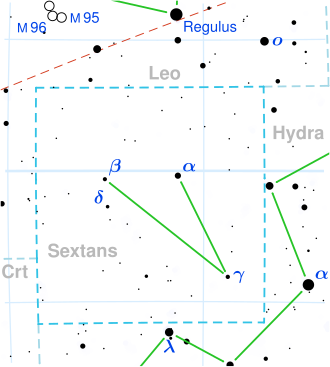
Gamma Sextantis, Latinized as γ Sextantis, is a binary star14 system in the equatorial constellation of Sextans. The combined apparent visual magnitude of the system is 5.05,2 which means it is faintly visible to the naked eye. The annual parallax shift is 11.75 mas,1 indicating a distance of around 280 light years.
The two components orbit each other with a period of 77.6 years and a high eccentricity of 0.741. The orbital plane is inclined by 143.2° to the line of sight from the Earth.9 With a visual magnitude of 5.6,6 the brighter component Gamma Sextantis A is an A-type main sequence star with a stellar classification of A1 V.6 The fainter companion Gamma Sextantis B has a classification of A4 V6 with a magnitude of 6.0.6 Their combined spectrum matches a classification of A0/1 V.5 Their angular separation 0.4 arcseconds, so observation with a telescope requires a diameter of at least 30 centimeters.
There is a magnitude 12.28 companion star Gamma Sextantis C at an angular separation of 36.9 arc seconds along a position angle of 333°, as of 2000. This separation has increased from 30.0 arc seconds in 1834. The proper motion of this star differs from the Gamma Sextantis AB system, having proper motions of −29 mas/yr and +5 mas/yr in right ascension and declination, respectively.15
References
References
- van Leeuwen, F. (2007), "Validation of the new Hipparcos reduction", Astronomy and Astrophysics, 474 (2): 653–664, arXiv:0708.1752, Bibcode:2007A&A...474..653V, doi:10.1051/0004-6361:20078357, S2CID 18759600.
- Johnson, H. L.; et al. (1966), "UBVRIJKL photometry of the bright stars", Communications of the Lunar and Planetary Laboratory, 4 (99): 99, Bibcode:1966CoLPL...4...99J.
- Heintz, W. D. (March 1982), "Orbits of 16 visual binaries", Astronomy and Astrophysics Supplement Series, 47: 569–573, Bibcode:1982A&AS...47..569H.
- Zorec, J.; Royer, F. (2012). "Rotational velocities of A-type stars. IV. Evolution of rotational velocities". Astronomy and Astrophysics. 537: A120. arXiv:1201.2052. Bibcode:2012A&A...537A.120Z. doi:10.1051/0004-6361/201117691.
- Houk, N.; Swift, C. (1999), "Michigan catalogue of two-dimensional spectral types for the HD Stars", Michigan Spectral Survey, 5, Ann Arbor, Michigan: Department of Astronomy, University of Michigan, Bibcode:1999MSS...C05....0H.
- Edwards, T. W. (April 1976), "MK classification for visual binary components", Astronomical Journal, 81: 245–249, Bibcode:1976AJ.....81..245E, doi:10.1086/111879.
- Wilson, Ralph Elmer (1953), "General Catalogue of Stellar Radial Velocities", Carnegie Institute Washington D.C. Publication, Washington: Carnegie Institution of Washington, Bibcode:1953GCRV..C......0W.
- Anderson, E.; Francis, Ch. (2012), "XHIP: An extended hipparcos compilation", Astronomy Letters, 38 (5): 331, arXiv:1108.4971, Bibcode:2012AstL...38..331A, doi:10.1134/S1063773712050015, S2CID 119257644.
- Tokovinin, Andrei; Mason, Brian D.; Mendez, Rene A.; Costa, Edgardo (July 2024), "Speckle Interferometry at SOAR Telescope in 2023", The Astronomical Journal, 168 (1): 28, Bibcode:2024AJ....168...28T, doi:10.3847/1538-3881/ad4d56, ISSN 0004-6256.
- David, Trevor J.; Hillenbrand, Lynne A. (2015), "The Ages of Early-Type Stars: Strömgren Photometric Methods Calibrated, Validated, Tested, and Applied to Hosts and Prospective Hosts of Directly Imaged Exoplanets", The Astrophysical Journal, 804 (2): 146, arXiv:1501.03154, Bibcode:2015ApJ...804..146D, doi:10.1088/0004-637X/804/2/146, S2CID 33401607.
- McDonald, I.; Zijlstra, A. A.; Watson, R. A. (2017). "Fundamental parameters and infrared excesses of Tycho-Gaia stars". Monthly Notices of the Royal Astronomical Society. 471 (1): 770. arXiv:1706.02208. Bibcode:2017MNRAS.471..770M. doi:10.1093/mnras/stx1433.
- Díaz, C. G.; et al. (July 2011), "Accurate stellar rotational velocities using the Fourier transform of the cross correlation maximum", Astronomy & Astrophysics, 531: A143, arXiv:1012.4858, Bibcode:2011A&A...531A.143D, doi:10.1051/0004-6361/201016386, S2CID 119286673.
- "gam Sex – Star", SIMBAD Astronomical Database, Centre de Données astronomiques de Strasbourg, retrieved 2016-12-14.
- Eggleton, P. P.; et al. (September 2008), "A catalogue of multiplicity among bright stellar systems", Monthly Notices of the Royal Astronomical Society, 389 (2): 869–879, arXiv:0806.2878, Bibcode:2008MNRAS.389..869E, doi:10.1111/j.1365-2966.2008.13596.x, S2CID 14878976.
- Mason, B. D.; et al. (2014), "The Washington Visual Double Star Catalog", The Astronomical Journal, 122 (6): 3466, Bibcode:2001AJ....122.3466M, doi:10.1086/323920.