  | |
| Observation data Epoch J2000 Equinox ICRS | |
|---|---|
| Constellation | Pavo |
| Right ascension | 21h 26m 26.60498s1 |
| Declination | −65° 21′ 58.3131″1 |
| Apparent magnitude (V) | 4.222 |
| Characteristics | |
| Evolutionary stage | main sequence1 |
| Spectral type | F9 V Fe-1.4 CH-0.73 |
| U−B color index | −0.134 |
| B−V color index | +0.484 |
| Variable type | Suspected |
| Astrometry | |
| Radial velocity (Rv) | −29.78±0.121 km/s |
| Proper motion (μ) | RA: +80.815 mas/yr1 Dec.: +800.573 mas/yr1 |
| Parallax (π) | 108.0102±0.1061 mas1 |
| Distance | 30.20 ± 0.03 ly (9.258 ± 0.009 pc) |
| Absolute magnitude (MV) | 4.405 |
| Details | |
| Mass | 0.934±0.0336 M☉ |
| Radius | 1.057±0.0126 R☉ |
| Luminosity | 1.461±0.0496 L☉ |
| Surface gravity (log g) | 4.359±0.0086 cgs |
| Temperature | 6,168±1306 K |
| Metallicity [Fe/H] | −0.66±0.096 dex |
| Rotational velocity (v sin i) | 1.0±0.67 km/s |
| Age | 5.9±1.26 Gyr |
| Other designations | |
| γ Pav, CD−65°2751, FK5 805, GJ 827, HD 203608, HIP 105858, HR 8181, SAO 254999, LHS 3674, LTT 8510 | |
| Database references | |
| SIMBAD | data |
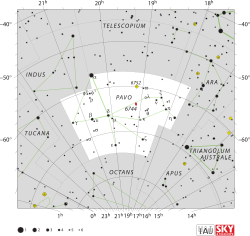
Gamma Pavonis, Latinized from γ Pavonis, is a star in the southern circumpolar constellation of Pavo. With an apparent visual magnitude of 4.22,2 it is a fourth-magnitude star and thereby visible to the naked eye. From parallax observations with the Gaia satellite, the distance to this star has been measured at 30.20 light-years (9.26 parsecs). It is drifting closer to the Sun with a radial velocity of −30 km/s.1
The stellar classification of F9 V3 puts it in the class of F-type main sequence stars that generate energy through the nuclear fusion of hydrogen at the core. It is a metal-poor star, which means it has a low abundance of elements heavier than helium. This star has about 93% of the Sun's mass, and about 106% its radius. It is a brighter star with 146% of the Sun's luminosity, which is it radiating from the outer envelope at an effective temperature of 6,168 K. Its age is estimated at 5.9 billion years.6
This star had rank 14 on TPF-C's top 100 target stars to search for a rocky planet in the Habitable Zone, approximately 1.2 AU, or a little beyond an Earth-like orbit.8
References
References
- Vallenari, A.; et al. (Gaia collaboration) (2023). "Gaia Data Release 3. Summary of the content and survey properties". Astronomy and Astrophysics. 674: A1. arXiv:2208.00211. Bibcode:2023A&A...674A...1G. doi:10.1051/0004-6361/202243940. S2CID 244398875. Gaia DR3 record for this source at VizieR.
- Jehin, E.; et al. (January 1999). "Abundance correlations in mildly metal-poor stars". Astronomy and Astrophysics. 341: 241–255. arXiv:astro-ph/9809405. Bibcode:1999A&A...341..241J.
- Gray, R. O.; et al. (July 2006). "Contributions to the Nearby Stars (NStars) Project: spectroscopy of stars earlier than M0 within 40 pc-The Southern Sample". The Astronomical Journal. 132 (1): 161–170. arXiv:astro-ph/0603770. Bibcode:2006AJ....132..161G. doi:10.1086/504637. S2CID 119476992.
- Johnson, H. L.; et al. (1966). "UBVRIJKL photometry of the bright stars". Communications of the Lunar and Planetary Laboratory. 4 (99): 99. Bibcode:1966CoLPL...4...99J.
- Holmberg, J.; Nordstrom, B.; Andersen, J. (July 2009). "The Geneva-Copenhagen survey of the solar neighbourhood. III. Improved distances, ages, and kinematics". Astronomy and Astrophysics. 501 (3): 941–947. arXiv:0811.3982. Bibcode:2009A&A...501..941H. doi:10.1051/0004-6361/200811191. S2CID 118577511.
- Huber, Daniel; et al. (2022-02-01). "A 20 Second Cadence View of Solar-type Stars and Their Planets with TESS: Asteroseismology of Solar Analogs and a Recharacterization of π Men c". The Astronomical Journal. 163 (2): 79. arXiv:2108.09109. Bibcode:2022AJ....163...79H. doi:10.3847/1538-3881/ac3000. ISSN 0004-6256.
- Bruntt, H.; et al. (July 2010). "Accurate fundamental parameters for 23 bright solar-type stars". Monthly Notices of the Royal Astronomical Society. 405 (3): 1907–1923. arXiv:1002.4268. Bibcode:2010MNRAS.405.1907B. doi:10.1111/j.1365-2966.2010.16575.x. S2CID 118495267.
- "TPF-C Top 100". Archived from the original on 12 December 2005.