  | |
| Observation data Epoch J2000 Equinox J2000 | |
|---|---|
| Constellation | Cassiopeia1 |
| Right ascension | 00h 56m 42.50108s2 |
| Declination | +60° 43′ 00.2984″2 |
| Apparent magnitude (V) | 2.393 (varies by±0.01)4 |
| Characteristics | |
| Evolutionary stage | main sequence5 |
| Spectral type | B0.5IVe6 |
| U−B color index | −1.087 |
| B−V color index | −0.157 |
| Variable type | γ Cas8 |
| Astrometry | |
| Radial velocity (Rv) | −6.89 km/s |
| Proper motion (μ) | RA: +25.17 mas/yr2 Dec.: −3.92 mas/yr2 |
| Parallax (π) | 5.94±0.12 mas2 |
| Distance | 550 ± 10 ly (168 ± 3 pc) |
| Absolute magnitude (MV) | −3.981 |
| Orbit6 | |
| Primary | Aa |
| Name | Ab |
| Period (P) | 203.523±0.076 d |
| Semi-major axis (a) | 1.632+0.002 −0.001 AU10 |
| Eccentricity (e) | 0 |
| Inclination (i) | 45° |
| Semi-amplitude (K1) (primary) | 4.297±0.090 km/s |
| Orbit11 | |
| Primary | Aab |
| Name | Ac |
| Period (P) | 60.0 yr |
| Semi-major axis (a) | 0.233″ |
| Orbit11 | |
| Primary | A |
| Name | B |
| Semi-major axis (a) | 2.054″ |
| Details | |
| Aa | |
| Mass | 15±212 M☉ |
| Radius | 10.9+0.8 −0.6 (equatorial) 7.9±0.4 (polar)12 R☉ |
| Luminosity | 19,000±50013 L☉ |
| Surface gravity (log g) | 3.5014 cgs |
| Temperature | 26,500 (polar) 17,300 (equatorial)12 K |
| Rotational velocity (v sin i) | 389±2012 km/s |
| Age | 8.0±0.415 Myr |
| Ab | |
| Mass | 0.93+0.04 −0.0110 M☉ |
| Radius | 6,000+65 −32010 km |
| B | |
| Mass | 1.0211 M☉ |
| Other designations | |
| Tiansi, Tsih16, Navi, γ Cas, 27 Cassiopeiae, AAVSO 0050+60, BD+59°144, FK5 32, HD 5394, HIP 4427, HR 264, SAO 11482, ADS 782, CCDM J00567+6043, WDS J00567+604317 | |
| γ Cas A: ADS 782 A, CCDM J00567+6043 A, WDS J00567+6043A | |
| γ Cas B: ADS 782 B, CCDM J00567+6043 B, WDS J00567+6043B | |
| Database references | |
| SIMBAD | data |
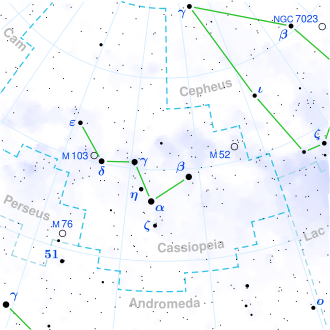
Gamma Cassiopeiae, Latinized from γ Cassiopeiae formally named Tiansi,18 is a multiple star system at the center of the distinctive "W" asterism in the northern circumpolar constellation of Cassiopeia. It was observed in 1866 by Angelo Secchi, the first star ever observed with emission lines.1920 It is now considered a Be star.
Gamma Cassiopeiae is a variable star system. Based upon parallax measurements made by the Hipparcos satellite, it is located at a distance of roughly 550 light-years from Earth. Together with its common-proper-motion companion, HD 5408, the system could contain a total of eight stars.21 It is one of the highest multiplicity systems known.20
Names
γ Cassiopeiae (Latinized to Gamma Cassiopeiae, abbreviated Gamma Cas or γ Cas) is the object's Bayer designation, and it has the Flamsteed designation 27 Cassiopeiae. Although it is a fairly bright star with a combined apparent visual magnitude of 2.47, it had no traditional Arabic or Latin name.
The Chinese name Tsih, "the whip" (Chinese: 策; pinyin: Cè), is commonly associated with this star.2223 The name however originally referred to κ Cassiopeiae,2425 and γ Cassiopeiae was just one of four horses (Chinese: 天駟; pinyin: Tiān Sì; "Heavenly Quadriga") pulling the chariot of legendary charioteer Wangliang (see β Cassiopeiae).24 This representation was later changed to make Gamma the whip.24 The IAU Working Group on Star Names approved the name Tiansi for γ Cassiopeiae Aa on 13 November 2025, after the older Chinese name, and it is now so entered in the IAU Catalog of Star Names.18
The star was used as an easily identifiable navigational reference point during space missions and American astronaut Virgil Ivan "Gus" Grissom nicknamed the star Navi after his own middle name spelled backwards.2627
Physical properties

Gamma Cassiopeiae is an eruptive variable star. It is the prototype of the class of Gamma Cassiopeiae variable stars. In the late 1930s it underwent what is described as a shell episode and the brightness increased to above magnitude 2.0, then dropped rapidly to 3.4.28 At maximum intensity, γ Cassiopeiae outshined both Alpha Cassiopeiae (Schedar; magnitude 2.25) and Beta Cassiopeiae (Caph; 2.3). It has since been gradually brightening back to around 2.2.29 Observations by the TESS satellite in November 2019 showed amplitudes of no more than 2%.4
Gamma Cassiopeiae is a rapidly spinning star with a projected rotational velocity of 389 km/s, giving it a pronounced equatorial bulge. When accounted for its axial inclination, the true value is found to be 450±20 km/s. The equatorial radius is 10.9 R☉ and the polar radius is 7.9 R☉.12 When combined with the star's high luminosity, the result is the ejection of matter that forms a hot circumstellar disk of gas. The emissions and brightness variations are apparently caused by this "decretion disk".
The spectrum of this massive star matches a stellar classification of B0.5 IVe. The 'e' suffix is used for stars that show emission lines of hydrogen in the spectrum, caused in this case by the circumstellar disk. This places it among a category known as Be stars; in fact, the first such star ever to be so designated.30 A luminosity class of IV suggest it is a subgiant star that has reached a stage of its evolution where it is exhausting the supply of hydrogen in its core region and transforming into a giant star, although it is modelled to be only about a third of the way through its main-sequence life5 after a relatively brief 8 million years.15 The outer atmosphere has an intense effective temperature of 25,000 K, which is causing it to glow with a blue-white hue. It has 17 times the Sun's mass and is radiating as much energy as 19,000 Suns.
Gamma Cassiopeiae exhibits characteristics consistent with a strong disordered magnetic field. No field can be measured directly from the Zeeman effect because of the star's rotation-broadened spectral lines. Instead, the presence of this field is inferred from a robust periodic signal of 1.21 days that suggests a magnetic field rooted on the rotating star's surface. The star's UV and optical spectral lines show ripples moving from blue to red over several hours, which indicates clouds of matter being held frozen over the star's surface by strong magnetic fields. This evidence suggests that a magnetic field from the star is interacting with the decretion disk, resulting in the X-ray emission. A disk dynamo has been advanced as a mechanism to explain this modulation of the X-rays. However, difficulties remain with this mechanism, among which is that there are no disk dynamos known to exist in other stars, rendering this behavior more difficult to analyze.31
X-ray emission
Gamma Cassiopeiae is the prototype of a small group of stellar sources of X-ray radiation that is at least 10 times stronger than emitted from other B or Be stars. The character of the X-ray spectrum is thermal, i.e. it is emitted from hot plasmas with temperatures higher than 60 million kelvins (5keV). It also shows very short-term, middle-term and long-term variations. Historically, it has been proposed that these X-rays might arise from magnetic interactions between the star and its disk,323334 from a collision between the disk and the wind from a hot stripped-star companion, or from accretion onto the surface of a degenerate companion such as a white dwarf or neutron star.
Observations are incompatible with the wind-disk collision35 and accretion on a neutron star.3637 In 2026, high-resolution data obtained with XRISM revealed that the signatures of the hot plasma followed the companion's motion, validating the scenario with accretion on a white dwarf.3839
Companions

Gamma Cassiopeiae has three visible companions, listed in double star catalogues as components B, C, and D.404121 Star B is about 2 arc-seconds distant and magnitude 11, and has a similar space velocity to the bright primary, making it likely to be physically associated. An orbit would take over a thousand years.11 Component C is magnitude 13, nearly an arc-minute distant,4243 and is listed in Gaia Data Release 3 as having a very different proper motion and being much more distant than Gamma Cassiopeiae.44 Finally, component D, about 21 arc-minutes distant, is the naked-eye star HR 266 (HD 5408), itself a quadruple system21 and thought to be associated although separated by about a parsec.11

Gamma Cassiopeiae A, the bright primary, is itself a spectroscopic binary with an orbital period of about 203.5 days and an eccentricity near zero. The companion is a white dwarf with a mass 0.93 times that of the Sun, and a size just smaller than Earth.45 It is likely to be more evolved than the primary and to have transferred mass to it during an earlier stage of evolution,646 although the primary is currently losing mass and the white dwarf is gaining mass though an accretion disk.1038 Additionally, Hipparcos data show a "wobble" with an amplitude of about 150 mas, that may correspond to the orbit of a third star. This star would have an orbital period of at least 60 years.47
See also
See also
- Iota Ursae Majoris, informally named Dnoces for astronaut Ed White
- Gamma Velorum, informally named Regor for astronaut Roger B. Chaffee
- Sh 2-185, an H II region centered on Gamma Cassiopeiae
References
References
- Anderson, E.; Francis, Ch. (2012). "XHIP: An extended hipparcos compilation". Astronomy Letters. 38 (5): 331. arXiv:1108.4971. Bibcode:2012AstL...38..331A. doi:10.1134/S1063773712050015. XHIP record for this object at VizieR.
- van Leeuwen, F. (November 2007). "Validation of the new Hipparcos reduction". Astronomy and Astrophysics. 474 (2): 653–664. arXiv:0708.1752. Bibcode:2007A&A...474..653V. doi:10.1051/0004-6361:20078357. S2CID 18759600.
- Ducati, J. R. (2002). "VizieR Online Data Catalog: Stellar Photometry in Johnson's 11-color system (Ducati, 2002)". Vizier Online Data Catalog. Bibcode:2002yCat.2237....0D.
- Labadie-Bartz, Jonathan; et al. (March 2021). "Short-term variability and mass loss in Be stars – VI. Frequency groups in γ Cas detected by TESS". Monthly Notices of the Royal Astronomical Society. 502 (1): 242–259. arXiv:2012.06454. doi:10.1093/mnras/staa3913.
- Zorec, J.; et al. (2005). "On the evolutionary status of Be stars. I. Field Be stars near the Sun". Astronomy and Astrophysics. 441 (1): 235–248. arXiv:astro-ph/0509119. Bibcode:2005A&A...441..235Z. doi:10.1051/0004-6361:20053051. S2CID 17592657.
- Nemravová, J.; et al. (2012). "Properties and nature of Be stars. 29. Orbital and long-term spectral variations of γ Cassiopeiae". Astronomy & Astrophysics. 537: A59. arXiv:1111.3761. Bibcode:2012A&A...537A..59N. doi:10.1051/0004-6361/201117922. S2CID 34272401.
- Nicolet, B. (1978). "Photoelectric photometric Catalogue of homogeneous measurements in the UBV System". Astronomy and Astrophysics Supplement Series. 34: 1–49. Bibcode:1978A&AS...34....1N.
- Samus, N. N.; Durlevich, O. V.; et al. (2009). "VizieR Online Data Catalog: General Catalogue of Variable Stars (Samus+ 2007–2013)". VizieR On-line Data Catalog: B/gcvs. 1: 02025. Bibcode:2009yCat....102025S.
- Wilson, Ralph Elmer (1953). "General Catalogue of Stellar Radial Velocities". Carnegie Institute Washington D.C. Publication. Bibcode:1953GCRV..C......0W.
- Gunderson, Sean J.; et al. (2024-12-27). "A Time-dependent Spectral Analysis of γ Cassiopeiae". The Astrophysical Journal. 978 (1): 105. arXiv:2411.11825. doi:10.3847/1538-4357/ad944e. ISSN 0004-637X.
- Tokovinin, Andrei (March 2018). "The Updated Multiple Star Catalog". The Astrophysical Journal Supplement Series. 235 (1): 6. arXiv:1712.04750. Bibcode:2018ApJS..235....6T. doi:10.3847/1538-4365/aaa1a5. ISSN 0067-0049. S2CID 119047709.
- Archer, A.; Aufdenberg, J. P.; Bangale, P.; Bartkoske, J. T.; Benbow, W.; Buckley, J. H.; Chen, Y.; Chin, N. B. Y.; Christiansen, J. L.; Chromey, A. J.; Duerr, A.; Escobar Godoy, M.; Feldman, S.; Feng, Q.; Filbert, S. (2025-06-18). "Measurement of the photosphere oblateness of γ Cassiopeiae via Stellar Intensity Interferometry with the VERITAS Observatory". The Astrophysical Journal. 995 (2): 191. arXiv:2506.15027. Bibcode:2025ApJ...995..191A. doi:10.3847/1538-4357/ae0744. ISSN 0004-637X.
- Klement, R.; et al. (2017). "Revealing the structure of the outer disks of be stars". Astronomy and Astrophysics. 601: A74. arXiv:1703.07321. Bibcode:2017A&A...601A..74K. doi:10.1051/0004-6361/201629932. S2CID 56439879.
- Sigut, T. A. A.; Jones, C. E. (October 2007). "The Thermal Structure of the Circumstellar Disk Surrounding the Classical Be Star γ Cassiopeiae". Astrophysical Journal. 668 (1): 481–491. arXiv:0706.4036. Bibcode:2007ApJ...668..481S. doi:10.1086/521209. S2CID 14362961.
- Tetzlaff, N.; Neuhäuser, R.; Hohle, M. M. (2011). "A catalogue of young runaway Hipparcos stars within 3 KPC from the Sun". Monthly Notices of the Royal Astronomical Society. 410 (1): 190. arXiv:1007.4883. Bibcode:2011MNRAS.410..190T. doi:10.1111/j.1365-2966.2010.17434.x.
- Falkner, David E. (2011). "The Autumn Constellations". The Mythology of the Night Sky. Patrick Moore's Practical Astronomy Series. pp. 139–162. doi:10.1007/978-1-4614-0137-7_8. ISBN 978-1-4614-0136-0. S2CID 127279699.
- "gam Cas -- High Mass X-ray Binary". SIMBAD. Strasbourg astronomical Data Center. Retrieved 20 July 2025.
- "IAU Catalog of Star Names". Retrieved 13 November 2025.
- Secchi, A. (1867). "Schreiben des Herrn Prof.Secchi, Dir. Der Sternwarte des Collegio Romano, an den Herausgeber". Astronomische Nachrichten. 68 (4): 63–64. Bibcode:1866AN.....68...63S. doi:10.1002/asna.18670680405.
- Mamajek, Eric (April 2017). "Gamma Cassiopeiae and HR 266: A Massive Septuplet Illuminating the IC 59 and IC 63 Nebulae at d = 168 pc". Journal of Double Star Observations. 13 (2): 264–267. Bibcode:2017JDSO...13..264M.
- Hutter, D. J.; et al. (2021). "Surveying the Bright Stars by Optical Interferometry. III. A Magnitude-limited Multiplicity Survey of Classical Be Stars". The Astrophysical Journal Supplement Series. 257 (2): 69. arXiv:2109.06839. Bibcode:2021ApJS..257...69H. doi:10.3847/1538-4365/ac23cb. S2CID 237503492.
- 唐山 (Tángshān) (1967). 天文學太空航空學辭典 [Dictionary of astronomy and astronautics] (in Chinese). 廣文書局. OCLC 22797568.
- Allen, Richard Hinckley (1963) [1899]. Star-names and their meanings. New York, NY: Dover Publications. p. 146. ISBN 978-1-931559-44-7.
{{cite book}}: CS1 maint: ignored ISBN errors (link) - Ridpath, Ian (1988). "Cassiopeia". Star Tales. James Clarke & Co. ISBN 9780718826956.
- Sun, Xiaochun; Kistemaker, Jacob (1997). The Chinese Sky During the Han: Constellating Stars and Society. Leiden, New York, Köln: Koninklijke Brill. pp. 150, 168. ISBN 9789004107373.
- Baldwin, Ralph B.; Torp-Smith, Robert (1941). "Light Curves of Gamma Cassiopeiae". Popular Astronomy. 49: 127. Bibcode:1941PA.....49..127B.
- Pollmann, E.; et al. (2014). "Long-term monitoring of Halpha emission strength and photometric V magnitude of gamma Cas". Information Bulletin on Variable Stars. 6109: 1. Bibcode:2014IBVS.6109....1P.
- Merrill, P. W.; et al. (1925). "Discovery and Observations of Stars of Class Be". Astrophysical Journal. 61: 389. Bibcode:1925ApJ....61..389M. doi:10.1086/142899.
- Robinson, R. D.; et al. (2002). "X-Ray and Optical Variations in the Classical Be Star γ Cassiopeia: The Discovery of a Possible Magnetic Dynamo". Astrophysical Journal. 575 (1): 435–448. arXiv:astro-ph/0205278. Bibcode:2002ApJ...575..435R. doi:10.1086/341141. S2CID 119495841.
- Smith, M. A.; Robinson, R. D. (1999). "A multiwavelength campaign on γ Cassiopeiae. III. The case for magnetically controlled circumstellar kinematics". Astrophysical Journal. 517 (2): 866–882. Bibcode:1999ApJ...517..866S. doi:10.1086/307216. S2CID 122521231.
- Cranmer, S.; et al. (2000). "A Multiwavelength Campaign on γ Cassiopeiae. IV. The Case for Illuminated Disk-enhanced Wind Streams". Astrophysical Journal. 537 (1): 433–447. Bibcode:2000ApJ...537..433C. doi:10.1086/309008.
- Smith, Myron A.; et al. (2004). "High-Resolution Chandra Spectroscopy of γ Cassiopeiae (B0.5e)". Astrophysical Journal. 600 (2): 972–985. arXiv:astro-ph/0309293. Bibcode:2004ApJ...600..972S. doi:10.1086/379873. S2CID 166002.
- Nazé, Y.; et al. (2022). "The X-ray emission of Be+stripped star binaries". Monthly Notices of the Royal Astronomical Society. 516 (3): 3366–3380. arXiv:2208.03990. Bibcode:2022MNRAS.516.3366N. doi:10.1093/mnras/stac2245.
- Smith, M.A.; et al. (2017). "Is there a propeller neutron star in gamma Cas?". Monthly Notices of the Royal Astronomical Society. 469 (2): 1502–1509. arXiv:1704.05060. Bibcode:2017MNRAS.469.1502S. doi:10.1093/mnras/stx926.
- Rauw, G.; et al. (2024). "Fluorescent Fe K line emission of gamma Cas stars. I. Do gamma Cas stars host propelling neutron stars?". Astronomy & Astrophysics. 682: A179. arXiv:2312.12373. Bibcode:2024A&A...682A.179R. doi:10.1051/0004-6361/202348076.
- Nazé, Yaël; Tsujimoto, Masahiro; Rauw, Gregor; Gunderson, Sean J. (2026). "Orbital motion detected in γ Cas Fe K emission lines". Astronomy & Astrophysics. 707: A334. arXiv:2603.22938. Bibcode:2026A&A...707A.334N. doi:10.1051/0004-6361/202558284.
- "XRISM solves famous star's 50-year mystery". European Space Agency.
- Mason, Brian D.; et al. (2001). "The 2001 US Naval Observatory Double Star CD-ROM. I. The Washington Double Star Catalog". The Astronomical Journal. 122 (6): 3466. Bibcode:2001AJ....122.3466M. doi:10.1086/323920.
- Aitken, Robert Grant; Doolittle, Eric (1932). New general catalogue of double stars within 120° of the North pole. Carnegie Institution of Washington. Bibcode:1932ngcd.book.....A.
- "Hipparcos catalogue record". VizieR. Retrieved 2009-04-13.
- Dommanget, J.; Nys, O. (1994). "Catalogue des composantes d'etoiles doubles et multiples (CCDM) premiere edition - Catalogue of the components of double and multiple stars (CCDM) first edition". Communications de l'Observatoire Royal de Belgique. 115: 1. Bibcode:1994CoORB.115....1D.
- Vallenari, A.; et al. (Gaia collaboration) (2023). "Gaia Data Release 3. Summary of the content and survey properties". Astronomy and Astrophysics. 674: A1. arXiv:2208.00211. Bibcode:2023A&A...674A...1G. doi:10.1051/0004-6361/202243940. S2CID 244398875. Gaia DR3 record for this source at VizieR.
- Klement, R.; et al. (2024). "The CHARA Array Interferometric Program on the Multiplicity of Classical Be Stars: New Detections and Orbits of Stripped Subdwarf Companions". The Astrophysical Journal. 962 (1): id 70. arXiv:2312.08252. Bibcode:2024ApJ...962...70K. doi:10.3847/1538-4357/ad13ec.
- Miroschnichenko, A. S.; et al. (2002). "Binary nature and long term nature of Gamma Cassiopeiae". Publications of the Astronomical Society of the Pacific. 114 (801): 1226. Bibcode:2002PASP..114.1226M. doi:10.1086/342766.
- Gontcharov, G. A.; et al. (2000). "New astrometric binaries among HIPPARCOS stars". Astronomy and Astrophysics. 355: 1164. Bibcode:2000A&A...355.1164G.
External links
External links
- Philippe Stee's homepage: Hot and Active Stars Research
- Gamma Cassiopeiae and the Be Stars.
- A New Class of X-ray Star?
- Gamma Cas and Friends, Astronomy Picture of the Day, 2009 December 24