 | |
 | |
| Names | |
|---|---|
| Other names
gallium triiodide
| |
| Identifiers | |
3D model (JSmol)
|
|
| ChemSpider |
|
| ECHA InfoCard | 100.033.269 |
| EC Number |
|
PubChem CID
|
|
CompTox Dashboard (EPA)
|
|
| |
| |
| Properties | |
| GaI3 | |
| Molar mass | 450.436 g/mol |
| Appearance | light yellow powder |
| Density | 4.5 g/cm31 |
| Melting point | 212 °C (414 °F; 485 K)1 |
| Boiling point | 340 °C (644 °F; 613 K)1 |
| decomposes | |
| −149.0·10−6 cm3/mol | |
| Thermochemistry2 | |
Heat capacity (C)
|
100 J/(mol·K) |
Std molar
entropy (S⦵298) |
205.0 J/(mol·K) |
Std enthalpy of
formation (ΔfH⦵298) |
−238.9 kJ/mol |
| Hazards | |
| GHS labelling: | |
  
| |
| Danger | |
| H314, H317, H334, H335, H361 | |
| P280, P305+P351+P338, P310 | |
| NFPA 704 (fire diamond) | |
Except where otherwise noted, data are given for materials in their standard state (at 25 °C [77 °F], 100 kPa).
| |



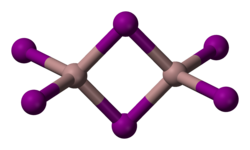
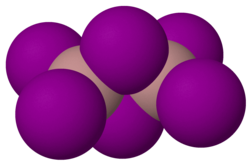
Gallium(III) iodide is the inorganic compound with the formula GaI3. A yellow hygroscopic solid, it is the most common iodide of gallium.3 In the chemical vapor transport method of growing crystals of gallium arsenide uses iodine as the transport agent. In the solid state, it exists as the dimer Ga2I6, with a diborane structure.4 When vaporized, its forms GaI3 molecules of D3h symmetry where the Ga–I distance is 2.458 Angstroms.5
Gallium triiodide can be reduced with gallium metal to give a green-colored gallium(I) iodide. The nature of this species is unclear, but it is useful for the preparation of gallium(I) and gallium(II) compounds.67
Gallium triiodide is a lewis acid, readily reacting with iodides to form the [GaI₄]⁻ anion.
Gallium triiodide needs to be prepared under anhydrous conditions because it reacts with water to form gallium hydroxide and hydrogen iodide:
GaI₃ + 3H₂O → Ga(OH)₃ + 3HI
References
References
- Haynes, p. 4.63
- Haynes, p. 5.20
- Donges, E. (1963). "Gallium(III) Iodide". In Brauer, G. (ed.). Handbook of Preparative Inorganic Chemistry, 2nd Ed. Vol. 1. NY, NY: Academic Press. p. 846.
- Brünig, C.; Locmelis, S.; Milke, E.; Binnewies, M. (2006). "Chemischer Transport fester Lösungen. 27. Mischphasenbildung und chemischer Transport im System Zn Se/Ga As". Zeitschrift für Anorganische und Allgemeine Chemie. 632 (6): 1067–1072. doi:10.1002/zaac.200600008.
- Haynes, p. 9.23
- Baker, Robert J.; Jones, Cameron (2005). ""GaI": A versatile reagent for the synthetic chemist". Dalton Trans (8): 1341–1348. doi:10.1039/b501310k. hdl:2262/69572. PMID 15824768.
- Green, Shaun P.; Jones, Cameron; Stasch, Andreas; Rose, Richard P. (2007). "'GaI': A new reagent for chemo- and diastereoselective C–C bond forming reactions". New J. Chem. 31: 127–134. doi:10.1039/b613669a.
Cited sources
- Haynes, William M., ed. (2016). CRC Handbook of Chemistry and Physics (97th ed.). CRC Press. ISBN 9781498754293.