| Fourknocks Passage Tomb | |
|---|---|
| Tuama Pasáiste na bhFuarchnoc | |
 The passage grave in 2007 | |
Location in Ireland | |
| 53°35′48″N 6°19′35″W / 53.596583°N 6.326479°W / 53.596583; -6.326479 | |
| Type | Passage grave |
| Location | Fourknocks, Stamullen, County Meath, Ireland |
| History | |
| Built | c. 2750 BC |
| Site notes | |
| Material | Stone |
| Elevation | 149 m (489 ft) |
| Area | Delvin Valley |
| Discovered | 1949 |
Official name | Fourknocks Passage Tomb |
| Reference no. | 472 |
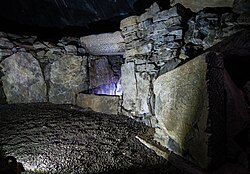
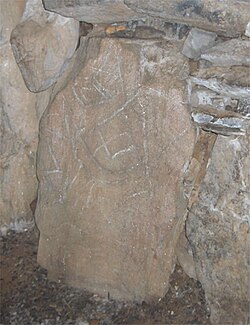
Fourknocks Passage Tomb is a passage grave and National Monument located in County Meath, Ireland.
Location
is located 2.7 km (1.7 mi) northwest of Naul, near a hilltop overlooking the Delvin River. The placename means either "cold hill" or "bare/exposed hill."1
History
Fourknocks Passage Tomb dates to 3000–2500 BC.
It was unknown to archaeology until 1949, when a woman making a visit to Newgrange mentioned, "there are mounds like this on my uncle’s farm." It is not marked on any of the old Ordnance Survey maps. It was first excavated from 1950 to 1952 by PJ Hartnett. He found cists, grave goods including a foot bowl and a carved antler pin, urns containing cremated remains and a posthole. Unlike other passage graves, the tomb at Fourknocks is not believed to have been covered over with stones. A wooden pole may have held up a wooden or animal-skin roof.
During reconstruction after excavation, a concrete roof was placed over the chamber for protection.2
Description
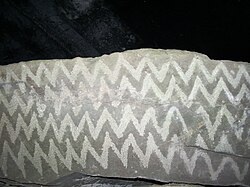
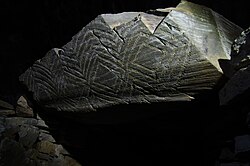
Fourknocks has a 17 foot long passage leading into a wide, pear-shaped chamber (18 X 21 ft) with three smaller offset chambers. Fourknocks has a strong similarity to Cairn L at Loughcrew.3 The original roof was likely a wooden structure supported by a central pole.4
Two of the lintels have chevron decoration and one of them has lozenge decoration.5
Two other mounds in the Fourknocks complex were excavated. One of these likely served as the cremation site for the bones found in the main tomb and was used for later interments.678
References
References
- "Na Fuarchnoic/Fourknocks".
- "Fourknocks".
- Meehan, Cary (2004). Sacred Ireland. Somerset: Gothic Image Publications. p. 268. ISBN 0 906362 43 1.
- "Fourknocks Megalithic Passage Tomb Tours".
- "Fourknocks Passage Tomb".
- "Fourknocks - Voices from the Dawn".
- "Fourknocks Megalithic Passage Tomb - Ireland".
- "Fourknocks".