| Four Perils | |||||||
|---|---|---|---|---|---|---|---|
    | |||||||
| Chinese name | |||||||
| Chinese | 四凶 | ||||||
| Literal meaning | Four Perils | ||||||
| |||||||
| Japanese name | |||||||
| Kanji | 四凶 | ||||||
| Hiragana | しきょう | ||||||
| |||||||
| Si Zui | |||||||
|---|---|---|---|---|---|---|---|
 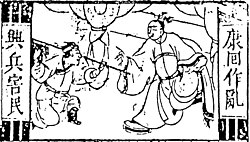 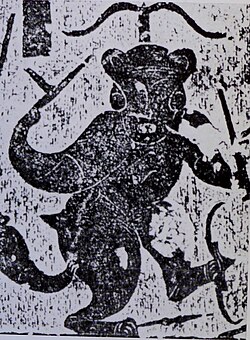  Clockwise: Huandou as seen in the Classic of Mountains and Seas, Gonggong at war with Zhurong, Gun in small seal script, and Chi You, the progenitor of the Sanmiao tribe. | |||||||
| Chinese name | |||||||
| Chinese | 四罪 | ||||||
| Literal meaning | Four Evildoers Four Criminals | ||||||
| |||||||
| Japanese name | |||||||
| Kanji | 四罪 | ||||||
| Hiragana | しざい | ||||||
| |||||||
The Four Perils (Chinese: 四凶; pinyin: Sì Xiōng) are four malevolent beings that exist in Chinese mythology.
Book of Documents
The Four Criminals (四罪; Sì Zuì) are a set of individuals who caused great trouble for the rule of Emperor Yao of the Taotang clan and Emperor Shun of the Youyu clan.12 Three of the criminals are of the Sanmiao tribe: Huandou, Gonggong, and the tribe itself. The last criminal, Gun, was of the Youxia clan. Gun's son would go on to found the Xia dynasty, having fulfilled his father's legacy of controlling the floods.1
According to the Bamboo Annals, Gonggong was the first of several individuals tasked with managing the Great Flood. This occurred during Emperor Yao's 19th year.3 He failed, and this forced Yao to consult the Four Mountains for advice. According to the Canon of Yao in the Book of Documents, Huandou was seemingly surprised at the inadequacy of Gonggong, and Gun was recommended instead. Yao begrudgingly agreed, and so Gun went to manage the cataclysm. After nine years, no progress was made. His son, Yu, would be recommended to finish the job, and succeeded, thus being named Yu the Great. Gonggong and Gun would be exiled far away from Emperor Yao's territory for their incompetence. In response, Huandou would rebel against the Taotang and Youyu clan's increasing influence over the region, which resulted in him being defeated several times by Yu the Great during Emperor Shun's reign, which would put an end to the Sanmiao tribe. After this, the three, and the broader tribe, would be labelled as the Four Criminals.41
Zuo Zhuan, Shanhaijing, and Shenyijing
In the Zuo Zhuan,56 Shanhaijing, and Shenyijing, the Four Perils (Sì Xiōng) are defined as:
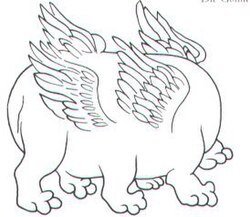
- Hundun (渾敦, 混沌; Hùndùn; 'chaotic torrent'a), a yellow winged creature of chaos with six legs and no face;78
- Qiongqi (窮奇; Qióngqí; 'distressingly strange', 'thoroughly odd'), a monstrous creature that eats people,910
- Taowu (檮杌; Táowù; 'block stump'), a reckless, stubborn creature;11 The Taowu is said to appear with "a human face, a tiger's feet, a pig's tusks and a tail 18 feet long."1213
- Taotie (饕餮; Tāotiè; 'greedy glutton'), a gluttonous beast.14
However, the Zuo Zhuan does not describe these four beings as mythological beasts, but instead as "historical" persons. Hundun is said to have descended from Emperor Hong, Qiongqi from Shaohao, Taowu from Zhuanxu, and Taotie from the Jinyun lineage.15
Identification
Zhang Shoujie's Correct Meanings of the Record of the Grand Historian (史記正義; Shǐjì Zhèngyì) identifies Huandou with Hundun (渾沌), Gonggong with Qiongqi (窮竒), Gun with Taowu (檮杌), and the Sanmiao (三苗) with Taotie (饕餮).16
Notes
Notes
References
References
- Book of Documents "Canon of Shun" quote: “流共工于幽洲,放驩兜于崇山,竄三苗于三危,殛鯀于羽山,四罪而天下咸服。”
- Shiji "Annals of the Five Emperors" "請流共工於幽陵,以變北狄;放讙兜於崇山,以變南蠻;遷三苗於三危,以變西戎;殛鯀於羽山,以變東夷:四罪而天下咸服。"
- Sturgeon, Donald (ed.). "帝堯陶唐氏". 竹書紀年 [Bamboo Annals] (in Literary Chinese). Chinese Text Project.
十九年,命共工治河。
- Fu, Sheng. "堯典". In Sturgeon, Donald (ed.). 尚書 [Book of Documents] (in Literary Chinese). Chinese Text Project.
- Shiji "Annals of the Five Emperors" quote: "昔帝鴻氏有不才子,掩義隱賊,好行凶慝,天下謂之渾沌。少暤氏有不才子,毀信惡忠,崇飾惡言,天下謂之窮奇。顓頊氏有不才子,不可教訓,不知話言,天下謂之梼杌。此三族世憂之。至于堯,堯未能去。縉云氏有不才子,貪于飲食,冒于貨賄,天下謂之饕餮。天下惡之,比之三凶。舜賓於四門,乃流四凶族,遷于四裔,以御螭魅,於是四門辟,言毋凶人也。"
- Zuo zhuan "Duke Wen" quote: "舜臣堯,賓于四門,流四凶族,渾敦,窮奇,檮杌,饕餮, 投諸四裔,以禦魑魅,". translation: "When Shun became Yao's minister, he received the nobles from the four quarters of the empire, and banished these four wicked ones, Chaos (Hundun 渾敦), Monster (Qiongqi 窮奇), Block (Taowu 檮杌), and Glutton (Taotie 饕餮), casting them out into the four distant regions, to meet the spite of the sprites and evil things (Chimei 魑魅)."
- Shanhaijing "Classic of the West Mountains" quote: "有神焉,其狀如黃囊,赤如丹火,六足四翼,渾敦無面目,是識歌舞,實惟帝江也。"
- Shenyijing "Classic of the West Wilderness: Ten Examples" quote: "崑崙西有獸焉,其狀如犬,長毛四足,似羆而無爪,有目而不見,行不開。有兩耳而不聞,有人知往。有腹無五臟,有腸直而不旋,食物徑過。人有德行而往牴觸之。有凶德則往依憑之。天使其然,名為渾沌。《春秋》云:渾沌,帝鴻氏不才子也。空居無為,常咋其尾,回轉仰天而笑。"
- Shanhaijing "Classic of the West Mountains" quote: "其上有獸焉,其狀如牛,蝟毛,名曰窮奇,音如獋狗,是食人。"
- Shenyijing "Classic of the Northwest WIlderness: Six Examples" quote: "西北有獸焉,狀似虎,有翼能飛,便剿食人。知人言語,聞人鬥,輒食直者;聞人忠信,輒食其鼻;聞人惡逆不善,輒殺獸往饋之。名曰窮奇,亦食諸禽獸也。"
- Shenyijing, "Classic of the West Wilderness: Ten Examples" quote: "西方荒中有獸焉,其狀如虎而犬毛,長二尺,人面虎足,豬口牙,尾長一丈八尺,攪亂荒中,名檮杌,一名傲狠,一名難訓。《春秋》雲顓頊氏有不才子名檮杌是也。"
- 東方朔. (in Chinese) – via Wikisource.
西方荒中有獸焉,其狀如虎而犬毛,長二尺,人面虎足,猪口牙,尾長一丈八尺,攪乱荒中,名梼杌,一名傲狠,一名難訓。《春秋》云顓頊氏有不才子名梼杌是也。
- Dongfang 東方, Shuo 朔 (2022). 神异经. Chengdou: 巴蜀书社 [Bashu Book Club]. ISBN 978-7-5531-1784-3.
- Shenyijing, "Classic of the Southwest Wilderness: Three Examples" quote: "西方荒中有獸焉,其狀如虎而犬毛,長二尺,人面虎足,豬口牙,尾長一丈八尺,攪亂荒中,名檮杌,一名傲狠,一名難訓。《春秋》雲顓頊氏有不才子名檮杌是也。"
- Durrant, Stephen W.; Li, Wai-yee; Schaberg, David, eds. (2016). Zuo tradition =: Zuozhuan: commentary on the "Spring and autumn annals". Classics of Chinese thought. Seattle: University of Washington Press. p. 574. ISBN 978-0-295-99915-9.
- Shiji Zhengyi "Volume 1" Siku Quanshu version, Zhejiang university's copy p. 133 pf 156