| Forest Sandstone | |
|---|---|
| Stratigraphic range: Hettangian-Sinemurian ~ | |
 | |
| Type | Geological formation |
| Unit of | Karoo Supergroup Upper Karoo Group |
| Underlies | Batoka Formation |
| Overlies | Pebbly Arkose Formation |
| Lithology | |
| Primary | Sandstone |
| Location | |
| Coordinates | 20°00′S 28°24′E / 20.0°S 28.4°E / -20.0; 28.4 |
| Approximate paleocoordinates | 35°00′S 5°06′E / 35.0°S 5.1°E / -35.0; 5.1 |
| Region | South-central Africa |
| Country | Botswana Zambia Zimbabwe |
| Type section | |
| Named for | Forests of Nyamandlovu District, Zimbabwe |
| Named by | A.M. MacGregor, Zimbabwe Geological Survey |
Forest Sandstone (Zimbabwe) | |
The Forest Sandstone is a geological formation in southern Africa, dating to roughly between 200 and 190 million years ago and covering the Hettangian to Sinemurian stages of the Jurassic Period in the Mesozoic Era.1 As its name suggests, it consists mainly of sandstone.
Fossils of the prosauropod dinosaur Massospondylus and the primitive sauropod Vulcanodon have been recovered from the Forest Sandstone.
Geology
Description
The formation is a sedimentary unit, consisting mainly of aeolian sands and silts with interbedded fluvial sediments,2 laid down during a period of increasing aridity.3
Extent
The Forest Sandstone is found in Botswana, Zambia and Zimbabwe, in the Mid-Zambezi, Mana Pools, Cabora Bassa and Limpopo Basins,4567 with its greatest thickness in the Cabora Bassa Basin.8
Deposition
Age
The formation is dated at 200 to 190 Ma.1
Stratigraphy
The Forest Sandstone is the penultimate formation in the Upper Karoo Group of the Karoo Supergroup, lying above the Pebbly Arkose Formation and below the Batoka Formation.7 In the Thuli Basin it is sometimes referred to as the Samkoto Formation.9
The Forest Sandstone has been correlated to the Clarens Formation of the Great Karoo Basin in South Africa.578
Fossil content
Archosaurs
Color key
|
Notes Uncertain or tentative taxa are in small text; |
- Protosuchia
| Protosuchians of the Forest Sandstone Formation | |||||
|---|---|---|---|---|---|
| Genus | Species | Presence | Materials | Notes | Images |
| Protosuchidae | indeterminate | Geographically located in Matabeleland North, Zimbabwe. | unknown protosuchid crocodile10 | ||
- Sphenodontia
| Sphenodontians of the Forest Sandstone Formation | |||||
|---|---|---|---|---|---|
| Genus | Species | Presence | Materials | Notes | Images |
| Clevosaurus10 | indeterminate | Unspecified, Zimbabwe | |||
Dinosaurs
Color key
|
Notes Uncertain or tentative taxa are in small text; |
- Sauropodomorphia
| Sauropodomorphs of the Forest Sandstone Formation | |||||
|---|---|---|---|---|---|
| Genus | Species | Presence | Materials | Notes | Images |
| Massospondylus11 | M. carinatus11 | Geographically located in Matabeleland North, Zimbabwe.11 | a sauropodomorph | 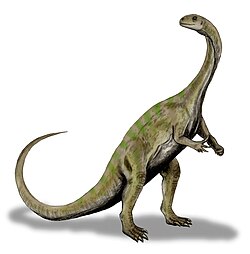 | |
| Vulcanodon1213 | V. karibaensis | Geographically located in the Bumi Hills area and the Sibilobilo Islands, in Kariba (District), Mashonaland West, Zimbabwe | Partial skeleton and scapula | A sauropodomorph |  |
| Prosauropoda11 | Indeterminate 11 | Geographically located in Matabeleland North, Zimbabwe.11 | |||
- Theropods
| Theropods of the Forest Sandstone Formation | |||||
|---|---|---|---|---|---|
| Genus | Species | Presence | Materials | Notes | Images |
| Megapnosaurus11 | M. rhodesiensis11 | Geographically located in Nyamandhlovu area, Tsholotsho District, Matabeleland North, Zimbabwe.11 | A coelophysid theropod, formally referred to as Syntarsus by Weishampel et al.11 | 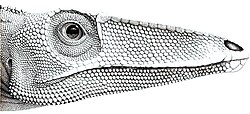 | |
Economic importance
Hydrogeology
The Forest Sandstone is the major groundwater-bearing unit of the Upper Karoo Group.14
References
References
- "Forest Sandstone Formation". Paleobiology Database. Retrieved 2010-01-03.
- Danielsen, Jens E.; Dahlin, Torleif; Owen, Richard; Mangeya, Pride; Auken, Esben (2007). "Geophysical and hydrogeologic investigation of groundwater in the Karoo stratigraphic sequence at Sawmills in northern Matabeleland, Zimbabwe: a case history". Hydrogeology Journal. 15 (5): 945. Bibcode:2007HydJ...15..945D. doi:10.1007/s10040-007-0191-z. S2CID 2059067.
- Maurice E. Tucker; Michael J. Benton (1982). "Triassic environments, climate and reptile evolution" (PDF). Palaeogeography, Palaeoclimatology, Palaeoecology. 40 (4): 361–379. Bibcode:1982PPP....40..361T. doi:10.1016/0031-0182(82)90034-7. Archived from the original (PDF) on 2009-01-26. Retrieved 2010-01-08.
- Bordy, Emese M.; Catuneanu, Octavian (2001). "Sedimentology of the upper Karoo fluvial strata in the Tuli Basin, South Africa". Journal of African Earth Sciences. 33 (3–4): 605. Bibcode:2001JAfES..33..605B. doi:10.1016/S0899-5362(01)00090-2.
- d'Engelbronner, E.R. (1996). "New palynological data from Karoo sediments, Mana Pools basin, northern Zimbabwe". Journal of African Earth Sciences. 23 (1): 17–30. Bibcode:1996JAfES..23...17D. doi:10.1016/S0899-5362(96)00049-8.
- Jones, D. L.; Duncan, R. A.; Briden, J. C.; Randall, D. E.; MacNiocaill, C. (2001). "Age of the Batoka basalts, northern Zimbabwe, and the duration of Karoo Large Igneous Province magmatism". Geochemistry, Geophysics, Geosystems. 2 (2): n/a. Bibcode:2001GGG.....2.1022J. doi:10.1029/2000GC000110.
- Nyambe, Imasiku A.; Utting, John (1997). "Stratigraphy and palynostratigraphy, Karoo Supergroup (Permian and Triassic), mid-Zambezi Valley, southern Zambia". Journal of African Earth Sciences. 24 (4): 563. Bibcode:1997JAfES..24..563N. doi:10.1016/S0899-5362(97)00081-X.
- Catuneanu, O.; Wopfner, H.; Eriksson, P.G.; Cairncross, B.; Rubidge, B.S.; Smith, R.M.H.; Hancox, P.J. (2005). "The Karoo basins of south-central Africa". Journal of African Earth Sciences. 43 (1–3): 211–253. Bibcode:2005JAfES..43..211C. doi:10.1016/j.jafrearsci.2005.07.007.
- Rogers, Raymond R.; Rogers, Kristina Curry; Munyikwa, Darlington; Terry, Rebecca C.; Bradley s.Singer (2004). "Sedimentology and taphonomy of the upper Karoo-equivalent Mpandi Formation in the Tuli Basin of Zimbabwe, with a new 40Ar/39Ar age for the Tuli basalts" (PDF). Journal of African Earth Sciences. 40 (3–4): 147. Bibcode:2004JAfES..40..147R. doi:10.1016/j.jafrearsci.2004.11.004.
- Paul E. Olsen; Peter M. Galton (1984). "A review of the reptile and amphibian assemblages from the Stromberg of southern Africa, with special emphasis on the footprints and age of the Stromberg" (PDF). Palaeont. Afr. 25: 87–110.
- Weishampel, David B; et al. (2004). "Dinosaur distribution (Early Jurassic, Africa)." In: Weishampel, David B.; Dodson, Peter; and Osmólska, Halszka (eds.): The Dinosauria, 2nd, Berkeley: University of California Press. Pp. 535–536. ISBN 0-520-24209-2.
- Viglietti, Pia A.; Barrett, Paul M.; Broderick, Tim J.; Munyikwa, Darlington; MacNiven, Rowan; Broderick, Lucy; Chapelle, Kimberley; Glynn, Dave; Edwards, Steve (January 2018). "Stratigraphy of the Vulcanodon type locality and its implications for regional correlations within the Karoo Supergroup". Journal of African Earth Sciences. 137: 149–156. Bibcode:2018JAfES.137..149V. doi:10.1016/j.jafrearsci.2017.10.015. ISSN 1464-343X.
- M.A. Raath (1972). "Fossil vertebrate studies in Rhodesia: a new dinosaur (Reptilia: Saurischia) from near the Triassic-Jurassic boundary". Arnoldia. 5.
- Larsen, Flemming; R. Owen; T. Dahlin; P. Mangeya; G. Barmen (2002). "A preliminary analysis of the groundwater recharge to the Karoo formations, mid-Zambezi basin, Zimbabwe" (PDF). Physics and Chemistry of the Earth. 27 (11–22): 765–772. Bibcode:2002PCE....27..765L. doi:10.1016/s1474-7065(02)00064-5. Archived from the original (PDF) on 2011-08-20.