
Forcipules are the modified, pincer-like front legs of centipedes that are used to inject venom into prey.12 They are the only known examples of front legs acting as venom injectors.13
Nomenclature
Forcipules go by a variety of names in both scientific and colloquial usages. They are sometimes known as poison-claws or jaw legs,4 referencing their evolution from maxillipeds, a term which they are also sometimes known by in the context of centipedes (maxillipeds, maxillipedes). Other names include prehensors, telopodites, and forcipulae (singular forcipula).56 In the specific case in which the forcipules are used to inject venom, they are called toxicognaths (from English toxic 'toxic' and Ancient Greek γνάθος (gnathos) 'jaw') 7
The term forcipule references their similarity with forceps.1

Anatomy, systematics, and variation
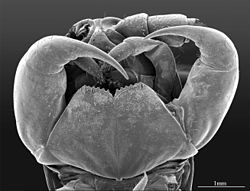
Forcipules evolved from the maxillipeds - front-legs - of centipedes' last common ancestor, believed to be somewhat Scutigeromorph-like. They were initially leg-like, then progressed into a more pincer or claw-like shape, as seen today, and became restricted to horizontal movement.1 The forcipules of modern Scutigeromorphs are the most significantly different in shape: they are more leg-like, and cannot hold prey in the way that they are used among other orders: they are used for envenomation only, making their use more comparable to a knife than a pincer.8
References
References
- Dugon, Michel M.; Black, Alexander; Arthur, Wallace (2012-05-01). "Variation and specialisation of the forcipular apparatus of centipedes (Arthropoda: Chilopoda): A comparative morphometric and microscopic investigation of an evolutionary novelty". Arthropod Structure & Development. 41 (3): 231–243. doi:10.1016/j.asd.2012.02.001. ISSN 1467-8039. PMID 22370199.
- "Are Centipedes Poisonous? | Do Centipedes Bite or Sting? | Orkin". www.orkin.com. Retrieved 2022-08-23.
- Shelley, Rowland M. (March 1999). "Centipedes and Millipedes with Emphasis on North American Fauna". Kansas School Naturalist. 45 (3): 3–16. CiteSeerX 10.1.1.365.8963. Archived from the original on 2016-11-12.
- "Molecular Expressions: Science, Optics & You - Olympus MIC-D: Oblique Gallery - Centipede Poison Claws". micro.magnet.fsu.edu. Retrieved 2022-09-05.
- Shelley, Rowland M (March 1999). "Centipedes and Millipedes with an emphasis on North American fauna". The Kansas School Naturalist. 45 (3): 3–15. ISSN 0022-877X – via CiteSeerX.
- Bonato, Lucio; Edgecombe, Gregory; Lewis, John; Minelli, Alessandro; Pereira, Luis; Shelley, Rowland; Zapparoli, Marzio (2010-11-18). "A common terminology for the external anatomy of centipedes (Chilopoda)". ZooKeys (69): 17–51. doi:10.3897/zookeys.69.737. ISSN 1313-2970. PMC 3088443. PMID 21594038.
- "Definition of TOXICOGNATH". www.merriam-webster.com. Retrieved 2022-08-23.
- Dugon, Michel M. (2017), Malhotra, Anita (ed.), "Evolution, Morphology, and Development of the Centipede Venom System", Evolution of Venomous Animals and Their Toxins, Toxinology, Dordrecht: Springer Netherlands, pp. 261–278, doi:10.1007/978-94-007-6458-3_1, ISBN 978-94-007-6457-6, retrieved 2022-08-23
{{citation}}: CS1 maint: work parameter with ISBN (link)