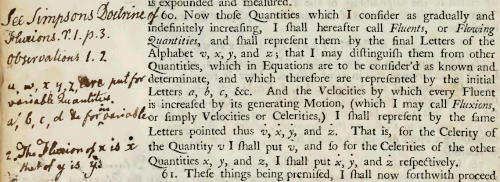
A fluxion is the instantaneous rate of change, or gradient, of a fluent (a time-varying quantity, or function) at a given point.1 Fluxions were introduced by Isaac Newton to describe his form of a time derivative (a derivative with respect to time). Newton introduced the concept in 1665 and detailed them in his mathematical treatise, Method of Fluxions.2 Fluxions and fluents made up Newton's early calculus.3
Example
If the fluent is defined as (where is time) the fluxion (derivative) at is:
Here is an infinitely small amount of time.4 So, the term is second order infinite small term and according to Newton, we can now ignore because of its second order infinite smallness comparing to first order infinite smallness of .5 So, the final equation gets the form:
He justified the use of as a non-zero quantity by stating that fluxions were a consequence of movement by an object.
Criticism
Bishop George Berkeley, a prominent philosopher of the time, denounced Newton's fluxions in his essay The Analyst, published in 1734.6 Berkeley refused to believe that they were accurate because of the use of the infinitesimal . He did not believe it could be ignored and pointed out that if it was zero, the consequence would be division by zero. Berkeley referred to them as "ghosts of departed quantities", a statement which unnerved mathematicians of the time and led to the eventual disuse of infinitesimals in calculus.
Towards the end of his life Newton revised his interpretation of as infinitely small, preferring to define it as approaching zero, using a similar definition to the concept of limit.7 He believed this put fluxions back on safe ground. By this time, Leibniz's derivative (and his notation) had largely replaced Newton's fluxions and fluents, and remains in use today.
See also
See also
- History of calculus
- Newton's notation
- Hyperreal number: A modern formalization of the reals that includes infinity and infinitesimals
- Nonstandard analysis
References
References
- Newton, Sir Isaac (1736). The Method of Fluxions and Infinite Series: With Its Application to the Geometry of Curve-lines. Henry Woodfall; and sold by John Nourse. Retrieved 6 March 2017.
- Weisstein, Eric W. "Fluxion". MathWorld.
- Fluxion at the Encyclopædia Britannica
- Buckmire, Ron. "History of Mathematics" (PDF). Retrieved 28 January 2017.
- "Isaac Newton (1642-1727)". www.mhhe.com. Retrieved 6 March 2017.
- Berkeley, George (1734). . London. p. 25 – via Wikisource.
- Kitcher, Philip (March 1973). "Fluxions, Limits, and Infinite Littlenesse. A Study of Newton's Presentation of the Calculus". Isis. 64 (1): 33–49. doi:10.1086/351042. S2CID 121774892.
Further reading
- Clegg, Brian (2003). "Chapter 9: Fluxion Wars". A Brief History of Infinity. London: Constable & Robinson. ISBN 9781841196503.