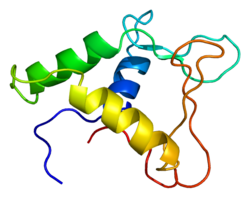
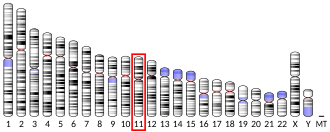






Friend leukemia integration 1 transcription factor (FLI1), also known as transcription factor ERGB, is a protein that in humans is encoded by the FLI1 gene, which is a proto-oncogene.567
Function
Fli-1 is a member of the ETS transcription factor family that was first identified in erythroleukemias induced by Friend Murine Leukemia Virus (F-MuLV). Fli-1 is activated through retroviral insertional mutagenesis in 90% of F-MuLV-induced erythroleukemias. The constitutive activation of fli-1 in erythroblasts leads to a dramatic shift in the Epo/Epo-R signal transduction pathway, blocking erythroid differentiation, activating the Ras pathway, and resulting in massive Epo-independent proliferation of erythroblasts. These results suggest that Fli-1 overexpression in erythroblasts alters their responsiveness to Epo and triggers abnormal proliferation by switching the signaling event(s) associated with terminal differentiation to proliferation.
Clinical significance
In addition to Friend erythroleukemia, proviral integration at the fli-1 locus also occurs in leukemias induced by the 10A1, Graffi, and Cas-Br-E viruses. Fli-1 aberrant expression is also associated with chromosomal abnormalities in humans. In pediatric Ewing's sarcoma a chromosomal translocation generates a fusion of the 5' transactivation domain of EWSR1 (also known as EWS) with the 3' Ets domain of Fli-1. The resulting fusion oncoprotein, EWS/Fli-1, acts as an aberrant transcriptional activator.8 with strong transforming capabilities. EWS/Fli-1 may steer clinically important genes via interaction with enhancer-like GGAA-microsatellites.9 The importance of Fli-1 in the development of human leukemia, such as acute myelogenous leukemia (AML), has been demonstrated in studies of translocation involving the Tel transcription factor, which interacts with Fli-1 through protein-protein interactions. A recent study has demonstrated high levels of Fli-1 expression in several benign and malignant neoplasms using immunohistochemistry.
A possible association with Paris-Trousseau syndrome has been suggested.10
References
References
- GRCh38: Ensembl release 89: ENSG00000151702 – Ensembl, May 2017
- GRCm38: Ensembl release 89: ENSMUSG00000016087 – Ensembl, May 2017
- "Human PubMed Reference:". National Center for Biotechnology Information, U.S. National Library of Medicine.
- "Mouse PubMed Reference:". National Center for Biotechnology Information, U.S. National Library of Medicine.
- Baud V, Lipinski M, Rassart E, Poliquin L, Bergeron D (September 1991). "The human homolog of the mouse common viral integration region, FLI1, maps to 11q23-q24". Genomics. 11 (1): 223–4. doi:10.1016/0888-7543(91)90124-W. PMID 1765382.
- Prasad DD, Rao VN, Reddy ES (October 1992). "Structure and expression of human Fli-1 gene". Cancer Research. 52 (20): 5833–7. PMID 1394211.
- Rao VN, Ohno T, Prasad DD, Bhattacharya G, Reddy ES (August 1993). "Analysis of the DNA-binding and transcriptional activation functions of human Fli-1 protein". Oncogene. 8 (8): 2167–73. PMID 8336942.
- Ohno T, Rao VN, Reddy ES (December 1993). "EWS/Fli-1 chimeric protein is a transcriptional activator". Cancer Research. 53 (24): 5859–63. PMID 7503813.
- Musa J, Cidre-Aranaz F, Aynaud MM, Orth MF, Mirabeau O, Varon M, Grossetête S, Surdez D, Ohmura S, Gerke JS, Marchetto A (2019). "Cooperation of cancer drivers with regulatory germline variants shapes clinical outcomes". Nature Communications. 10 (1) 4128. Bibcode:2019NatCo..10.4128M. bioRxiv 10.1101/506659. doi:10.1038/s41467-019-12071-2. PMC 6739408. PMID 31511524.
- Raslova H, Komura E, Le Couédic JP, Larbret F, Debili N, Feunteun J, et al. (July 2004). "FLI1 monoallelic expression combined with its hemizygous loss underlies Paris-Trousseau/Jacobsen thrombopenia". The Journal of Clinical Investigation. 114 (1): 77–84. doi:10.1172/JCI21197. PMC 437972. PMID 15232614.
Further reading
Further reading
- Ben-David Y, Giddens EB, Bernstein A (February 1990). "Identification and mapping of a common proviral integration site Fli-1 in erythroleukemia cells induced by Friend murine leukemia virus". Proceedings of the National Academy of Sciences of the United States of America. 87 (4): 1332–6. Bibcode:1990PNAS...87.1332B. doi:10.1073/pnas.87.4.1332. PMC 53469. PMID 2304901.
- Ben-David Y, Giddens EB, Letwin K, Bernstein A (June 1991). "Erythroleukemia induction by Friend murine leukemia virus: insertional activation of a new member of the ets gene family, Fli-1, closely linked to c-ets-1". Genes & Development. 5 (6): 908–18. doi:10.1101/gad.5.6.908. PMID 2044959.
- Delattre O, Zucman J, Plougastel B, Desmaze C, Melot T, Peter M, et al. (September 1992). "Gene fusion with an ETS DNA-binding domain caused by chromosome translocation in human tumours". Nature. 359 (6391): 162–5. Bibcode:1992Natur.359..162D. doi:10.1038/359162a0. PMID 1522903. S2CID 4331584.
- Pereira R, Quang CT, Lesault I, Dolznig H, Beug H, Ghysdael J (February 1999). "FLI-1 inhibits differentiation and induces proliferation of primary erythroblasts". Oncogene. 18 (8): 1597–608. doi:10.1038/sj.onc.1202534. PMID 10102630. S2CID 25190024.
- Tamir A, Howard J, Higgins RR, Li YJ, Berger L, Zacksenhaus E, et al. (June 1999). "Fli-1, an Ets-related transcription factor, regulates erythropoietin-induced erythroid proliferation and differentiation: evidence for direct transcriptional repression of the Rb gene during differentiation". Molecular and Cellular Biology. 19 (6): 4452–64. doi:10.1128/mcb.19.6.4452. PMC 104404. PMID 10330185.
- Zochodne B, Truong AH, Stetler K, Higgins RR, Howard J, Dumont D, et al. (May 2000). "Epo regulates erythroid proliferation and differentiation through distinct signaling pathways: implication for erythropoiesis and Friend virus-induced erythroleukemia". Oncogene. 19 (19): 2296–304. doi:10.1038/sj.onc.1203590. PMID 10822380. S2CID 7468572.
- Starck J, Doubeikovski A, Sarrazin S, Gonnet C, Rao G, Skoultchi A, et al. (January 1999). "Spi-1/PU.1 is a positive regulator of the Fli-1 gene involved in inhibition of erythroid differentiation in friend erythroleukemic cell lines". Molecular and Cellular Biology. 19 (1): 121–35. doi:10.1128/mcb.19.1.121. PMC 83871. PMID 9858537.
- Truong AH, Ben-David Y (December 2000). "The role of Fli-1 in normal cell function and malignant transformation". Oncogene. 19 (55): 6482–9. doi:10.1038/sj.onc.1204042. PMID 11175364. S2CID 28146474.
- Ohno T, Rao VN, Reddy ES (December 1993). "EWS/Fli-1 chimeric protein is a transcriptional activator". Cancer Research. 53 (24): 5859–63. PMID 7503813.
- Dhulipala PD, Lee L, Rao VN, Reddy ES (September 1998). "Fli-1b is generated by usage of differential splicing and alternative promoter". Oncogene. 17 (9): 1149–57. doi:10.1038/sj.onc.1202030. PMID 9764825.
- Rao VN, Ohno T, Prasad DD, Bhattacharya G, Reddy ES (August 1993). "Analysis of the DNA-binding and transcriptional activation functions of human Fli-1 protein". Oncogene. 8 (8): 2167–73. PMID 8336942.
- Ban J, Siligan C, Kreppel M, Aryee D, Kovar H (2006). "Ews-Fli1 in Ewing's Sarcoma: Real Targets and Collateral Damage". New trends in cancer for the 21st century. Advances in Experimental Medicine and Biology. Vol. 587. pp. 41–52. doi:10.1007/978-1-4020-5133-3_4. ISBN 978-1-4020-4966-8. PMID 17163154.
- Prasad DD, Rao VN, Reddy ES (October 1992). "Structure and expression of human Fli-1 gene". Cancer Research. 52 (20): 5833–7. PMID 1394211.
- Watson DK, Smyth FE, Thompson DM, Cheng JQ, Testa JR, Papas TS, Seth A (October 1992). "The ERGB/Fli-1 gene: isolation and characterization of a new member of the family of human ETS transcription factors". Cell Growth & Differentiation. 3 (10): 705–13. PMID 1445800.
- Delattre O, Zucman J, Plougastel B, Desmaze C, Melot T, Peter M, et al. (September 1992). "Gene fusion with an ETS DNA-binding domain caused by chromosome translocation in human tumours". Nature. 359 (6391): 162–5. Bibcode:1992Natur.359..162D. doi:10.1038/359162a0. PMID 1522903. S2CID 4331584.
- Baud V, Lipinski M, Rassart E, Poliquin L, Bergeron D (September 1991). "The human homolog of the mouse common viral integration region, FLI1, maps to 11q23-q24". Genomics. 11 (1): 223–4. doi:10.1016/0888-7543(91)90124-W. PMID 1765382.
- Bergeron D, Poliquin L, Kozak CA, Rassart E (January 1991). "Identification of a common viral integration region in Cas-Br-E murine leukemia virus-induced non-T-, non-B-cell lymphomas". Journal of Virology. 65 (1): 7–15. doi:10.1128/JVI.65.1.7-15.1991. PMC 240483. PMID 1845910.
- Bhagirath T, Abe S, Nojima T, Yoshida MC (June 1995). "Molecular analysis of a t(11;22) translocation junction in a case of Ewing's sarcoma". Genes, Chromosomes & Cancer. 13 (2): 126–32. doi:10.1002/gcc.2870130209. PMID 7542907. S2CID 36929552.
- Liang H, Mao X, Olejniczak ET, Nettesheim DG, Yu L, Meadows RP, et al. (December 1994). "Solution structure of the ets domain of Fli-1 when bound to DNA". Nature Structural Biology. 1 (12): 871–5. doi:10.1038/nsb1294-871. PMID 7773776. S2CID 26261743.
- May WA, Lessnick SL, Braun BS, Klemsz M, Lewis BC, Lunsford LB, et al. (December 1993). "The Ewing's sarcoma EWS/FLI-1 fusion gene encodes a more potent transcriptional activator and is a more powerful transforming gene than FLI-1". Molecular and Cellular Biology. 13 (12): 7393–8. doi:10.1128/mcb.13.12.7393. PMC 364810. PMID 8246959.
- Hromas R, May W, Denny C, Raskind W, Moore J, Maki RA, et al. (February 1993). "Human FLI-1 localizes to chromosome 11Q24 and has an aberrant transcript in neuroepithelioma". Biochimica et Biophysica Acta (BBA) - Gene Structure and Expression. 1172 (1–2): 155–8. doi:10.1016/0167-4781(93)90283-J. PMID 8439553.
- Magnaghi-Jaulin L, Masutani H, Robin P, Lipinski M, Harel-Bellan A (March 1996). "SRE elements are binding sites for the fusion protein EWS-FLI-1". Nucleic Acids Research. 24 (6): 1052–8. doi:10.1093/nar/24.6.1052. PMC 145748. PMID 8604338.
- Barbeau B, Bergeron D, Beaulieu M, Nadjem Z, Rassart E (June 1996). "Characterization of the human and mouse Fli-1 promoter regions". Biochimica et Biophysica Acta (BBA) - Gene Structure and Expression. 1307 (2): 220–32. doi:10.1016/0167-4781(96)00060-7. PMID 8679708.
- Watson DK, Robinson L, Hodge DR, Kola I, Papas TS, Seth A (January 1997). "FLI1 and EWS-FLI1 function as ternary complex factors and ELK1 and SAP1a function as ternary and quaternary complex factors on the Egr1 promoter serum response elements". Oncogene. 14 (2): 213–21. doi:10.1038/sj.onc.1200839. PMID 9010223.
- Kwiatkowski BA, Bastian LS, Bauer TR, Tsai S, Zielinska-Kwiatkowska AG, Hickstein DD (July 1998). "The ets family member Tel binds to the Fli-1 oncoprotein and inhibits its transcriptional activity". The Journal of Biological Chemistry. 273 (28): 17525–30. doi:10.1074/jbc.273.28.17525. PMID 9651344.
- Carrère S, Verger A, Flourens A, Stehelin D, Duterque-Coquillaud M (June 1998). "Erg proteins, transcription factors of the Ets family, form homo, heterodimers and ternary complexes via two distinct domains". Oncogene. 16 (25): 3261–8. doi:10.1038/sj.onc.1201868. PMID 9681824. S2CID 26807714.
- Zucman-Rossi J, Legoix P, Victor JM, Lopez B, Thomas G (September 1998). "Chromosome translocation based on illegitimate recombination in human tumors". Proceedings of the National Academy of Sciences of the United States of America. 95 (20): 11786–91. Bibcode:1998PNAS...9511786Z. doi:10.1073/pnas.95.20.11786. PMC 21718. PMID 9751743.
- Dalgleish P, Sharrocks AD (January 2000). "The mechanism of complex formation between Fli-1 and SRF transcription factors". Nucleic Acids Research. 28 (2): 560–9. doi:10.1093/nar/28.2.560. PMC 102515. PMID 10606656.
- Knoop LL, Baker SJ (August 2000). "The splicing factor U1C represses EWS/FLI-mediated transactivation". The Journal of Biological Chemistry. 275 (32): 24865–71. doi:10.1074/jbc.M001661200. PMID 10827180.
- Spyropoulos DD, Pharr PN, Lavenburg KR, Jackers P, Papas TS, Ogawa M, Watson DK (August 2000). "Hemorrhage, impaired hematopoiesis, and lethality in mouse embryos carrying a targeted disruption of the Fli1 transcription factor". Molecular and Cellular Biology. 20 (15): 5643–52. doi:10.1128/MCB.20.15.5643-5652.2000. PMC 86032. PMID 10891501.
- Mastrangelo T, Modena P, Tornielli S, Bullrich F, Testi MA, Mezzelani A, et al. (August 2000). "A novel zinc finger gene is fused to EWS in small round cell tumor". Oncogene. 19 (33): 3799–804. doi:10.1038/sj.onc.1203762. PMID 10949935. S2CID 24580332.
External links
External links
- FLI1+protein,+human at the U.S. National Library of Medicine Medical Subject Headings (MeSH)
This article incorporates text from the United States National Library of Medicine, which is in the public domain.