| FitzHerbert baronets | |
|---|---|
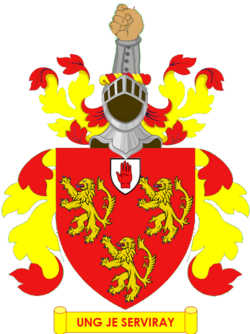 | |
| Crest | A dexter hand erect in an open gauntlet all Proper. |
| Shield | Gules three lions rampant Or. |
| Motto | Ung Je Serviray (One Will I Serve) 1 |
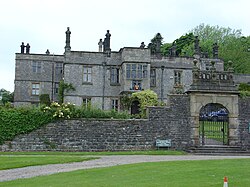
The FitzHerbert baronetcy, of Tissington in the County of Derby, is a title in the Baronetage of Great Britain. It was created on 22 January 1784 for William FitzHerbert, of Tissington Hall, Derbyshire.23
Successive baronets served as High Sheriff of Derbyshire in 1815, 1865, 1866 and 1940.34
Fitzherbert family history
The FitzHerberts descend from a Norman knight, Herbert, whose son was known by the patronymic filius Herberti in Latin and fils de Herbert in Norman French. They are related to the FitzHerberts of Swynnerton Hall, Staffordshire (see Baron Stafford).5
In 1125, William Fitz-Herbert was granted the tenancy of Norbury Manor in Norbury, Derbyshire. Nicholas FitzHerbert and his son Ralph purchased it from the priory in 1444. The senior male line of the family held the manor until selling it in 1881.67 The original charter from King Henry III of England in 1125 has survived.8
FitzHerbert baronets, of Tissington (1784)
- Sir William FitzHerbert, 1st Baronet (1748–1791)34
- Sir Anthony Perrin FitzHerbert, 2nd Baronet (1779–1798)34
- Sir Henry FitzHerbert, 3rd Baronet (1783–1858)34
- Sir William FitzHerbert, 4th Baronet (1808–1896)43
- Sir Richard FitzHerbert, 5th Baronet (1846–1906)349
- Sir Hugo Meynell FitzHerbert, 6th Baronet (1872–1934)410
- Sir William FitzHerbert, 7th Baronet (1874–1963)411
- Sir John Richard Frederick FitzHerbert, 8th Baronet (1913–1989), son of Henry FitzHerbert, Archdeacon of Derby, a younger son of the 5th Baronet12
- Sir Richard Ranulph FitzHerbert, 9th Baronet (born 1963)13
The heir to the baronetcy is the present holder's son, Frederick David FitzHerbert (born 1995).513
The document collection of the FitzHerbert family of Tissington is held by the Derbyshire Record Office.14
Extended family
Alleyne, a younger brother of the 1st Baronet, was created Baron St Helens in 1791 (Peerage of Ireland) and in 1801 (Peerage of the United Kingdom).5
References
References
- Debrett's peerage, baronetage, knightage, and companionage. 1878.
- "No. 12502". The London Gazette. 16 December 1783. p. 1.
- Cokayne, George Edward (1906). Complete Baronetage. Vol. V. Exeter: W. Pollard & Co., Ltd. pp. 245–246.
- Burke's Genealogical and Heraldic Dictionary of the Peerage, Baronetage and Knightage (99th ed.). London: Burke's Peerage Ltd. and Shaw Publishing. 1949. pp. 766–767.
- Mosley, Charles, ed. (2003). Burke's Peerage, Baronetage & Knighthood (107 ed.). Burke's Peerage & Gentry. pp. 1438–1441. ISBN 0-9711966-2-1.
- Society, Derbyshire Archaeological (1885). Journal of the Derbyshire Archaeological and Natural History Society. The Society. p. 221.
- Emery, Anthony (1996). Greater Medieval Houses of England and Wales, 1300-1500: Volume 2, East Anglia, Central England and Wales. Cambridge University Press. p. 426. ISBN 9780521581318.
- Burke, Bernard (1898). A Genealogical and Heraldic History of the Landed Gentry of Great Britain & Ireland. Harrison & sons. pp. 521–522. Retrieved 12 May 2018.
- "Fitzherbert, Rev. Sir Richard". Who's Who. A & C Black. (Subscription or UK public library membership required.)
- "Fitzherbert, Sir Hugo (Meynell)". Who's Who. A & C Black. (Subscription or UK public library membership required.)
- "Fitzherbert, Sir William". Who's Who. A & C Black. (Subscription or UK public library membership required.)
- "FitzHerbert, Sir John (Richard Frederick)". Who's Who. A & C Black. (Subscription or UK public library membership required.)
- "Fitzherbert, Sir Richard (Ranulph)". Who's Who. A & C Black. (Subscription or UK public library membership required.)
- "D239 - FitzHerbert family of Tissington". Derbyshire Records Office. Retrieved 28 June 2020.