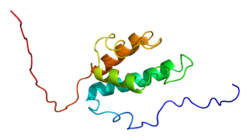
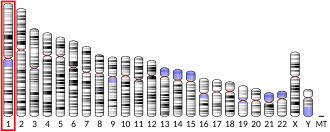




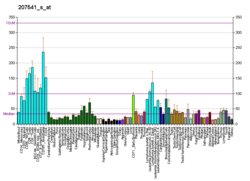
Exosome component 10, also known as EXOSC10, is a human gene, the protein product of which (sometimes called PM/Scl-100) is part of the exosome complex and is an autoantigen is patients with certain autoimmune diseases, most notably scleromyositis.5 Mutations of the gene can cause microcephaly.6
References
References
- GRCh38: Ensembl release 89: ENSG00000171824 – Ensembl, May 2017
- GRCm38: Ensembl release 89: ENSMUSG00000017264 – Ensembl, May 2017
- "Human PubMed Reference:". National Center for Biotechnology Information, U.S. National Library of Medicine.
- "Mouse PubMed Reference:". National Center for Biotechnology Information, U.S. National Library of Medicine.
- "Entrez Gene: EXOSC10 exosome component 10".
- Ulmke PA, et al. "EXOSC10 haploinsufficiency causes primary microcephaly by derepression of Sonic hedgehog signalling". Brain. Oxford Academic. doi:10.1093/brain/awaf405.
Further reading
Further reading
- Blüthner M, Bautz FA (1992). "Cloning and characterization of the cDNA coding for a polymyositis-scleroderma overlap syndrome-related nucleolar 100-kD protein". J. Exp. Med. 176 (4): 973–80. doi:10.1084/jem.176.4.973. PMC 2119404. PMID 1383382.
- Ge Q, Frank MB, O'Brien C, Targoff IN (1992). "Cloning of a complementary DNA coding for the 100-kD antigenic protein of the PM-Scl autoantigen". J. Clin. Invest. 90 (2): 559–70. doi:10.1172/JCI115895. PMC 443135. PMID 1644924.
- Allmang C, Petfalski E, Podtelejnikov A, et al. (1999). "The yeast exosome and human PM-Scl are related complexes of 3' --> 5' exonucleases". Genes Dev. 13 (16): 2148–58. doi:10.1101/gad.13.16.2148. PMC 316947. PMID 10465791.
- Brouwer R, Allmang C, Raijmakers R, et al. (2001). "Three novel components of the human exosome". J. Biol. Chem. 276 (9): 6177–84. doi:10.1074/jbc.M007603200. hdl:20.500.11820/a03680a4-cf3a-4827-805c-447483ff4b9f. PMID 11110791.
- Stover C, Endo Y, Takahashi M, et al. (2001). "The human gene for mannan-binding lectin-associated serine protease-2 (MASP-2), the effector component of the lectin route of complement activation, is part of a tightly linked gene cluster on chromosome 1p36.2-3". Genes Immun. 2 (3): 119–27. doi:10.1038/sj.gene.6363745. PMID 11426320. S2CID 23496123.
- Chen CY, Gherzi R, Ong SE, et al. (2002). "AU binding proteins recruit the exosome to degrade ARE-containing mRNAs". Cell. 107 (4): 451–64. doi:10.1016/S0092-8674(01)00578-5. PMID 11719186. S2CID 14817671.
- Raijmakers R, Noordman YE, van Venrooij WJ, Pruijn GJ (2002). "Protein-protein interactions of hCsl4p with other human exosome subunits". J. Mol. Biol. 315 (4): 809–18. doi:10.1006/jmbi.2001.5265. hdl:2066/261980. PMID 11812149.
- Brouwer R, Vree Egberts WT, Hengstman GJ, et al. (2002). "Autoantibodies directed to novel components of the PM/Scl complex, the human exosome". Arthritis Res. 4 (2): 134–8. doi:10.1186/ar389. PMC 83843. PMID 11879549.
- Raijmakers R, Egberts WV, van Venrooij WJ, Pruijn GJ (2002). "Protein-protein interactions between human exosome components support the assembly of RNase PH-type subunits into a six-membered PNPase-like ring". J. Mol. Biol. 323 (4): 653–63. doi:10.1016/S0022-2836(02)00947-6. hdl:2066/186665. PMID 12419256.
- Scherl A, Couté Y, Déon C, et al. (2003). "Functional proteomic analysis of human nucleolus". Mol. Biol. Cell. 13 (11): 4100–9. doi:10.1091/mbc.E02-05-0271. PMC 133617. PMID 12429849.
- Strausberg RL, Feingold EA, Grouse LH, et al. (2003). "Generation and initial analysis of more than 15,000 full-length human and mouse cDNA sequences". Proc. Natl. Acad. Sci. U.S.A. 99 (26): 16899–903. Bibcode:2002PNAS...9916899M. doi:10.1073/pnas.242603899. PMC 139241. PMID 12477932.
- Raijmakers R, Egberts WV, van Venrooij WJ, Pruijn GJ (2003). "The association of the human PM/Scl-75 autoantigen with the exosome is dependent on a newly identified N terminus". J. Biol. Chem. 278 (33): 30698–704. doi:10.1074/jbc.M302488200. hdl:2066/186428. PMID 12788944.
- Lejeune F, Li X, Maquat LE (2003). "Nonsense-mediated mRNA decay in mammalian cells involves decapping, deadenylating, and exonucleolytic activities". Mol. Cell. 12 (3): 675–87. doi:10.1016/S1097-2765(03)00349-6. PMID 14527413.
- Ota T, Suzuki Y, Nishikawa T, et al. (2004). "Complete sequencing and characterization of 21,243 full-length human cDNAs". Nat. Genet. 36 (1): 40–5. doi:10.1038/ng1285. PMID 14702039.
- Bouwmeester T, Bauch A, Ruffner H, et al. (2004). "A physical and functional map of the human TNF-alpha/NF-kappa B signal transduction pathway". Nat. Cell Biol. 6 (2): 97–105. doi:10.1038/ncb1086. PMID 14743216. S2CID 11683986.
- Raijmakers R, Renz M, Wiemann C, et al. (2004). "PM-Scl-75 is the main autoantigen in patients with the polymyositis/scleroderma overlap syndrome". Arthritis Rheum. 50 (2): 565–9. doi:10.1002/art.20056. PMID 14872500.
- Lehner B, Sanderson CM (2004). "A protein interaction framework for human mRNA degradation". Genome Res. 14 (7): 1315–23. doi:10.1101/gr.2122004. PMC 442147. PMID 15231747.
- Gerhard DS, Wagner L, Feingold EA, et al. (2004). "The status, quality, and expansion of the NIH full-length cDNA project: the Mammalian Gene Collection (MGC)". Genome Res. 14 (10B): 2121–7. doi:10.1101/gr.2596504. PMC 528928. PMID 15489334.
- van Dijk EL, Schilders G, Pruijn GJ (2007). "Human cell growth requires a functional cytoplasmic exosome, which is involved in various mRNA decay pathways". RNA. 13 (7): 1027–35. doi:10.1261/rna.575107. PMC 1894934. PMID 17545563.