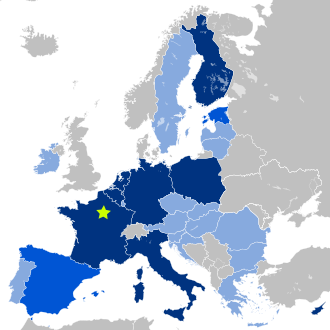
 Lead Nation
 European Secure Software-defined Radio (ESSOR) is a planned European Union (EU) Permanent Structured Cooperation project for the development of common technologies for European military software-defined radio systems, to guarantee the interoperability and security of voice and data communications between EU forces in joint operations, on a variety of platforms.123
History
The project was based on United States' Software Communications Architecture and Joint Tactical Radio System,4 to which Thales was a major contributor. Germany initially did not participate in ESSOR, developing instead its own SDR system, Streitkräftegemeinsame, verbundfähige Funkgerät-Ausstattung.5
Consortium
The work of development is being carried out by a consortium of private companies, one from each member country, including Thales (FR), Leonardo (IT), Indra Sistemas (SP), Radmor (PL), Bittium (FI) and Rohde & Schwarz (DE).
References
References
- "PESCO Overview of First Collaborative of projects for press" (PDF).
- Thomas Withington. Talking to Each Other. US Army and USMC Waveforms. // Military Technology. – 2018. - № 10. P. 70 - 73.
- "European Secure Software defined Radio (ESSOR) | PESCO". Retrieved 2024-09-19.
- "The French case study". The Transformation of the Armed Forces: 91–126. 2012.
- Zaitsev, I; Molev, A (2014). "NATO Countries' Military Radio Communications Systems: Development Prospects". Military Thought. 23 (1): 144–145.