| Euphaeidae | |
|---|---|

| |
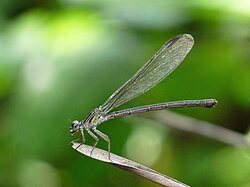
| Euphaea fraseri, male | |
| |
| Euphaea fraseri, female | |
Scientific classification 
| |
| Kingdom: | Animalia |
| Phylum: | Arthropoda |
| Clade: | Pancrustacea |
| Class: | Insecta |
| Order: | Odonata |
| Suborder: | Zygoptera |
| Superfamily: | Euphaeoidea |
| Family: | Euphaeidae Selys, 18531 |
| Subfamilies | |
| |
| Synonyms2 | |
| |
Euphaeidae, commonly known as gossamerwings, is a family of damselflies in the superfamily Euphaeoidea, found from southern Europe across tropical and eastern Asia to New Guinea. The family contains about 80 living species in nine genera, most of which inhabit forest streams and rivers.34
Euphaeids are among the largest damselflies and are often strikingly coloured, with metallic bodies and patterned wings. Although they resemble the better-known broad-winged damselflies of the family Calopterygidae, they can be distinguished by their densely veined wings and by the unique larvae, which possess additional pairs of abdominal gills.56
Description
Euphaeids are medium-sized to large damselflies with robust bodies and broad wings. Many species have metallic green, blue or bronze colouration, while males of some species possess darkened or patterned wings used in display behaviour.6
The wings are densely veined and usually contain numerous antenodal cross-veins, a feature noted by Sélys when he established the group in 1853.1 Adults typically inhabit shaded streams and rivers in forested habitats.4
The larvae are distinctive among damselflies in possessing seven pairs of lateral abdominal gills in addition to the three terminal caudal gills. This character has been regarded as one of the principal features defining the family.5
Taxonomic history
Sélys established the "Legion Euphaea" in 1853 for a group of large Asian damselflies centred on the genus Euphaea.1 The family-group name Euphaeinae was later introduced by Jakobson and Bianchi in 1905, from which the modern family name Euphaeidae is derived.7
The family has generally been regarded as a distinct lineage of damselflies, although some authors argued that the older name Epallagidae should take precedence.8910 Because Euphaeidae has remained overwhelmingly dominant in the scientific literature, modern classifications continue to use that name.11
Morphological and molecular studies consistently recover Euphaeidae as a natural evolutionary group.512131415 Modern phylogenetic analyses identify Lestoideidae as its closest living relative within Calopterygoidea.5
Subfamilies, tribes, and genera
The family contains nine living genera and a number of fossil genera known from Eocene and Oligocene deposits.
- †Eodichromatinae
- †Eodichromatini
- †Ejerslevia Zessin, 2011 (Fur Formation, Ypresian, Denmark)
- †Eodichroma Cockerell, 1923 (Wellborn Formation, Priabonian, Texas)
- †Labandeiraia Petrulevičius et al., 2007 (Fur Formation & Green River Formation, Ypresian, Denmark & Colorado)
- †Parazacallites Nel, 1988 (Aix-en-Provence Formation, Chattian, France)
- †Republica Archibald & Cannings, 2021 (Klondike Mountain Formation, Ypresian, Washington)
- †Solveigia wittecki Zessin, 2011 (Fur Formation, Ypresian, Denmark)
- †Wolfgangeuphaea Ferwer & Nel, 2020 (Baltic Amber, Priabonian, Europe)
- †Litheuphaeini
- †Litheuphaea Fraser, 1955 (Goshen flora, Green River Formation & Baltic Amber, Ypresian - Repuelian?, Europe, Colorado, & Oregon)
- incertae sedis
- †Eodysphaea Bechly et al., 2020 (Green River Formation, Ypresian, Colorado)
- †Eodichromatini
- Euphaeinae
- Anisopleura Selys, 1853
- Bayadera Selys, 1853
- Cryptophaea Hämäläinen, 2003
- Cyclophaea Ris, 1930
- Dysphaea Selys, 1853
- †Elektroeuphaea Nel et al., 2013 (Baltic Amber, Priabonian, Europe)
- Epallage Charpentier, 1840
- Euphaea Selys, 1840
- Heterophaea Cowley, 1934
- Schmidtiphaea Asahina, 1978
- Incertae sedis
- †Epallagites Cockerell (Green River Formation, Ypresian, Colorado)
Etymology
The family name Euphaeidae is derived from the type genus Euphaea, with the standard zoological suffix -idae used for animal families.
The genus name Euphaea is presumably derived from the Greek εὐφαιής (euphaēs), meaning "splendid", "beautiful" or "radiant", likely referring to the striking appearance of these damselflies and the metallic colours displayed by many species.116
References
References
- Selys-Longchamps, E. (1853). "Synopsis des Caloptérygines". Bulletins de l'Académie royale des sciences, des lettres et des beaux-arts de Belgique (in French). 20 (Annexe): 1-73 [47] – via Biodiversity Heritage Library.
- Bridges, Charles A. (1994). Catalogue of the family-group, genus-group and species-group names of the Odonata of the world (3rd ed.). Urbana, Illinois: Charles A. Bridges. p. II.1. doi:10.5962/bhl.title.15291.
- Paulson, D.; Schorr, M.; Abbott, J.; Bota-Sierra, C.; Deliry, C.; Dijkstra, K.-D.; Lozano, F. "World Odonata List". OdonataCentral. University of Alabama.
- Silsby, Jill (2001). Dragonflies of the World. CSIRO Publishing. p. 82. ISBN 0643065121.
- Dijkstra, Klaas-Douwe B.; Kalkman, Vincent J.; Dow, Rory A.; Stokvis, Frank R.; Van Tol, Jan (2014). "Redefining the damselfly families: A comprehensive molecular phylogeny of Zygoptera (Odonata)". Systematic Entomology. 39 (1): 68–96. doi:10.1111/syen.12035.
- Hämäläinen, M. (2003). "Cryptophaea, a new euphaeid genus and three new species of Caloptera damselflies from Thailand (Odonata: Euphaeidae, Calopterygidae)". Zool. Med. Leiden. 77 (25): 441–454.
- Jakobson, G. G.; Bianchi, V. L. (1905). Orthoptera and Pseudoneuroptera of the Russian Empire and bordering countries [Прямокрылые и ложносетчатокрылые Российской империи и сопредельных стран] (in Russian). St. Petersburg: A.F. Devrien. pp. 952 [722]. ISBN 978-5-4460-2061-4.
{{cite book}}: ISBN / Date incompatibility (help) - Bechly, Günter (1998). "New fossil damselflies from Baltic amber, with description of a new species, a redescription of Litheuphaea carpenteri Fraser, and a discussion on the phylogeny of Epallagidae (Zygoptera: Caloptera)". International Journal of Odonatology. 1 (1): 33–63 [46]. doi:10.1080/13887890.1998.9748092.
- Bechly, Günter (1999). "Epallagidae versus Euphaeidae revisited". International Journal of Odonatology. 2 (2): 137–139. doi:10.1080/13887890.1999.9748124.
- Trueman, John W.H. (1999). "The Family-Group Names Based on Selys' Légions". International Journal of Odonatology. 2 (2): 141–144. Bibcode:1999IJOdo...2..141T. doi:10.1080/13887890.1999.9748125.
- Dijkstra, Klaas-Douwe B.; Bechly, Günter; Bybee, Seth M.; Dow, Rory A.; Dumont, Henri J.; Fleck, Günther; Garrison, Rosser W.; Hämäläinen, Matti; Kalkman, Vincent J.; Karube, Haruki; May, Michael L.; Orr, Albert G.; Paulson, Dennis R.; Rehn, Andrew C.; Theischinger, Günther; Trueman, John W.H.; Van Tol, Jan; von Ellenrieder, Natalia; Ware, Jessica (2013). "The classification and diversity of dragonflies and damselflies (Odonata). In: Zhang, Z.-Q. (Ed.) Animal Biodiversity: An Outline of Higher-level Classification and Survey of Taxonomic Richness (Addenda 2013)". Zootaxa. 3703 (1): 36–45. doi:10.11646/zootaxa.3703.1.9. hdl:10072/61365. ISSN 1175-5334.
- Rehn, A.C. (2003). "Phylogenetic analysis of higher-level relationships of Odonata". Systematic Entomology. 28 (2): 181–239. Bibcode:2003SysEn..28..181R. doi:10.1046/j.1365-3113.2003.00210.x.
- Bybee, S.M.; Ogden, T.H.; Branham, M.A.; Whiting, M.F. (2008). "Molecules, morphology and fossils: a comprehensive approach to odonate phylogeny and the evolution of the odonate wing". Cladistics. 24 (4): 477–514. doi:10.1111/j.1096-0031.2007.00191.x. PMID 34879634.
- Dumont, H.J.; Vierstraete, A.; Vanfleteren, J.R. (2010). "A molecular phylogeny of the Odonata (Insecta)". Systematic Entomology. 35 (1): 6–18. Bibcode:2010SysEn..35....6D. doi:10.1111/j.1365-3113.2009.00489.x.
- Bybee, S. M.; Kalkman, V. J.; Erickson, R. J.; Frandsen, P. B.; Breinholt, J. W.; Suvorov, A.; Ware, J. L. (2021). "Phylogeny and classification of Odonata using targeted genomics". Molecular Phylogenetics and Evolution. 160: 1–15. Bibcode:2021MolPE.16007115B. doi:10.1016/j.ympev.2021.107115. hdl:11093/2768. PMID 33609713.
- Brown, Roland Wilbur (1954). Composition of Scientific Words: A Manual of Methods and a Lexicon of Materials for the Practice of Logotechnics. [Washington].