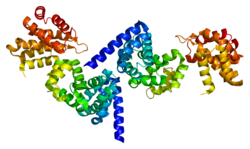
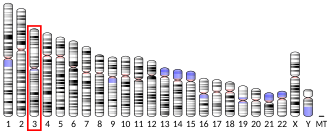




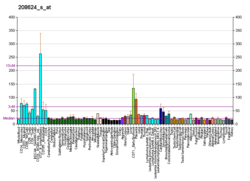
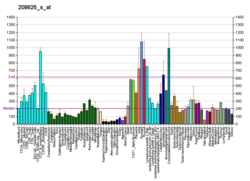
Eukaryotic translation initiation factor 4 gamma 1 is a protein that in humans is encoded by the EIF4G1 gene.56
Function
The protein encoded by this gene is a component of the protein complex eIF4F, which is involved in the recognition of the mRNA cap, ATP-dependent unwinding of 5'-terminal secondary structure (carried out by the eIF4A subunit), and recruitment of mRNA to the ribosome. Alternative splicing results in five transcript variants encoding four distinct isoforms.7 eIF4G serves as a scaffold, interacting with mRNA and the other components of the eIF4F complex, as well as the PABP and eIF3. It also facilitates the loading of the small ribosomal subunit onto the mRNA.8
eIF4G1 controls mitochondrial oxidative phosphorylation, axonal morphogenesis, and memory through promoting translation of select mRNAs, although it has a general role in canonical eukaryotic translation initiation 9
Interactions
Eukaryotic translation initiation factor 4 gamma has been shown to interact with MKNK1,10 EIF4A1,111213 EIF4E,1213141516 MKNK217 and PABPC1.18
References
References
- GRCh38: Ensembl release 89: ENSG00000114867 – Ensembl, May 2017
- GRCm38: Ensembl release 89: ENSMUSG00000045983 – Ensembl, May 2017
- "Human PubMed Reference:". National Center for Biotechnology Information, U.S. National Library of Medicine.
- "Mouse PubMed Reference:". National Center for Biotechnology Information, U.S. National Library of Medicine.
- Yan R, Rychlik W, Etchison D, Rhoads RE (November 1992). "Amino acid sequence of the human protein synthesis initiation factor eIF-4 gamma". The Journal of Biological Chemistry. 267 (32): 23226–23231. doi:10.1016/S0021-9258(18)50080-6. PMID 1429670.
- Imataka H, Sonenberg N (December 1997). "Human eukaryotic translation initiation factor 4G (eIF4G) possesses two separate and independent binding sites for eIF4A". Molecular and Cellular Biology. 17 (12): 6940–6947. doi:10.1128/mcb.17.12.6940. PMC 232551. PMID 9372926.
- "Entrez Gene: EIF4G1 eukaryotic translation initiation factor 4 gamma, 1".
- Gentry RC, Ide NA, Comunale VM, Hartwick EW, Kinz-Thompson CD, Gonzalez RL (2023-11-15), The mechanism of mRNA activation, doi:10.1101/2023.11.15.567265, PMC 10680758, PMID 38014128
- Kim SH, Choi JH, Marsal-García L, Amiri M, Yanagiya A, Sonenberg N (June 2023). "The mRNA translation initiation factor eIF4G1 controls mitochondrial oxidative phosphorylation, axonal morphogenesis, and memory". Proceedings of the National Academy of Sciences of the United States of America. 120 (25) e2300008120. doi:10.1073/pnas.2300008120. PMC 10288579. PMID 37307456.
- Pyronnet S, Imataka H, Gingras AC, Fukunaga R, Hunter T, Sonenberg N (January 1999). "Human eukaryotic translation initiation factor 4G (eIF4G) recruits mnk1 to phosphorylate eIF4E". The EMBO Journal. 18 (1): 270–279. doi:10.1093/emboj/18.1.270. PMC 1171121. PMID 9878069.
- Ewing RM, Chu P, Elisma F, Li H, Taylor P, Climie S, et al. (2007). "Large-scale mapping of human protein-protein interactions by mass spectrometry". Molecular Systems Biology. 3 (1): 89. doi:10.1038/msb4100134. PMC 1847948. PMID 17353931.
- Connolly E, Braunstein S, Formenti S, Schneider RJ (May 2006). "Hypoxia inhibits protein synthesis through a 4E-BP1 and elongation factor 2 kinase pathway controlled by mTOR and uncoupled in breast cancer cells". Molecular and Cellular Biology. 26 (10): 3955–3965. doi:10.1128/MCB.26.10.3955-3965.2006. PMC 1489005. PMID 16648488.
- Harris TE, Chi A, Shabanowitz J, Hunt DF, Rhoads RE, Lawrence JC (April 2006). "mTOR-dependent stimulation of the association of eIF4G and eIF3 by insulin". The EMBO Journal. 25 (8): 1659–1668. doi:10.1038/sj.emboj.7601047. PMC 1440840. PMID 16541103.
- Vary TC, Jefferson LS, Kimball SR (December 1999). "Amino acid-induced stimulation of translation initiation in rat skeletal muscle". The American Journal of Physiology. 277 (6 Pt 1): E1077–86. doi:10.1152/ajpendo.1999.277.6.E1077. PMID 10600798. S2CID 4516850.
- Mader S, Lee H, Pause A, Sonenberg N (September 1995). "The translation initiation factor eIF-4E binds to a common motif shared by the translation factor eIF-4 gamma and the translational repressors 4E-binding proteins". Molecular and Cellular Biology. 15 (9): 4990–4997. doi:10.1128/MCB.15.9.4990. PMC 230746. PMID 7651417.
- Kumar V, Sabatini D, Pandey P, Gingras AC, Majumder PK, Kumar M, et al. (April 2000). "Regulation of the rapamycin and FKBP-target 1/mammalian target of rapamycin and cap-dependent initiation of translation by the c-Abl protein-tyrosine kinase". The Journal of Biological Chemistry. 275 (15): 10779–10787. doi:10.1074/jbc.275.15.10779. PMID 10753870.
- Scheper GC, Parra JL, Wilson M, Van Kollenburg B, Vertegaal AC, Han ZG, et al. (August 2003). "The N and C termini of the splice variants of the human mitogen-activated protein kinase-interacting kinase Mnk2 determine activity and localization". Molecular and Cellular Biology. 23 (16): 5692–5705. doi:10.1128/MCB.23.16.5692-5705.2003. PMC 166352. PMID 12897141.
- Imataka H, Gradi A, Sonenberg N (December 1998). "A newly identified N-terminal amino acid sequence of human eIF4G binds poly(A)-binding protein and functions in poly(A)-dependent translation". The EMBO Journal. 17 (24): 7480–7489. doi:10.1093/emboj/17.24.7480. PMC 1171091. PMID 9857202.
Further reading
Further reading
- Gingras AC, Raught B, Sonenberg N (2000). "eIF4 initiation factors: effectors of mRNA recruitment to ribosomes and regulators of translation". Annual Review of Biochemistry. 68: 913–963. doi:10.1146/annurev.biochem.68.1.913. PMID 10872469.
- Yan R, Rhoads RE (March 1995). "Human protein synthesis initiation factor eIF-4 gamma is encoded by a single gene (EIF4G) that maps to chromosome 3q27-qter". Genomics. 26 (2): 394–398. doi:10.1016/0888-7543(95)80227-D. PMID 7601469.
- Mader S, Lee H, Pause A, Sonenberg N (September 1995). "The translation initiation factor eIF-4E binds to a common motif shared by the translation factor eIF-4 gamma and the translational repressors 4E-binding proteins". Molecular and Cellular Biology. 15 (9): 4990–4997. doi:10.1128/MCB.15.9.4990. PMC 230746. PMID 7651417.
- Pause A, Belsham GJ, Gingras AC, Donzé O, Lin TA, Lawrence JC, et al. (October 1994). "Insulin-dependent stimulation of protein synthesis by phosphorylation of a regulator of 5'-cap function". Nature. 371 (6500): 762–767. Bibcode:1994Natur.371..762P. doi:10.1038/371762a0. PMID 7935836. S2CID 4360955.
- Lamphear BJ, Yan R, Yang F, Waters D, Liebig HD, Klump H, et al. (September 1993). "Mapping the cleavage site in protein synthesis initiation factor eIF-4 gamma of the 2A proteases from human Coxsackievirus and rhinovirus". The Journal of Biological Chemistry. 268 (26): 19200–19203. doi:10.1016/S0021-9258(19)36499-3. PMID 8396129.
- Haghighat A, Mader S, Pause A, Sonenberg N (November 1995). "Repression of cap-dependent translation by 4E-binding protein 1: competition with p220 for binding to eukaryotic initiation factor-4E". The EMBO Journal. 14 (22): 5701–5709. doi:10.1002/j.1460-2075.1995.tb00257.x. PMC 394685. PMID 8521827.
- Bonaldo MF, Lennon G, Soares MB (September 1996). "Normalization and subtraction: two approaches to facilitate gene discovery". Genome Research. 6 (9): 791–806. doi:10.1101/gr.6.9.791. PMID 8889548.
- Lamphear BJ, Rhoads RE (December 1996). "A single amino acid change in protein synthesis initiation factor 4G renders cap-dependent translation resistant to picornaviral 2A proteases". Biochemistry. 35 (49): 15726–15733. doi:10.1021/bi961864t. PMID 8961935.
- Brass N, Heckel D, Sahin U, Pfreundschuh M, Sybrecht GW, Meese E (January 1997). "Translation initiation factor eIF-4gamma is encoded by an amplified gene and induces an immune response in squamous cell lung carcinoma". Human Molecular Genetics. 6 (1): 33–39. doi:10.1093/hmg/6.1.33. PMID 9002667.
- Eberle J, Krasagakis K, Orfanos CE (May 1997). "Translation initiation factor eIF-4A1 mRNA is consistently overexpressed in human melanoma cells in vitro". International Journal of Cancer. 71 (3): 396–401. doi:10.1002/(SICI)1097-0215(19970502)71:3<396::AID-IJC16>3.0.CO;2-E. PMID 9139875. S2CID 13458929.
- Gradi A, Imataka H, Svitkin YV, Rom E, Raught B, Morino S, et al. (January 1998). "A novel functional human eukaryotic translation initiation factor 4G". Molecular and Cellular Biology. 18 (1): 334–342. doi:10.1128/mcb.18.1.334. PMC 121501. PMID 9418880.
- Piron M, Vende P, Cohen J, Poncet D (October 1998). "Rotavirus RNA-binding protein NSP3 interacts with eIF4GI and evicts the poly(A) binding protein from eIF4F". The EMBO Journal. 17 (19): 5811–5821. doi:10.1093/emboj/17.19.5811. PMC 1170909. PMID 9755181.
- Imataka H, Gradi A, Sonenberg N (December 1998). "A newly identified N-terminal amino acid sequence of human eIF4G binds poly(A)-binding protein and functions in poly(A)-dependent translation". The EMBO Journal. 17 (24): 7480–7489. doi:10.1093/emboj/17.24.7480. PMC 1171091. PMID 9857202.
- Pyronnet S, Imataka H, Gingras AC, Fukunaga R, Hunter T, Sonenberg N (January 1999). "Human eukaryotic translation initiation factor 4G (eIF4G) recruits mnk1 to phosphorylate eIF4E". The EMBO Journal. 18 (1): 270–279. doi:10.1093/emboj/18.1.270. PMC 1171121. PMID 9878069.
- Laroia G, Cuesta R, Brewer G, Schneider RJ (April 1999). "Control of mRNA decay by heat shock-ubiquitin-proteasome pathway". Science. 284 (5413): 499–502. Bibcode:1999Sci...284..499L. doi:10.1126/science.284.5413.499. PMID 10205060.
- Vary TC, Jefferson LS, Kimball SR (December 1999). "Amino acid-induced stimulation of translation initiation in rat skeletal muscle". The American Journal of Physiology. 277 (6 Pt 1): E1077–86. doi:10.1152/ajpendo.1999.277.6.E1077. PMID 10600798. S2CID 4516850.
- Cuesta R, Laroia G, Schneider RJ (June 2000). "Chaperone hsp27 inhibits translation during heat shock by binding eIF4G and facilitating dissociation of cap-initiation complexes". Genes & Development. 14 (12): 1460–1470. doi:10.1101/gad.14.12.1460. PMC 316692. PMID 10859165.
- Chartier-Harlin MC, Dachsel JC, Vilariño-Güell C, Lincoln SJ, Leprêtre F, Hulihan MM, et al. (September 2011). "Translation initiator EIF4G1 mutations in familial Parkinson disease". American Journal of Human Genetics. 89 (3): 398–406. doi:10.1016/j.ajhg.2011.08.009. PMC 3169825. PMID 21907011.