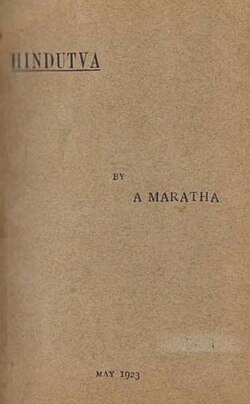
 Title page of the 1923 edition | |
| Author | Vinayak Damodar Savarkar |
|---|---|
| Language | English |
| Subject | Hindutva |
| Genre | Political manifesto Political philosophy |
| Publication date | May 1923 |
| Publication place | British India |
| Media type | Print (hardcover and paperback) |
| Pages | 88 (original publication) 141 (1969 publication) |
| ISBN | 9788188388257 (2003 publication) |
| OCLC | 0670049905 |
Essentials of Hindutva, also titled Hindutva: Who is a Hindu? or simply Hindutva, is a 1923 political pamphlet by Indian politician and ideologue Vinayak Damodar Savarkar. It was published pseudonymously while Savarkar was in prison. Savarkar's pamphlet formulated Hindutva, a Hindu nationalist ideology.
Background
Prior usage of the term "Hindutva"
The term "Hindutva" was originally coined by Chandranath Basu,12 a conservative essayist, who used it to denote a Hindu cultural worldview rather than a political ideology.3 He discussed the term in a Bengali book entitled Hindutva: Hindur Prakrita Itihas (transl. Hindutva: The Authentic History of the Hindus), published in 1892.12 In the book, Basu distances himself from Hindu mythology in favour of Advaita Vedanta, argues for the centrality of dharma in Hinduism, glorifies the ancient "land of the Hindus",45 defends the caste system and child marriage,6 critiques European modernity, and calls for greater "manliness" to counter what he perceives as rising effeminacy.45
Socio-political context behind Essentials of Hindutva
Following World War I, South Asian Muslims launched the Khilafat Movement across British India in opposition to the planned dismemberment of the Ottoman Empire. Its alliance with the Indian National Congress, however, collapsed after Mahatma Gandhi's withdrawal of the non-cooperation movement in 1922, heightening communal tensions and polarisation between Hindus and Muslims.78 Among sections of the Hindu intelligentsia, there emerged a majoritarian inferiority complex, partly rooted in a loss of self-esteem fostered by a 19th century colonial stereotype that portrayed Hindus as a "puny race".9 The same period witnessed B. R. Ambedkar's first organisation of Dalits as an anti-Brahmin movement in the Bombay Presidency;7 on the other hand, caste and sectarian divisions within Hinduism came to be obsessively viewed in Hindu nationalist discourse as weaknesses.9 Meanwhile, the proportion of Hindus in British India, as recorded in the decennial census, fell from 74% in 1881 to 68% in 1931, prompting some Hindu nationalist ideologues to describe Hindus as a "dying race".9Note 1Note 2 It was in this socio-political context that Essentials of Hindutva was written.177
Savarkar and publication
In 1910, Vinayak Damodar Savarkar was arrested in London on multiple criminal charges, including the procurement and distribution of arms, abetment of murder, "waging war against the King Emperor of India", and sedition; extradited to Bombay to stand trial, he was convicted and sentenced to serve two life terms in Cellular Jail in the Andaman Islands.1819 After submitting a series of clemency petitions, he was transferred to a prison in Ratnagiri, where he remained until his conditional release in 1924.20 During his imprisonment, he wrote Essentials of Hindutva,2122 under the pseudonym 'A Maratha'.23Note 3 In May 1923, the pamphlet was smuggled out of his cell and delivered to V. V. Kelkar, who subsequently published it.252426 The pamphlet was written and published in English,27 comprising just eighty-eight pages.28
Titles and editions
There is little agreement on the title of the pamphlet. The original 1923 publication simply states "Hindutva by 'A Maratha', May 1923" on the title page, while the first page is entitled Essentials of Hindutva; this was not a chapter title, as this edition had none. A 1938 edition retains the 1923 title but now names Savarkar as the author and includes a portrait of him. In that edition, however, the opening pages feature a Sanskrit epigraph with an English translation, entitled Who is a Hindu?.29Note 4 The sixth edition in 1989 retains Hindutva on the dust jacket and Hindutva: Who is a Hindu? on the title page, yet the first page reverts to Essentials of Hindutva; this edition also includes chapter titles and subheadings. The running heads add further inconsistency, with Hindutva appearing on the verso and Essentials of Hindutva on the recto.30 The 2007 edition is simply entitled Essentials of Hindutva. The Marathi and Hindi translations follow a similar pattern, with both dust jackets entitled Hindutva, while the first page of each carries a translation of Essentials of Hindutva as a subtitle.31Note 5 All three titles have been used in scholarly analysis.31
Themes
Racial and ethnic Hindu identity
In Essentials of Hindutva, Savarkar racialises and ethnicises an imagined Hindu identity,32 and argues for the creation of a Hindu Rashtra (transl. Hindu nation).33 His criteria for being considered a Hindu is inclusive across caste, creed, and faith;3435 any person for whom India is both pitrabhumi (transl. Ancestral land) and punyabhumi (transl. Sacred land) qualifies as a Hindu.363738 However, he frames punyabhumi more so in patriotic and cultural terms rather than solely religious ones, with patriotism expressed through his notion of martyrdom, envisioned as heroism and hero worship.39 He also forms clear boundaries between those deemed Hindus and non-Hindus,34 advocating for the purification of the nation from those deemed outsiders, such as Muslims and Christians, who, according to Savarkar, have their sacred lands outside of India, in "Arabia or Palestine";40 in the pamphlet, they are portrayed as "impure" and incompatible with Indian society.38 However, he does not explicitly argue for strict racial purity;4142 he contends that Hindus who had converted to Islam or Christianity may be readmitted if they convert back to Hinduism43 as well as marry and have children with Hindus,44 thereby being welcomed back to the "Hindu fold".43
Some of us were Aryans and some Anaryans; but Ayars and Nayars—we were all Hindus and own a common blood. Some of us are Brahmins and some Namshudras or Panchams; but Brahmins or Chandals—we are all Hindus and own a common blood. Some of us are Dakshanatyas and some Gouds; but Gouds or Saraswats—we are all Hindus and own a common blood. Some of us were Vanars and some Kinners: but Vanars or Nars—we are all Hindus and own a common blood. Some of us are monists some pantheists; some theists and some atheists. But monotheists or atheists—we are all Hindus and own a common blood.45
Articulating a militantly chauvinistic and nativist form of racial and territorial nationhood,46 Savarkar argues that Hindus constitute a distinct and primordial civilisation4748 and stresses Hindu devotion to common ethnic ties, rooted in the ideals of sacred blood and sacred soil.46 He blends Hindu ethnic nationalism49 with Brahminical authority in the caste system;505152 his emphasis on race was an attempt to downplay caste divisions that he, as a Brahmin, sought to preserve.515354 Appealing to the imagined racial unity, racial oneness, and racial superiority of the Hindus,5556 Savarkar attacks the British conception of castes being racially differentiated, yet argues for the defence of a caste system which was barely distinguishable, founded on a hierarchically conceived notion of noble and pure upper-caste blood.57 His over-integrated conception of an imagined Hindu race was both formed against, and mirrored, the racial supremacism of British colonialism;5859 he repeatedly asserts that the racial inheritance of Hindu blood is the defining characteristic of Hindutva.58
Distinction between Hinduism and Hindutva
Savarkar contrasts Hinduism, which he describes as merely a "spiritual or religious dogma or system",4060 with the term "Hindutva" (transl. Hindu-ness),61 which, he writes, "embraces all the departments of thought and activity of the whole being of our Hindu race".6263 He characterises Hinduism as "limited, less satisfactory and essentially sectarian", arguing that it is only one of several aspects of Hindutva.6438 Later in the pamphlet, he states, "if there be really any word of alien growth it is this word Hinduism and so we should not allow our thoughts to get confused by this new-fangled term".64Note 6
History
In the pamphlet, Savarkar frames history as the means of understanding Hindutva, stating, "Hindutva is not a word but a history"; not a "spiritual or religious history", he adds, but "a history in full".68
Global Hindu colonialism
This definition of Hindutva is compatible with any conceivable expansion of our Hindu people. Let our colonists continue unabated their labours of founding a Greater India, a Mahabharata, to the best of their capacities and contribute all that is best in our civilization to the upbuilding of humanity [...] The only geographical limits to Hindutva are the limits of our earth!37
Savarkar argues that the hundreds of thousands of Hindus who had reached distant parts of the world as merchants and traders were colonisers, with the potential to "own a whole country" and "form a separate state". He contends that the process of Hindu colonisation would improve lives on a global scale or, as he puts it, "from Pole to Pole". In his view, Hindus needed not only to unify territorially, a notion that later evolved into the concept of Akhand Bharat, but to colonise parts of the planet in order to establish a Hindu world empire.69 Throughout the pamphlet, he uses the terms "Hindu nation" and "Hindu empire" interchangeably.70
Conflict of life and death
Savarkar wrote that a "conflict of life and death" had ensued ever since Mahmud of Ghazni of the Ghaznavid Empire crossed the Indus River into the Indian subcontinent in 11th century CE, and that this prolonged conflict made Hindus "intensely conscious of ourselves as Hindus and were welded into a nation".7172
Western influence
Savarkar's conception of Hindutva drew heavily on British and German orientalist thought as well as on contemporary currents of ethnic nationalism in Europe.73 He was well acquainted with the works of Charles Darwin, Herbert Spencer, Ernst Haeckel, and Thomas Henry Huxley, and supported racial theory.5374 He was particularly influenced by Johann Kaspar Bluntschli's concept of German ethnic and racial nationalism.54Note 7 Philosopher Martha Nussbaum has described the pamphlet as a "European product".7677
Explanatory notes
- One prominent example was in 1909, when U. N. Mukherji published a series of articles from The Bengalee as a pamphlet entitled Hindus: A Dying Race.1011 Based on census data, Mukherji claims that the Hindu population of Bengal will disappear completely,12 and that extrapolating demographic trends, Hindus will go numerically extinct within 420 years.1013 He speaks of a "united Mahomedan world",14 drawing on exaggerated stereotypes of Muslim communal unity,10 which he contrasts with Hindus who, according to him, are "crumbling to pieces" due to caste and class conflict.14 He states, "Disunion is the cornerstone of our community".15
- Furthermore, the notion of Hindus being a "dying race" was exploited by the British for their colonial policy of "divide and conquer".1116
- Also spelled as 'A Mahratta'.24
- A foreword is included in the same edition by Bhai Parmanand who refers to the pamphlet simply as Hindutva, using neither of the other two titles.29
- The Marathi translation is Hindutvaci Mulabhuta Tattve and the Hindi translation is Hindutva ke Pramukhatam Abhilakshan.31
- Savarkar has variously been described as an agnostic65 and an atheist.66 He rejected Hindu mysticism,65 the divinity of Hindu religious scriptures, the theory of rebirth, and idolatry.39 He attacked Hindu customs and practices as a "backward" past in contrast to a "scientific" present.67 Nevertheless, he regularly utilised religious language for political purposes.39
- While imprisoned, Savarkar read and taught Bluntschli's works.5975 Bluntschli distinguished between a racially superior "principal nation" and a racially inferior "alien nation". This framework appealed to Savarkar, as it allowed him to compensate the British claims of racial superiority, by asserting the racial superiority of an imagined Hindu race against an imagined Muslim race. Adopting Bluntschli's model, Savarkar argued that Hindus constituted the principal nation, while Muslims constituted the alien nation.59
References
References
Citations
- Chaturvedi 2022, p. 8, 138.
- Sen 2018, p. 180.
- Sen 2014, p. 150.
- Chaturvedi 2022, pp. 138–139.
- Sen 2018, pp. 180–181.
- Jha 2014, p. 3.
- Goodrick-Clarke 1998, pp. 43–44.
- Jaffrelot 1999, pp. 25–26.
- Jaffrelot 2021, p. 12.
- Jaffrelot 1999, p. 24.
- Das 2023, p. 115.
- Chaturvedi 2022, p. 193.
- Guha 2024, pp. 5002–5016.
- Chaturvedi 2022, pp. 193–194.
- Chaturvedi 2022, p. 194.
- Gupta 2004, p. 4303.
- Jaffrelot 2021, pp. 12–13.
- Bakhle 2010, p. 151.
- Chaturvedi 2015, p. 19.
- Jha 2022, pp. 17–19.
- Basu 2017, p. 23.
- Nederman & Shogimen 2009, p. 190.
- Chaturvedi 2015, p. 14.
- Bakhle 2024, p. 5.
- Chaturvedi 2015, p. 137.
- van Driem 2021, p. 31.
- Basu 2017, p. 133.
- Bakhle 2024, p. 318.
- Chaturvedi 2022, p. 7.
- Chaturvedi 2022, pp. 7–8.
- Chaturvedi 2022, p. 8.
- Sources:
- Goodrick-Clarke 1998, p. 50
- Bhatt 2020, p. 95
- Sabastian 2025, pp. 60–61
- Leidig 2020, p. 222
- Bakhle 2010, pp. 149–186
- Guha 2024, pp. 5002–5016
- Lakhi Mangharam 2025, pp. 91–127
- Kapur 2022, pp. 499–516
- Baber 2021, pp. 151–169
- Mudde 2019, p. 44.
- Bakhle 2010, p. 161.
- Sen 2015, pp. 690–711.
- Bakhle 2010, p. 154.
- Thobani 2019, pp. 745–762.
- Yilmaz & Morieson 2025, p. 48.
- Wolf 2010, pp. 1–20.
- Zachariah 2015, pp. 608–612.
- Chaturvedi 2022, pp. 191–192.
- Jaffrelot 1999, pp. 28–29.
- Samuel 2020, pp. 127–149.
- Jaffrelot 2021, p. 13.
- Bakhle 2010, pp. 160–161.
- Frykenberg 2008, p. 190.
- Goodrick-Clarke 1998, p. 49.
- Thobani 2019, p. 752.
- Sources:
- Goodrick-Clarke 1998, p. 44
- Nederman & Shogimen 2009, pp. 190–191
- Jaffrelot 1999, pp. 26–27
- Lakhi Mangharam 2025, pp. 91–127
- Baber 2021, pp. 151–169
- Goodrick-Clarke 1998, p. 44.
- Bhatt 2020, pp. 94–96.
- Jaffrelot 1999, pp. 31–32.
- Jaffrelot 1999, p. 28.
- Goodrick-Clarke 1998, p. 50.
- van Driem 2021, pp. 26–55.
- Kapur 2022, pp. 499–516.
- Bhatt 2020, pp. 94–95.
- Bhatt 2020, p. 95.
- Dusche 2010, p. 45.
- Basu 2017, p. 101.
- van der Linden 2024, pp. 1–26.
- Bakhle 2010, p. 159.
- Chaturvedi 2022, p. 175.
- Chaturvedi 2022, pp. 155–156.
- Goldstein 2017, p. 46.
- Nandy 2014, pp. 91–112.
- Devare 2011, p. 153.
- Chaturvedi 2022, pp. 10–11.
- Chaturvedi 2022, pp. 122–123.
- Chaturvedi 2022, pp. 123–124.
- Jha 2024, pp. 43–44.
- Jha 2022, pp. 21–22.
- Sources:
- Bhatt 2020, pp. 86–88
- Jaffrelot 1999, pp. 28–32
- Nederman & Shogimen 2009, pp. 190–191
- Thobani 2019, p. 752
- Sabastian 2025, p. 60.
- Jaffrelot 1999, p. 32.
- Nussbaum 2009, pp. 158–160.
- Nederman & Shogimen 2009, p. 190–191.
Bibliography
- Bakhle, Janaki (2010). "Country First? Vinayak Damodar Savarkar (1883–1966) and the Writing of Essentials of Hindutva". Public Culture. 22 (1). doi:10.1215/08992363-2009-020.
- Bakhle, Janaki (2024). Savarkar and the Making of Hindutva. Princeton University Press. ISBN 9780691250366.
- Basu, Manisha (2017). The Rhetoric of Hindu India: Language and Urban Nationalism. Cambridge University Press. ISBN 9781107149878.
- Chaturvedi, Vinayak (2015). "A Revolutionary's Biography: The Case of V D Savarkar". In Kama Maclean; J. Daniel Elam (eds.). Revolutionary Lives in South Asia: Acts and Afterlives of Anticolonial Political Action. Routledge. ISBN 9781138379374.
- Chaturvedi, Vinayak (2022). Hindutva and Violence: V. D. Savarkar and the Politics of History. SUNY Press. ISBN 9781438488783.
- Dusche, Michael (2010). "Origins of Ethnic Nationalism in Germany and Repercussions in India". Economic and Political Weekly. 45 (2 2). JSTOR 27807077.
- Frykenberg, Robert E. (2008). "Hindutva as a Political Religion: An Historical Perspective". In Roger Griffin; Robert Mallett; John Tortorice (eds.). The Sacred in Twentieth-Century Politics: Essays in Honour of Professor Stanley G. Payne. Palgrave Macmillan. doi:10.1057/9780230241633_10. ISBN 9780230537743.
- Goodrick-Clarke, Nicholas (1998). Hitler's Priestess: Savitri Devi, the Hindu-Aryan Myth, and Neo-Nazism. New York University Press. ISBN 9780814731109.
- Jaffrelot, Christophe (1999). The Hindu Nationalist Movement and Indian Politics 1925 to the 1990s: Strategies of Identity-building, Implantation and Mobilisation (with Special Reference to Central India). C. Hurst & Company. ISBN 9780140246025.
- Jaffrelot, Christophe (2021). Modi's India: Hindu Nationalism and the Rise of Ethnic Democracy. Princeton University Press. ISBN 9780691223094.
- Jha, Dhirendra K. (2024). Golwalkar: The Myth Behind the Man, The Man Behind the Machine. Simon & Schuster. ISBN 9788197949241.
- Jha, Dhirendra K. (2022). Gandhi's Assassin: The Making of Nathuram Godse and His Idea of India. Penguin Random House. ISBN 9789354921681.
- Nandy, Ashis (2014). "A Disowned Father of the Nation in India: Vinayak Damodar Savarkar and the Demonic and the Seductive in Indian Nationalism". Inter-Asia Cultural Studies. 15 (1). doi:10.1080/14649373.2014.882087.
- Nederman, Cary J.; Shogimen, Takashi (2009). Western Political Thought in Dialogue with Asia. Bloomsbury Publishing. ISBN 9780739123782.
- Samuel, Joshua (2020). Untouchable Bodies, Resistance, and Liberation. Brill Publishers. ISBN 9789004420052.
- Sen, Satadru (2015). "Fascism Without Fascists? A Comparative Look at Hindutva and Zionism". South Asia: Journal of South Asian Studies. 38 (4). doi:10.1080/00856401.2015.1077924.
- Thobani, Sitara (2019). "Alt-Right with the Hindu-Right: Long-Distance Nationalism and the Perfection of Hindutva". Ethnic and Racial Studies. 42 (5). doi:10.1080/01419870.2018.1468567.
- van der Linden, Bob (2024). Romantic Nationalism in India: Cultivation of Culture and the Global Circulation of Ideas. Brill Publishers. ISBN 9789004694804.
- van Driem, George (2021). Ethnolinguistic Prehistory: The Peopling of the World from the Perspective of Language, Genes and Material Culture. Brill Publishers. ISBN 9789004448377.
- Zachariah, Benjamin (2015). "Global Fascisms and the Volk: The Framing of Narratives and the Crossing of Lines". South Asia: Journal of South Asian Studies. 38 (4). doi:10.1080/00856401.2015.1080404.
- Bhatt, Chetan (2020). Hindu Nationalism: Origins, Ideologies and Modern Myths. Routledge. ISBN 9781000184228.
- Guha, Ayan (2024). "Hindu Nationalism and the Converging, Diverging and Intersecting Identities of Caste and Race in India: Dialogue, Dilemma and Discourse". Journal of Asian and African Studies. 60 (8). doi:10.1177/00219096241275409.
- Lakhi Mangharam, Mukti (2025). "Decolonizing Decolonization: Undoing Ethno-Nationalist Conceptions of "Indigeneity"". Lit: Literature Interpretation Theory. 36 (2). doi:10.1080/10436928.2025.2516394.
- Kapur, Ratna (2022). "Race-making, religion and rights in the post-colony: unmasking the pathogen in assembling a Hindu nation". International Journal of Law in Context. 18 (4). doi:10.1017/S1744552322000155.
- Baber, Zaheer (2021). "'Race might be a unicorn, but its horn could draw blood': Racialisation, Class and Racism in a Non-Western Context". Critical Sociology. 48 (1). doi:10.1177/0896920521992093.
- Das, Sayan (2023). "Colonial Census and Saffron Demography: The Shaping of Numerical Communities and Contestations in India". In Sarah Bracke; Luis Manuel Hernández Aguilar (eds.). The Politics of Replacement: Demographic Fears, Conspiracy Theories, and Race Wars. Taylor & Francis. ISBN 9781003813095.
- Nussbaum, Martha (2009). The Clash Within: Democracy, Religious Violence, and India's Future. Harvard University Press. ISBN 9780674041561.
- Gupta, Charu (2004). "Censuses, Communalism, Gender and Identity: A Historical Perspective". Economic and Political Weekly. 39 (39). JSTOR 4415578.
- Sabastian, Luna (2025). Fascism in India: Race, Caste, and Hindutva. Harvard University Press. ISBN 9780674299436.
- Goldstein, Björn (2017). "The Unconscious Indianization of 'Western' Conservatism — Is Indian Conservatism a Universal Model?". In Matthew Johnson; Mark Garnett; David Walker (eds.). Conservatism and Ideology. Routledge. ISBN 9781317529002.
- Wolf, Siegfried O. (2010). "Vinayak Damodar Savarkar's 'Strategic Agnosticism': A Compilation of his Socio-Political Philosophy and Worldview". Heidelberg Papers in South Asian and Comparative Politics (51).
- Yilmaz, Ihsan; Morieson, Nicholas (2025). Weaponizing Civilizationalism for Authoritarianism: How Turkey, India, Russia, and China Challenge Liberal Democracy. Palgrave Macmillan. ISBN 9789819616589.
- Devare, Aparna (2011). History and the Making of a Modern Hindu Self. Routledge. ISBN 9780415860857.
- Leidig, Eviane (2020). "Hindutva as a Variant of Right-Wing Extremism". Patterns of Prejudice. 54 (3). doi:10.1080/0031322X.2020.1759861. hdl:11250/3050022.
- Mudde, Cas (2019). The Far Right Today. Wiley. ISBN 9781509536832.
- Sen, Amiya P. (2014). Religion And Rabindranath Tagore: Select Discourses, Addresses, and, Letters in Translation. Oxford University Press. ISBN 9780198098966.
- Sen, Amiya P. (2018). "A Hindu Conservative Negotiates Modernity: Chandranath Basu (1844–1910) and Reflections on the Self and Culture in Colonial Bengal". In Rafael Klöber; Manju Ludwig (eds.). HerStory – Historical Scholarship between South Asia and Europe: Festschrift in Honour of Gita Dharampal-Frick. CrossAsia E-Publishing. ISBN 9783946742449.
- Jha, D. N. (2014). Rethinking Hindu Identity. Routledge. ISBN 9781845534608.
External links
External links
- 1923 edition at the Internet Archive
- 1969 edition at the Internet Archive