
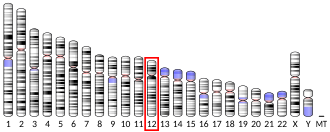



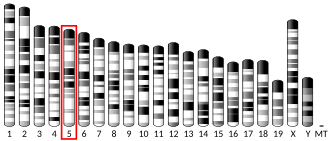


Endoplasmic reticulum protein 29 (ERp29) is a chaperone protein that in humans is encoded by the ERP29 gene.5
Function
ERp29 is a reticuloplasmin, a protein which resides in the lumen of the endoplasmic reticulum (ER). The protein shows sequence similarity to the protein disulfide-isomerase family.6 However, it lacks the thioredoxin motif characteristic of this family, suggesting that this protein does not function as a disulfide isomerase.6 The protein dimerizes and is thought to play a role in the processing of secretory proteins within the ER. Alternative splicing results in multiple transcript variants encoding different isoforms.5
References
References
- GRCh38: Ensembl release 89: ENSG00000089248 – Ensembl, May 2017
- GRCm38: Ensembl release 89: ENSMUSG00000029616 – Ensembl, May 2017
- "Human PubMed Reference:". National Center for Biotechnology Information, U.S. National Library of Medicine.
- "Mouse PubMed Reference:". National Center for Biotechnology Information, U.S. National Library of Medicine.
- "Entrez Gene: ERP29 endoplasmic reticulum protein 29".
- Galligan JJ, Petersen DR (July 2012). "The human protein disulfide isomerase gene family". Human Genomics. 6 (1): 6. doi:10.1186/1479-7364-6-6. PMC 3500226. PMID 23245351.
Further reading
Further reading
- Hubbard MJ (Sep 2002). "Functional proteomics: The goalposts are moving". Proteomics. 2 (9): 1069–78. doi:10.1002/1615-9861(200209)2:9<1069::AID-PROT1069>3.0.CO;2-R. PMID 12362325. S2CID 46402626.
- Mkrtchian S, Sandalova T (2006). "ERp29, an unusual redox-inactive member of the thioredoxin family". Antioxidants & Redox Signaling. 8 (3–4): 325–37. doi:10.1089/ars.2006.8.325. PMID 16677078.
- Hochstrasser DF, Frutiger S, Paquet N, Bairoch A, Ravier F, Pasquali C, Sanchez JC, Tissot JD, Bjellqvist B, Vargas R (Dec 1992). "Human liver protein map: a reference database established by microsequencing and gel comparison". Electrophoresis. 13 (12): 992–1001. doi:10.1002/elps.11501301201. PMID 1286669. S2CID 23518983.
- Hughes GJ, Frutiger S, Paquet N, Pasquali C, Sanchez JC, Tissot JD, Bairoch A, Appel RD, Hochstrasser DF (Nov 1993). "Human liver protein map: update 1993". Electrophoresis. 14 (11): 1216–22. doi:10.1002/elps.11501401181. PMID 8313870. S2CID 33424554.
- Mkrtchian S, Fang C, Hellman U, Ingelman-Sundberg M (Jan 1998). "A stress-inducible rat liver endoplasmic reticulum protein, ERp29". European Journal of Biochemistry. 251 (1–2): 304–13. doi:10.1046/j.1432-1327.1998.2510304.x. PMID 9492298.
- Ferrari DM, Nguyen Van P, Kratzin HD, Söling HD (Aug 1998). "ERp28, a human endoplasmic-reticulum-lumenal protein, is a member of the protein disulfide isomerase family but lacks a CXXC thioredoxin-box motif". European Journal of Biochemistry. 255 (3): 570–9. doi:10.1046/j.1432-1327.1998.2550570.x. PMID 9738895.
- Hubbard MJ, McHugh NJ (Nov 2000). "Human ERp29: isolation, primary structural characterisation and two-dimensional gel mapping". Electrophoresis. 21 (17): 3785–96. doi:10.1002/1522-2683(200011)21:17<3785::AID-ELPS3785>3.0.CO;2-2. PMID 11271497. S2CID 42538820.
- Shnyder SD, Hubbard MJ (Apr 2002). "ERp29 is a ubiquitous resident of the endoplasmic reticulum with a distinct role in secretory protein production". The Journal of Histochemistry and Cytochemistry. 50 (4): 557–66. doi:10.1177/002215540205000413. PMID 11897809.
- Sargsyan E, Baryshev M, Backlund M, Sharipo A, Mkrtchian S (Feb 2002). "Genomic organization and promoter characterization of the gene encoding a putative endoplasmic reticulum chaperone, ERp29". Gene. 285 (1–2): 127–39. CiteSeerX 10.1.1.593.9369. doi:10.1016/S0378-1119(02)00417-1. PMID 12039039.
- Basrur V, Yang F, Kushimoto T, Higashimoto Y, Yasumoto K, Valencia J, Muller J, Vieira WD, Watabe H, Shabanowitz J, Hearing VJ, Hunt DF, Appella E (2003). "Proteomic analysis of early melanosomes: identification of novel melanosomal proteins". Journal of Proteome Research. 2 (1): 69–79. doi:10.1021/pr025562r. PMID 12643545.
- Lim J, Hao T, Shaw C, Patel AJ, Szabó G, Rual JF, Fisk CJ, Li N, Smolyar A, Hill DE, Barabási AL, Vidal M, Zoghbi HY (May 2006). "A protein-protein interaction network for human inherited ataxias and disorders of Purkinje cell degeneration". Cell. 125 (4): 801–14. doi:10.1016/j.cell.2006.03.032. PMID 16713569. S2CID 13709685.
- Cheretis C, Dietrich F, Chatzistamou I, Politi K, Angelidou E, Kiaris H, Mkrtchian S, Koutselini H (Oct 2006). "Expression of ERp29, an endoplasmic reticulum secretion factor in basal-cell carcinoma". The American Journal of Dermatopathology. 28 (5): 410–2. doi:10.1097/01.dad.0000211521.49810.ac. PMID 17012915. S2CID 1661765.
- Zheng J, Liu X, Yan X, Dai L, Ji C (2006). "Purification and structural characterization of human ERp29". Protein and Peptide Letters. 13 (8): 753–9. doi:10.2174/092986606777841190. PMID 17073718.
- Chi A, Valencia JC, Hu ZZ, Watabe H, Yamaguchi H, Mangini NJ, Huang H, Canfield VA, Cheng KC, Yang F, Abe R, Yamagishi S, Shabanowitz J, Hearing VJ, Wu C, Appella E, Hunt DF (Nov 2006). "Proteomic and bioinformatic characterization of the biogenesis and function of melanosomes". Journal of Proteome Research. 5 (11): 3135–44. doi:10.1021/pr060363j. PMID 17081065.
- Lippert U, Diao D, Barak NN, Ferrari DM (Apr 2007). "Conserved structural and functional properties of D-domain containing redox-active and -inactive protein disulfide isomerase-related protein chaperones" (PDF). The Journal of Biological Chemistry. 282 (15): 11213–20. doi:10.1074/jbc.M604440200. PMID 17296603. S2CID 25822309.