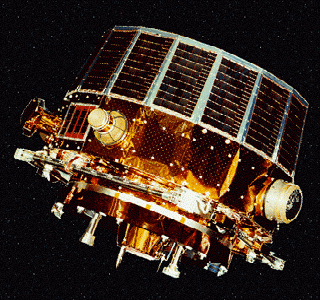
 The Equator-S satellite was operational between 2 December 1997 and 1 May 19981 | |
| Mission type | Heliophysics |
|---|---|
| Operator | ISTP |
| COSPAR ID | 1997-075B |
| SATCAT no. | 25068 |
| Website | https://www2011.mpe.mpg.de/EQS/eq-s-home.html |
| Mission duration | 2 years (planned) 150 days (achieved)1 |
| Spacecraft properties | |
| Manufacturer | Max Planck Institute for Extraterrestrial Physics1 |
| Launch mass | 230 kg (510 lb)2 |
| Start of mission | |
| Launch date | 2 December 1997, 22:52 (1997-12-02UTC22:52) UTC3 |
| Rocket | Ariane 44P (Flight V103) |
| Launch site | Guiana Space Centre ELA-2 |
| Contractor | Arianespace |
| End of mission | |
| Last contact | 1 May 1998 |
The Equator-S satellite was a spacecraft constructed by the Max Planck Institute for Extraterrestrial Physics for the International Solar-Terrestrial Physics Science Initiative. It was operational between 2 December 1997 and 1 May 1998.1
Description
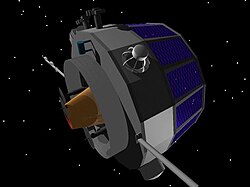
Equator-S was a low-cost mission, launched with the intention to study the Earth's magnetosphere around the equator at heights lower than 67,000 km.1 It was located in a near-equatorial orbit, which gave Equator-S the ability to make unique observations about the interaction between the magnetosphere and interplanetary space.4 Equator-S had a very high spin rate and was launched on an Ariane 4 rocket on 2 December 1997.1
The mission ended earlier than expected, having initially been intended to have a lifetime of two years. The mission was terminated on 1 May 1998 after the failure of the onboard processor system.1
References
References
- "Max Planck Institute- Equator S Summary". Retrieved 9 December 2021.
- "Spacecraft Specs". MP:EquatorS Archive. Max Planck Institute. Retrieved 9 December 2021.
- "Ariane 44P | JCSAT-5 & Equator S". nextspaceflight.com. Retrieved 19 July 2024.
- "NASA: Equator-S". NASA. Retrieved 13 December 2021.