  | |
| Observation data Epoch J2000.0 Equinox J2000.0 | |
|---|---|
| Constellation | Volans |
| Right ascension | 08h 07m 55.7945s1 |
| Declination | −68° 37′ 01.433″1 |
| Apparent magnitude (V) | +4.332 |
| Characteristics | |
| Spectral type | B5 III3 (B6 IV + B8 + A2 V + A2 V)4 |
| B−V color index | −0.122 |
| Astrometry | |
| Radial velocity (Rv) | +9.65 km/s |
| Proper motion (μ) | RA: −29.781(166)1 mas/yr Dec.: 29.887(177)1 mas/yr |
| Parallax (π) | 5.0597±0.1248 mas1 |
| Distance | 640 ± 20 ly (198 ± 5 pc) |
| Absolute magnitude (MV) | −1.826 |
| Details7 | |
| ε Vol Aa | |
| Surface gravity (log g) | 3.62 cgs |
| Temperature | 14,348 K |
| Rotational velocity (v sin i) | 1 km/s |
| ε Vol Ab | |
| Surface gravity (log g) | 4.07 cgs |
| Temperature | 10,772 K |
| Rotational velocity (v sin i) | 7 km/s |
| Other designations | |
| ε Vol, CPD−68°736, HD 68520, HIP 39794, HR 3223, SAO 250128, WDS J08079–68378 | |
| Database references | |
| SIMBAD | data |
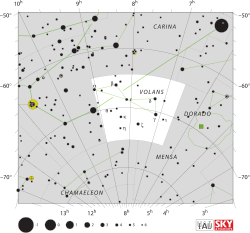
Epsilon Volantis, Latinized from ε Volantis, is a quadruple star system4 in the southern constellation Volans. This star is at the center of the constellation of Volans and connects the "wings" of the constellation. Based upon parallax measurements, is roughly 640 light years from Earth.
The primary component, Epsilon Volantis A, is a spectroscopic binary.9 It is classified a blue-white B-type giant star and has an apparent magnitude of +4.35. (The individual components are classified as B6IV and B8.)4 The binary system has an orbital period of 14.1683 days. The binary's companion, Epsilon Volantis B, is 6.05 arcseconds away and has an apparent magnitude of +8.1. It too is a spectroscopic binary, consisting of two A-type main sequence stars with stellar classifications of A2 V and an orbital period of "a few days".4
References
References
- Brown, A. G. A.; et al. (Gaia collaboration) (2021). "Gaia Early Data Release 3: Summary of the contents and survey properties". Astronomy & Astrophysics. 649: A1. arXiv:2012.01533. Bibcode:2021A&A...649A...1G. doi:10.1051/0004-6361/202039657. S2CID 227254300. (Erratum: doi:10.1051/0004-6361/202039657e). Gaia EDR3 record for this source at VizieR.
- Cousins, A. W. J. (1977), "UCBV Magnitudes and Colours of South Circumpolar Stars", South African Astronomical Observatory Circulars, 1: 51, Bibcode:1977SAAOC...1...51C.
- Houk, N.; Cowley, A. P. (1975), University of Michigan Catalogue of two-dimensional spectral types for the HD stars, vol. 1, Bibcode:1975mcts.book.....H.
- Veramendi, M. E.; González, J. F. (July 2014), "Spectroscopic study of early-type multiple stellar systems. II. New binary subsystems", Astronomy & Astrophysics, 567: 10, arXiv:1405.1084, Bibcode:2014A&A...567A..35V, doi:10.1051/0004-6361/201423736, S2CID 21711755, A35.
- Wilson, Ralph Elmer (1953), "General catalogue of stellar radial velocities", Carnegie Institute Washington D.C. Publication, Carnegie Institution of Washington, Bibcode:1953GCRV..C......0W.
- Anderson, E.; Francis, Ch. (2012), "XHIP: An extended hipparcos compilation", Astronomy Letters, 38 (5): 331, arXiv:1108.4971, Bibcode:2012AstL...38..331A, doi:10.1134/S1063773712050015, S2CID 119257644.
- Kovalev, Mikhail; Straumit, Ilya (2023). "Application of the binary spectral model to high-resolution spectra. First estimation of the fundamental parameters for HD 20784". Monthly Notices of the Royal Astronomical Society. 523 (3): 3741–3748. arXiv:2210.00863. Bibcode:2023MNRAS.523.3741K. doi:10.1093/mnras/stad1667.
- "eps Vol". SIMBAD. Centre de données astronomiques de Strasbourg. Retrieved 2016-09-02.
{{cite web}}: CS1 maint: postscript (link) - Medici, A.; Hubrig, S. (January 2000), "Triple System epsilon Vol and Quadruple System eta Mus: the Mass Ratio in Close Binary Systems", Information Bulletin on Variable Stars, 4827 (4827): 1, Bibcode:2000IBVS.4827....1M.