  | |
| Observation data Epoch J2000 Equinox ICRS | |
|---|---|
| Constellation | Pavo |
| Right ascension | 20h 00m 35.55558s1 |
| Declination | −72° 54′ 37.8198″1 |
| Apparent magnitude (V) | 3.972 |
| Characteristics | |
| Spectral type | A0 Va2 |
| U−B color index | −0.053 |
| B−V color index | −0.032 |
| Astrometry | |
| Radial velocity (Rv) | −6.7±0.74 km/s |
| Proper motion (μ) | RA: +81.781 mas/yr Dec.: −132.161 mas/yr |
| Parallax (π) | 31.04±0.17 mas1 |
| Distance | 105.1 ± 0.6 ly (32.2 ± 0.2 pc) |
| Absolute magnitude (MV) | 1.432 |
| Details | |
| Mass | 2.25 M☉ |
| Radius | 1.746 R☉ |
| Luminosity | 327 L☉ |
| Surface gravity (log g) | 4.32±0.026 cgs |
| Temperature | 10,4408 K |
| Rotational velocity (v sin i) | 857 km/s |
| Age | 276 Myr |
| Other designations | |
| ε Pav, CPD−73°2086, FK5 748, GC 27631, HD 188228, HIP 98495, HR 7590, SAO 257757 | |
| Database references | |
| SIMBAD | data |
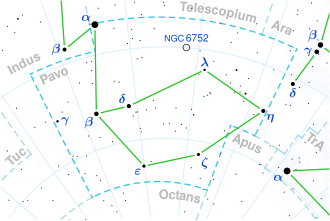
Epsilon Pavonis is a single,9 white-hued star in the constellation Pavo. Its name is a Bayer designation that is Latinized from ε Pavonis, and abbreviated Epsilon Pav or ε Pav. It can be viewed with the naked eye, having an apparent visual magnitude of 3.97.2 The annual parallax shift of 31.04 mas1 provides a distance estimate of 105 light years from the Sun.
With a stellar classification of A0 Va,2 Epsilon Pavonis is an ordinary A-type main-sequence star that is generating energy through hydrogen fusion at its core. It is just 27 million years old6 with a projected rotational velocity of 85 km/s.7 The star has 2.2 times the mass of the Sun5 and 1.74 times the Sun's radius.6 It is radiating 32 times the Sun's luminosity from its photosphere7 at an effective temperature of 10,440 K.8
This star is a member of the proposed Argus Association, a young moving group of more than 60 stars associated with the IC 2391 cluster.10 Epsilon Pavonis is moving closer to the Sun with a radial velocity of −6.7 km/s.4
References
References
- Van Leeuwen, F. (2007). "Validation of the new Hipparcos reduction". Astronomy and Astrophysics. 474 (2): 653–664. arXiv:0708.1752. Bibcode:2007A&A...474..653V. doi:10.1051/0004-6361:20078357. S2CID 18759600. Vizier catalog entry
- Anderson, E.; Francis, Ch. (2012). "XHIP: An extended hipparcos compilation". Astronomy Letters. 38 (5): 331. arXiv:1108.4971. Bibcode:2012AstL...38..331A. doi:10.1134/S1063773712050015. S2CID 119257644. Vizier catalog entry
- Mermilliod, J. C. (2006). "VizieR Online Data Catalog: Homogeneous Means in the UBV System (Mermilliod 1991)". VizieR On-line Data Catalog: II/168. Originally Published in: Institut d'Astronomie. 2168. Bibcode:2006yCat.2168....0M.Vizier catalog entry
- Gontcharov, G. A. (2006). "Pulkovo Compilation of Radial Velocities for 35 495 Hipparcos stars in a common system". Astronomy Letters. 32 (11): 759–771. arXiv:1606.08053. Bibcode:2006AstL...32..759G. doi:10.1134/S1063773706110065. S2CID 119231169.
- Tetzlaff, N.; Neuhäuser, R.; Hohle, M. M. (2011). "A catalogue of young runaway Hipparcos stars within 3 kpc from the Sun". Monthly Notices of the Royal Astronomical Society. 410 (1): 190–200. arXiv:1007.4883. Bibcode:2011MNRAS.410..190T. doi:10.1111/j.1365-2966.2010.17434.x. S2CID 118629873. Vizier catalog entry
- Gerbaldi, M.; et al. (June 1999), "Search for reference A0 dwarf stars: Masses and luminosities revisited with HIPPARCOS parallaxes", Astronomy and Astrophysics Supplement, 137 (2): 273–292, Bibcode:1999A&AS..137..273G, doi:10.1051/aas:1999248.
- Zorec, J.; Royer, F. (2012). "Rotational velocities of A-type stars". Astronomy & Astrophysics. 537: A120. arXiv:1201.2052. Bibcode:2012A&A...537A.120Z. doi:10.1051/0004-6361/201117691. S2CID 55586789. Vizier catalog entry
- David, Trevor J.; Hillenbrand, Lynne A. (2015). "The Ages of Early-Type Stars: Strömgren Photometric Methods Calibrated, Validated, Tested, and Applied to Hosts and Prospective Hosts of Directly Imaged Exoplanets". The Astrophysical Journal. 804 (2): 146. arXiv:1501.03154. Bibcode:2015ApJ...804..146D. doi:10.1088/0004-637X/804/2/146. S2CID 33401607. Vizier catalog entry
- Eggleton, P. P.; Tokovinin, A. A. (2008). "A catalogue of multiplicity among bright stellar systems". Monthly Notices of the Royal Astronomical Society. 389 (2): 869. arXiv:0806.2878. Bibcode:2008MNRAS.389..869E. doi:10.1111/j.1365-2966.2008.13596.x. S2CID 14878976.
- Zuckerman, B.; et al. (May 2011). "The Tucana/Horologium, Columba, AB Doradus, and Argus Associations: New Members and Dusty Debris Disks". The Astrophysical Journal. 732 (2): 19. arXiv:1104.0284. Bibcode:2011ApJ...732...61Z. doi:10.1088/0004-637X/732/2/61. S2CID 62797470. 61.