| Eodiscidae Temporal range:
| |
|---|---|
| |
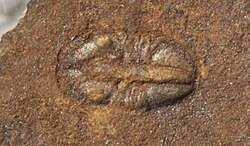
| Pagetia taijiangensis, 6mm, from Kaili, Guizhou, China, Middle Cambrian | |
Scientific classification 
| |
| Kingdom: | Animalia |
| Phylum: | Arthropoda |
| Clade: | †Artiopoda |
| Class: | †Trilobita (?) |
| Order: | †Agnostida |
| Suborder: | †Eodiscina |
| Superfamily: | †Eodiscoidea |
| Family: | †Eodiscidae Raymond, 1913 |
| Genera1 | |
| |
| Synonyms | |
| |
Eodiscidae is a family of agnostid trilobites that lived during the final Lower Cambrian (late Toyonian) and the Middle Cambrian. They are small or very small, and have a thorax of two or three segments. Eodiscidae includes nine genera (see box).
Taxonomy
The Eodiscids probably descended from the agnostids of family Yukoniidae.2
Description

Like other agnostids, the body of eodiscids is diminutive, the headshield (or cephalon) and tailshield (or pygidium) are of approximately same size, with 2 or 3 thoracic segments in-between, each consisting of a horizontal inner portion that abruptly passes into an inclined outer portion (fulcrate). The central raised area of the cephalon (or glabella) is narrow, usually with parallel sides and rounded front. The furrow between the occipital ring and the more frontal parts of the glabella are a pair of pits low on its sides beneath a large median spine extending from the glabella backwards. The distance between the glabella and the border (or preglabellar area) is usually long. This border has dozens of small furrows radiating inward (a so-called scrobiculate border), but this defining feature may be absent in effaced species or destroyed by poor preservation. The axis of the pygidium has four to ten rings.1
References
References
- Whittington, H. B. (1997). Treatise on Invertebrate Paleontology Part O, Revised, Volume 1 – Trilobita – Introduction, Order Agnostida, Order Redlichiida.
- Jell, P.A. (1975). "Australian Middle Cambrian Eodiscoids with a review of the superfamily". Palaeontographica Abteilung A. 150: 1–97. cited in H.B. Whittington; et al., eds. (1997). Part O, Treatise on Invertebrate Paleontology. Revised, Volume 1 – Trilobita – Introduction, Order Agnostida, Order Redlichiida.