| Eocarcinus Temporal range:
| |
|---|---|

| |
| Holotype (top) and paratype (bottom) specimens | |
Scientific classification 
| |
| Kingdom: | Animalia |
| Phylum: | Arthropoda |
| Clade: | Pancrustacea |
| Class: | Malacostraca |
| Order: | Decapoda |
| Suborder: | Pleocyemata |
| Infraorder: | Brachyura |
| Family: | †Eocarcinidae Withers, 1932 |
| Genus: | †Eocarcinus Withers, 1932 |
| Species: | †E. praecursor
|
| Binomial name | |
| †Eocarcinus praecursor Withers, 1932
| |
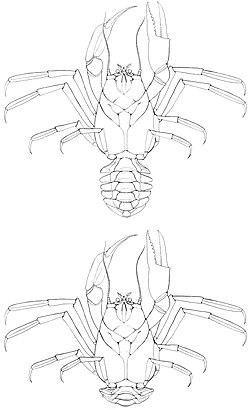

Eocarcinus praecursor is a Jurassic species of decapod crustacean, sufficiently distinct from its relatives to be placed in its own family (Eocarcinidae).1 Often considered the oldest true crab, it was considered by a 2010 study to be an early member of the Anomura. However, a reanalysis in 2020 again found it to be the earliest known stem-group crab.2
Distribution
It lived during the early Pliensbachian age (Lower Jurassic),3 and has been found in rocks at two sites in the United Kingdom – Mickelton Tunnel (near Aston Magna), Gloucestershire and Runswick Bay, Yorkshire.4
Description
In many of its characters, it represents a transitional stage between the Glypheoidea and the Middle Jurassic crabs in the Prosopidae.3 Since its ancestors were long-tailed decapods, and its successors were short-tailed crabs, Eocarcinus has been described as "the lobster who decided to become a crab".5 Previously considered to be the oldest known true crab, a 2010 revision concluded that Eocarcinus could not be accommodated among the Brachyura, and was instead transferred to the Anomura.6 However, a 2020 reanalysis found that it was again the earliest known stem-group crab, but that it had not undergone the process of carcinisation.2
References
References
- Sammy De Grave; N. Dean Pentcheff; Shane T. Ahyong; et al. (2009). "A classification of living and fossil genera of decapod crustaceans" (PDF). Raffles Bulletin of Zoology. Suppl. 21: 1–109. Archived from the original (PDF) on 2011-06-06.
- Scholtz, Gerhard (November 2020). "Eocarcinus praecursor Withers, 1932 (Malacostraca, Decapoda, Meiura) is a stem group brachyuran". Arthropod Structure & Development. 59 100991. Bibcode:2020ArtSD..5900991S. doi:10.1016/j.asd.2020.100991. PMID 32891896.
- M. Krobicki; M. Zaton (2008). "Middle and Late Jurassic roots of brachyuran crabs: Palaeoenvironmental distribution during their early evolution". Palaeogeography, Palaeoclimatology, Palaeoecology. 263 (1–2): 30–43. Bibcode:2008PPP...263...30K. doi:10.1016/j.palaeo.2008.01.025.
- Danièle Guinot; Marcos Tavares (2001). "Une nouvelle famille de Crabes du Crétacé, et la notion de Podotremata Guinot, 1977 (Crustacea, Decapoda, Brachyura)" (PDF). Zoosystema. 23 (3): 507–546.
- Anonymous (1932). "The Royal Society Conversazione". British Medical Journal. 1 (3724): 946–947. doi:10.1136/bmj.1.3724.944. S2CID 220003084. JSTOR: 1st page, 2nd page
- Rodney M. Feldmann; Carrie E. Schweitzer (2010). "Is Eocarcinus Withers, 1932, a basal brachyuran?". Journal of Crustacean Biology. 30 (2): 241–250. Bibcode:2010JCBio..30..241S. doi:10.1651/09-3230.1.