Article · Wikipedia archive · Last revised Aug 5, 2026

Environment subsystem

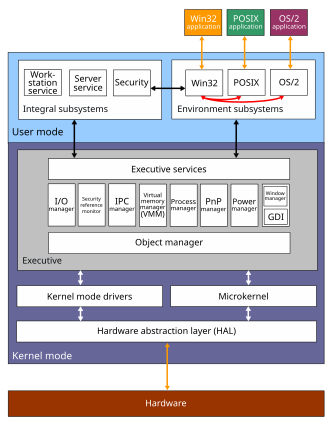
In the Windows NT architecture, environment subsystems are user space components of the operating system that provide compatibility with an application binary interface. They allow the operating system to run software developed for the platform in question. For example, Windows NT 4.0 has three environment subsystems: Win32, OS/2, and POSIX, the latter of which corresponding a subset of the most common functions in the application programming interfaces of Unix-like systems. The latter resides primarily in the dynamic-link library posix.dll. The environment subsystems are one part of the strategy Microsoft developed for making the Windows NT family of operating systems a hub for multi-platform computing in addition to other elements of the architecture of Windows NT like the hardware abstraction layer.

Last revised
Aug 5, 2026
Read time
≈ 1 min
Length
254 w
Citations
3
Source
Windows NT operating systems often support applications written or compiled for platforms other than Windows. In Windows 2000, applications compiled for OS/2 1.x run natively atop the NT kernel, but POSIX applications must be recompiled and linked against the relevant POSIX libraries. Some environment subsystems permit interprocess communication with applications in other subsystems. source ↗

In the Windows NT architecture, environment subsystems (sometimes referred to as personalities1) are user space components of the operating system that provide compatibility with an application binary interface. They allow the operating system to run software developed for the platform in question. For example, Windows NT 4.0 has three environment subsystems: Win32 (Windows API), OS/2, and POSIX, the latter of which corresponding a subset of the most common functions in the application programming interfaces of Unix-like systems.2 The latter resides primarily in the dynamic-link library posix.dll. The environment subsystems are one part of the strategy Microsoft developed for making the Windows NT family of operating systems a hub for multi-platform computing in addition to other elements of the architecture of Windows NT like the hardware abstraction layer.3

See also

See also

References

References

  1. Fleisch, B. D. (May 1997). The Failure of Personalities to Generalize. The Sixth Workshop on Hot Topics in Operating Systems. Cape Cod, MA: IEEE. pp. 8–13. doi:10.1109/HOTOS.1997.595174.
  2. Various (1993). Inside Windows NT. New Riders press. Bibcode:1993iwn..book.....C.
  3. Windows NT 4.0 Workstation Resource Kit. Microsoft Press. 1996.