Article · Wikipedia archive · Last revised Jul 27, 2026

End-to-end vector

In the physical chemistry study of polymers, the end-to-end vector is the vector that points from one end of a polymer to the other end.

Last revised
Jul 27, 2026
Read time
≈ 1 min
Length
186 w
Citations
1
Source
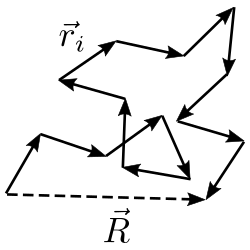
R {\displaystyle {\vec {R}}} is the end-to-end vector of the polymer. source ↗

In the physical chemistry study of polymers, the end-to-end vector is the vector that points from one end of a polymer to the other end.

If each monomer unit in a polymer is represented by a point in space, the translation vectors r i {\displaystyle {\vec {r}}_{i}} connect between these points. The end-to-end vector R {\displaystyle {\vec {R}}} is the sum of these translation vectors:

R = i r i {\displaystyle {\vec {R}}=\sum _{i}{\vec {r}}_{i}}

The norm of the end-to-end vector is called the end-to-end distance.

Relation to other quantities

The quadratic mean of the end-to-end distance r 2 {\displaystyle \left\langle r^{2}\right\rangle } can be related to the quadratic mean of the radius of gyration s 2 {\displaystyle \left\langle s^{2}\right\rangle } of a polymer by the relation:1

r 2 = 6 s 2 {\displaystyle \left\langle r^{2}\right\rangle =6\left\langle s^{2}\right\rangle }
Notes

Notes

  1. Gedde, Ulf W. (1995). Polymer Physics. Springer. p. 21. ISBN 0-412-62640-3.
See also

See also