| Elko Formation | |
|---|---|
| Stratigraphic range: Mid Eocene (Uintan)-Mid Miocene ~ | |
| Type | Formation |
| Sub-units | Elko Shale |
| Lithology | |
| Primary | Shale |
| Other | Limestone |
| Location | |
| Coordinates | 40°48′N 115°48′W / 40.8°N 115.8°W / 40.8; -115.8 |
| Approximate paleocoordinates | 41°30′N 112°54′W / 41.5°N 112.9°W / 41.5; -112.9 |
| Region | Nevada |
| Country | United States |
| Type section | |
| Named for | Elko County |
Elko Formation (the United States) Show map of the United StatesElko Formation (Nevada) Show map of Nevada | |
Elko Formation source ↗
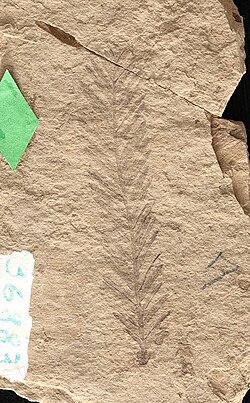
The Elko Formation, also known as Elko Shale(s), is an oil shale geologic formation in Elko County, northern Nevada, United States. The deltaic and lacustrine shales and limestones preserve fossils dating back to the Middle Eocene of the Paleogene to Middle Miocene of the Neogene period. The frog genus Elkobatrachus and ant species Pseudocamponotus elkoanus were named after the formation.
Description
The formation ranges in age from the Middle Eocene (Uintan), with the underlying lower member dated at 46.1 ± 0.1 Ma and the upper member of the Eocene section dated at 38.9 ± 0.3 Ma.1
A younger section is dated to the Late Eocene to Early Oligocene (37.2 to 28.4 Ma)2 and the Elko Shale member is dated to the Middle Miocene (16.0 to 11.6 Ma).3
Fossil content
The following fossils were reported from the formation:123
- Elkobatrachus brocki
- Miopelodytes gilmorei
- Pseudocamponotus elkoanus
- Candona sp.
- Lymnaea sp.
- Sphaerium sp.
- ?Pontoniella sp.
See also
See also
References
References
Further reading
Further reading
- A. C. Henrici and S. R. Haynes. 2006. Elkobatrachus brocki, a new pelobatid (Amphibia: Anura) from the Eocene Elko Formation of Nevada. Annals of Carnegie Museum 75(1):11-35
- E. H. Taylor. 1941. A new anuran from the middle Miocene of Nevada. University of Kansas Science Bulletin 27(4):61-69
- F. M. Carpenter. 1930. The Fossil Ants of North America. Bulletin of the Museum of Comparative Zoology, Harvard University 70:1-66