Article · Wikipedia archive·Last revised Jul 13, 2026
Elementary comparison testing
Elementary comparison testing (ECT) is a white-box, control-flow, test-design methodology used in software development. The purpose of ECT is to enable detailed testing of complex software. Software code or pseudocode is tested to assess the proper handling of all decision outcomes. As with multiple-condition coverage and basis path testing, coverage of all independent and isolated conditions is accomplished through modified condition/decision coverage (MC/DC). Isolated conditions are aggregated into connected situations creating formal test cases. The independence of a condition is shown by changing the condition value in isolation. Each relevant condition value is covered by test cases.
Elementary comparison testing (ECT) is a white-box, control-flow, test-design methodology used in software development.12 The purpose of ECT is to enable detailed testing of complex software. Software code or pseudocode is tested to assess the proper handling of all decision outcomes. As with multiple-condition coverage3 and basis path testing,1 coverage of all independent and isolated conditions is accomplished through modified condition/decision coverage (MC/DC).4 Isolated conditions are aggregated into connected situations creating formal test cases. The independence of a condition is shown by changing the condition value in isolation. Each relevant condition value is covered by test cases.
Test case
A test case consists of a logical path through one or many decisions from start to end of a process. Contradictory situations are deduced from the test case matrix and excluded. The MC/DC approach isolates every condition, neglecting all possible subpath combinations and path coverage.1
where
T is the number of test cases per decision and
n the number of conditions.
The decision consists of a combination of elementary conditions
The transition function is defined as
Given the transition
the isolated test path consists of
Test case graph
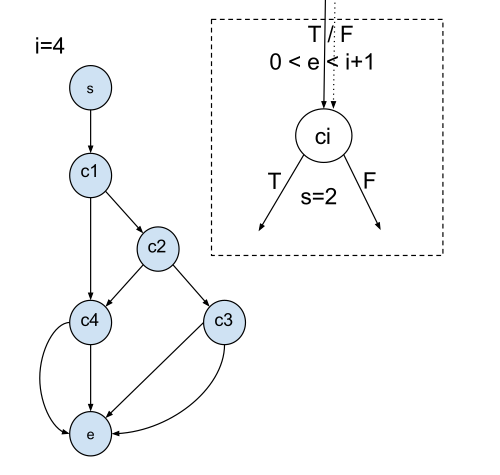
A test case graph illustrates all the necessary independent paths (test cases) to cover all isolated conditions. Conditions are represented by nodes, and condition values (situations) by edges. An edge addresses all program situations. Each situation is connected to one preceding and successive condition. Test cases might overlap due to isolated conditions.
Inductive proof of a number of condition paths
The elementary comparison testing method can be used to determine the number of condition paths by inductive proof.
there are edges from parent nodes and edges to child nodes from .
Each individual condition connects to at least one path
from the maximal possible connecting to isolating .
All predecessor conditions and respective paths are isolated. Therefore, when one node (condition) is added, the total number of paths, and required test cases, from start to finish increases by:
Q.E.D.
Figure 4: ECT Example Control-Flow Graph source ↗Figure 5: ECT Example D2 Conditions source ↗
This example shows ETC applied to a holiday booking system. The discount system offers reduced-price vacations. The offered discounts are for members or for expensive vacations, for moderate vacations with workday departures, and otherwise. The example shows the creation of logical and physical test cases for all isolated conditions.
Pseudocode
if days > 15 or price > 1000 or member thenreturn −0.2
else if (days > 8 and days ≤ 15 or price ≥ 500 and price ≤ 1000) and workday thenreturn −0.1
elsereturn 0.0
The highlighted diagonals in the MC/DC Matrix are describing the isolated conditions:
all duplicate situations are regarded as proven and removed.
Step 3: Logical test-Case matrix
Table 3: Example Logical Test Case Matrix
Situation
x
x
x
x
x
x
x
x
x
x
x
Test cases are formed by tracing decision paths. For every decision a succeeding and preceding subpath is searched until every connected path has a start and an end :
Step 4: Physical test-case matrix
Table 4: Example Physical Test Cases
Factor\Test Case
days
16
14
8
8
8
price
1100
600
departure
sa
member
silver
Result
0
0
-10
1
1
1
-20
1
1
1
Physical test cases are created from logical test cases by filling in actual value representations and their respective results.