| ECHS1 |
|---|
 |
|
| Identifiers |
|---|
| Aliases | ECHS1, SCEH, ECHS1D, enoyl-CoA hydratase, short chain, 1, mitochondrial, enoyl-CoA hydratase, short chain 1, mECH, mECH1 |
|---|
| External IDs | OMIM: 602292; MGI: 2136460; HomoloGene: 3018; GeneCards: ECHS1; OMA:ECHS1 - orthologs |
|---|
|
|
|
|
|
| Wikidata |
|
Enoyl Coenzyme A hydratase, short chain, 1, mitochondrial, also known as ECHS1, is a human gene.5
The protein encoded by this gene functions in the second step of the mitochondrial fatty acid beta-oxidation pathway. It catalyzes the hydration of 2-trans-enoyl-coenzyme A (CoA) intermediates to L-3-hydroxyacyl-CoAs. The gene product is a member of the hydratase/isomerase superfamily. It localizes to the mitochondrial matrix. Transcript variants utilizing alternative transcription initiation sites have been described in the literature.5
Structure
The ECHS1 gene is approximately 11 kb in length, and is composed of eight exons, with exons I and VIII containing the 5'- and 3'-untranslated regions, respectively. There are two major transcription start sites, located 62 and 63 bp upstream of the translation codon, were mapped by primer extension analysis. The 5'-flanking region of the ECHS1 gene is GC-rich and contains several copies of the SP1 binding motive but no typical TATA or CAAT boxes are apparent. Alu repeat elements have been identified within the region -1052/-770 relative to the cap site and in intron 7.6 The precursor polypeptide contains 290 amino acid residues, with an N-terminal mitochondrial targeting domain (1-27,28,29) leading to a ragged mature N-terminus. The mRNA has a 5'-untranslated sequence of 21 bp and a 3'-untranslated sequence of 391 bp.7
Function
Enoyl-CoA hydratase (ECH) catalyzes the second step in beta-oxidation pathway of fatty acid metabolism. The enzyme is involved in the formation of a β-hydroxyacyl-CoA thioester. The two catalytic glutamic acid residues are believed to act in concert to activate a water molecule, while Gly-141 is proposed to be involved in substrate activation. There are two potent inhibitors of ECHS, which irreversibly inactivate the enzyme via covalent adduct formation.8
Clinical significance
Enoyl-CoA hydratase short chain has been confirmed to interact with STAT3, such that ECHS1 specifically represses STAT3 activity by inhibiting STAT3 phosphorylation.9 STAT3 can act as both an oncogene and a tumor suppressor. ECHS1 itself has shown to occur in many cancers, particularly in hepatocellular carcinoma (HCC) development;10 both exogenous and endogenous forms of ECHS1 bind to HBs and induce apoptosis as a result. This means that ECHS1 may be used in the future as a therapy for patients with HBV-related hepatitis or HCC.11
References
References
- GRCh38: Ensembl release 89: ENSG00000127884 – Ensembl, May 2017
- GRCm38: Ensembl release 89: ENSMUSG00000025465 – Ensembl, May 2017
- "Human PubMed Reference:". National Center for Biotechnology Information, U.S. National Library of Medicine.
- "Mouse PubMed Reference:". National Center for Biotechnology Information, U.S. National Library of Medicine.
- "Entrez Gene: ECHS1 enoyl Coenzyme A hydratase, short chain, 1, mitochondrial".
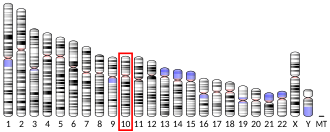
- Janssen, U; Davis, E. M.; Le Beau, M. M.; Stoffel, W (1997). "Human mitochondrial enoyl-CoA hydratase gene (ECHS1): Structural organization and assignment to chromosome 10q26.2-q26.3". Genomics. 40 (3): 470–5. doi:10.1006/geno.1996.4597. PMID 9073515.
- Kanazawa, M; Ohtake, A; Abe, H; Yamamoto, S; Satoh, Y; Takayanagi, M; Niimi, H; Mori, M; Hashimoto, T (1993). "Molecular cloning and sequence analysis of the cDNA for human mitochondrial short-chain enoyl-CoA hydratase". Enzyme & Protein. 47 (1): 9–13. doi:10.1159/000468650. PMID 8012501.
- Agnihotri, G; Liu, H. W. (2003). "Enoyl-CoA hydratase. Reaction, mechanism, and inhibition". Bioorganic & Medicinal Chemistry. 11 (1): 9–20. doi:10.1016/s0968-0896(02)00333-4. PMID 12467702.
- Chang, Y; Wang, S. X.; Wang, Y. B.; Zhou, J; Li, W. H.; Wang, N; Fang, D. F.; Li, H. Y.; Li, A. L.; Zhang, X. M.; Zhang, W. N. (2013). "ECHS1 interacts with STAT3 and negatively regulates STAT3 signaling". FEBS Letters. 587 (6): 607–13. Bibcode:2013FEBSL.587..607C. doi:10.1016/j.febslet.2013.02.005. PMID 23416296. S2CID 23233213.
- Zhu, X. S.; Dai, Y. C.; Chen, Z. X.; Xie, J. P.; Zeng, W; Lin, Y. Y.; Tan, Q. H. (2013). "Knockdown of ECHS1 protein expression inhibits hepatocellular carcinoma cell proliferation via suppression of Akt activity". Critical Reviews in Eukaryotic Gene Expression. 23 (3): 275–82. doi:10.1615/critreveukaryotgeneexpr.2013007531. PMID 23879543.
- Xiao, C. X.; Yang, X. N.; Huang, Q. W.; Zhang, Y. Q.; Lin, B. Y.; Liu, J. J.; Liu, Y. P.; Jazag, A; Guleng, B; Ren, J. L. (2013). "ECHS1 acts as a novel HBs Ag-binding protein enhancing apoptosis through the mitochondrial pathway in HepG2 cells". Cancer Letters. 330 (1): 67–73. doi:10.1016/j.canlet.2012.11.030. PMID 23178449.
Further reading
Further reading
- Hochstrasser DF, Frutiger S, Paquet N, et al. (1993). "Human liver protein map: a reference database established by microsequencing and gel comparison". Electrophoresis. 13 (12): 992–1001. doi:10.1002/elps.11501301201. PMID 1286669. S2CID 23518983.
- Dawson SJ, White LA (1992). "Treatment of Haemophilus aphrophilus endocarditis with ciprofloxacin". J. Infect. 24 (3): 317–20. doi:10.1016/S0163-4453(05)80037-4. PMID 1602151.
- Li J, Norwood DL, Mao LF, Schulz H (1991). "Mitochondrial metabolism of valproic acid". Biochemistry. 30 (2): 388–94. doi:10.1021/bi00216a012. PMID 1988037.
- Jackson S, Schaefer J, Middleton B, Turnbull DM (1995). "Characterisation of a novel enzyme of human fatty acid beta-oxidation: a matrix-associated, mitochondrial 2-enoyl-CoA hydratase". Biochem. Biophys. Res. Commun. 214 (1): 247–53. doi:10.1006/bbrc.1995.2281. PMID 7669045.
- Kanazawa M, Ohtake A, Abe H, et al. (1994). "Molecular cloning and sequence analysis of the cDNA for human mitochondrial short-chain enoyl-CoA hydratase". Enzyme and Protein. 47 (1): 9–13. doi:10.1159/000468650. PMID 8012501.
- Janssen U, Davis EM, Le Beau MM, Stoffel W (1997). "Human mitochondrial enoyl-CoA hydratase gene (ECHS1): structural organization and assignment to chromosome 10q26.2-q26.3". Genomics. 40 (3): 470–5. doi:10.1006/geno.1996.4597. PMID 9073515.
- Hubbard MJ, McHugh NJ (2001). "Human ERp29: isolation, primary structural characterisation and two-dimensional gel mapping". Electrophoresis. 21 (17): 3785–96. doi:10.1002/1522-2683(200011)21:17<3785::AID-ELPS3785>3.0.CO;2-2. PMID 11271497. S2CID 42538820.
- Jiang LQ, Wen SJ, Wang HY, Chen LY (2003). "Screening the proteins that interact with calpain in a human heart cDNA library using a yeast two-hybrid system". Hypertens. Res. 25 (4): 647–52. doi:10.1291/hypres.25.647. PMID 12358155.
- Strausberg RL, Feingold EA, Grouse LH, et al. (2003). "Generation and initial analysis of more than 15,000 full-length human and mouse cDNA sequences". Proc. Natl. Acad. Sci. U.S.A. 99 (26): 16899–903. Bibcode:2002PNAS...9916899M. doi:10.1073/pnas.242603899. PMC 139241. PMID 12477932.
- Deloukas P, Earthrowl ME, Grafham DV, et al. (2004). "The DNA sequence and comparative analysis of human chromosome 10". Nature. 429 (6990): 375–81. Bibcode:2004Natur.429..375D. doi:10.1038/nature02462. PMID 15164054.
- Gerhard DS, Wagner L, Feingold EA, et al. (2004). "The status, quality, and expansion of the NIH full-length cDNA project: the Mammalian Gene Collection (MGC)". Genome Res. 14 (10B): 2121–7. doi:10.1101/gr.2596504. PMC 528928. PMID 15489334.
- Bruneel A, Labas V, Mailloux A, et al. (2006). "Proteomics of human umbilical vein endothelial cells applied to etoposide-induced apoptosis". Proteomics. 5 (15): 3876–84. doi:10.1002/pmic.200401239. PMID 16130169. S2CID 26007149.
- Ewing RM, Chu P, Elisma F, et al. (2007). "Large-scale mapping of human protein-protein interactions by mass spectrometry". Mol. Syst. Biol. 3 (1): 89. doi:10.1038/msb4100134. PMC 1847948. PMID 17353931.
- Takahashi M, Watari E, Shinya E, et al. (2007). "Suppression of virus replication via down-modulation of mitochondrial short chain enoyl-CoA hydratase in human glioblastoma cells". Antiviral Res. 75 (2): 152–8. doi:10.1016/j.antiviral.2007.02.002. PMID 17395278.