| Drosera pygmaea | |
|---|---|
| |
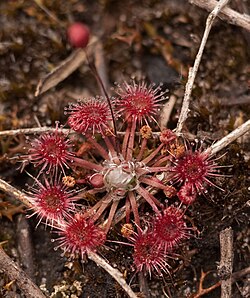
| Early summer growth of Drosera pygmaea at the Peter Murrell Reserve, near Hobart, Tasmania, Australia. | |
Scientific classification 
| |
| Kingdom: | Plantae |
| Clade: | Embryophytes |
| Clade: | Tracheophytes |
| Clade: | Spermatophytes |
| Clade: | Angiosperms |
| Clade: | Eudicots |
| Order: | Caryophyllales |
| Family: | Droseraceae |
| Genus: | Drosera |
| Subgenus: | Drosera subg. Ergaleium |
| Section: | Drosera sect. Bryastrum Planch. |
| Species: | D. pygmaea
|
| Binomial name | |
| Drosera pygmaea DC. (1824)
| |
| Synonyms | |
| |
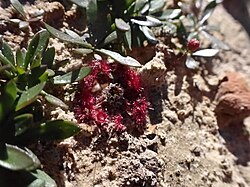
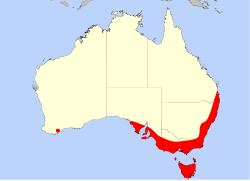
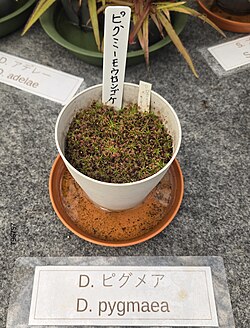
Drosera pygmaea is a carnivorous, rosette-forming biennial or annual species of herb native to Australia and New Zealand.1 The specific epithet, which translates as "dwarf" from Latin, is a reference to the very small size of this plant, which grows to between 8 and 18 mm in diameter.1 Small, pale flowers are produced at the ends of 1- to 3-inch stems. It is perhaps the most well-known of the pygmy sundews.2 Within New Zealand D. pygmaea is found in a wide range of habitats from coastal to subalpine, it requires open ground as it is easily outcompeted from taller species.3
References
References
- Bruce Salmon, "Carnivorous Plants of New Zealand", Ecosphere publications, 2001
- "Drosera - Sundews". Botanique: Carnivorous and Unusual Plants. 7 June 2015. Retrieved 10 January 2016.
- "Drosera pygmaea". New Zealand Plant Conservation Network. Retrieved 2 November 2025.