| Observation data Epoch J2000.0 Equinox ICRS | |
|---|---|
| Constellation | Leo |
| Right ascension | 11h 17m 15.92381s2 |
| Declination | +17° 57′ 41.6804″2 |
| Apparent magnitude (V) | 17.5-193 |
| Characteristics | |
| Variable type | AM Her3 |
| Astrometry | |
| Radial velocity (Rv) | 0.04 km/s |
| Proper motion (μ) | RA: −28.700 mas/yr2 Dec.: −1.444 mas/yr2 |
| Parallax (π) | 3.2781±0.3110 mas2 |
| Distance | 990 ± 90 ly (310 ± 30 pc) |
| Orbit | |
| Period (P) | 0.06236284265 yr |
| Eccentricity (e) | 0.0 (fixed) |
| Inclination (i) | 79.56° |
| Details | |
| White dwarf | |
| Mass | 0.66 M☉ |
| Temperature | 13,5005 K |
| Donor star | |
| Mass | 0.096 M☉ |
| Other designations | |
| DP Leo,7 X 11146+1823 | |
| Database references | |
| SIMBAD | data |
| Exoplanet Archive | data |
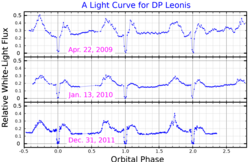
DP Leonis (abbreviated DP Leo) is a binary star system in the equatorial constellation of Leo. It is a variable star that ranges in apparent visual magnitude from 17.5 down to 19.3 The system is located at a distance of approximately 990 light-years from the Sun based on parallax.2 It is a cataclysmic variable star of the AM Herculis-type also known as polars. The system comprises an eclipsing white dwarf and red dwarf in tight orbit (nearly 1.5 hours) and an extrasolar planet.8 This eclipsing variable was discovered by P. Biermann and associates in 1982 as the optical counterpart to the EINSTEIN X-ray source E1114+182.9
Planetary system
In 2010, Qian et al. announced the detection of a third body of planetary mass around the eclipsing binary system. The presence of a third body had already been suspected in 2002.6 The object is roughly 6 times more massive than Jupiter and is located 8.6 AU from the binary.
| Companion (in order from star) |
Mass | Semimajor axis (AU) |
Orbital period (years) |
Eccentricity | Inclination (°) |
Radius |
|---|---|---|---|---|---|---|
| b | ≥6.1 ± 0.5 MJ | 8.2 ± 0.4 | 28.0 ± 2.0 | 0.39 ± 0.13 | — | — |
References
References
- Beuermann, K.; Dreizler, S.; Hessman, F. V.; Schwope, A. D. (February 2014). "Evidence for an oscillation of the magnetic axis of the white dwarf in the polar DP Leonis". Astronomy and Astrophysics. 562: A63. arXiv:1401.1638. Bibcode:2014A&A...562A..63B. doi:10.1051/0004-6361/201323192. S2CID 118631556.
- Brown, A. G. A.; et al. (Gaia collaboration) (August 2018). "Gaia Data Release 2: Summary of the contents and survey properties". Astronomy & Astrophysics. 616. A1. arXiv:1804.09365. Bibcode:2018A&A...616A...1G. doi:10.1051/0004-6361/201833051. Gaia DR2 record for this source at VizieR.
- Samus, N. N.; et al. (2017). "General Catalogue of Variable Stars". Astronomy Reports. 5.1. 61 (1): 80–88. Bibcode:2017ARep...61...80S. doi:10.1134/S1063772917010085. S2CID 125853869. Retrieved 2021-11-30.
- Duflot, M.; et al. (December 1995). "Radial velocities: The Wilson-Evans-Batten catalogue". Astronomy and Astrophysics Supplement. 114: 269. Bibcode:1995A&AS..114..269D.
- Beuermann, K.; et al. (February 2011). "The giant planet orbiting the cataclysmic binary DP Leonis". Astronomy and Astrophysics. 526: 5. arXiv:1011.3905. Bibcode:2011A&A...526A..53B. doi:10.1051/0004-6361/201015942. S2CID 119184531. A53.
- Schwope, A. D.; et al. (2002). "A multiwavelength timing analysis of the eclipsing polar DP Leo". Astronomy and Astrophysics. 392 (2): 541–551. arXiv:astro-ph/0111457. Bibcode:2002A&A...392..541S. doi:10.1051/0004-6361:20011651. S2CID 17284811.
- "DP Leo". SIMBAD. Centre de données astronomiques de Strasbourg. Retrieved 2021-03-25.
- Qian, S.-B.; et al. (2010). "Detection of a Giant Extrasolar Planet Orbiting the Eclipsing Polar DP Leo". The Astrophysical Journal Letters. 708 (1): L66–L68. Bibcode:2010ApJ...708L..66Q. doi:10.1088/2041-8205/708/1/L66.
- Biermann, P.; et al. (June 1985). "The new eclipsing magnetic binary system E 1114+182". Astrophysical Journal. 293: 303–320. Bibcode:1985ApJ...293..303B. doi:10.1086/163238.