| Doryphora aromatica | |
|---|---|
| |
Scientific classification 
| |
| Kingdom: | Plantae |
| Clade: | Embryophytes |
| Clade: | Tracheophytes |
| Clade: | Spermatophytes |
| Clade: | Angiosperms |
| Clade: | Magnoliids |
| Order: | Laurales |
| Family: | Atherospermataceae |
| Genus: | Doryphora |
| Species: | D. aromatica
|
| Binomial name | |
| Doryphora aromatica | |
| Synonyms2 | |
|
Daphnandra aromatica F.M.Bailey | |
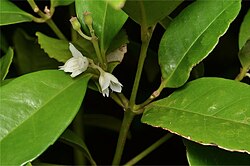
Doryphora aromatica, commonly known as sassafras, northern sassafras, northern grey sassafras, net sassafras or grey sassafras,3 is a species of flowering plant in the Southern Sassafras Family Atherospermataceae and is endemic to north-east Queensland. It is a tree with elliptic or egg-shaped leaves with the narrower end towards the base, white flowers with 5 stamens and 6 to 8 carpels, and achenes splitting to release feather-like fruits.
Description
Doryphora aromatica is a tree that typically grows to 12–40 m (39–131 ft) high. Its leaves are elliptic to egg-shaped with the narrower end towards the base, 50–135 mm (2.0–5.3 in) long and 20–43 mm (0.79–1.69 in) wide on a petiole 5–8 mm (0.20–0.31 in) long,3 and emit an aromatic odour when crushed.4 The edges of the leaves are sometimes shallowly toothed, and both surfaces have a prominent midvein. The flowers are white with 4 tepals 5–7 mm (0.20–0.28 in) long and 2.5–3.5 mm (0.098–0.138 in) wide, the androecium with 3 whorls of 5 stamens and 6 to 11 staminodes, and there are 6 to 8 carpels. Flowering occurs from February to June and the achenes are 3.0–4.5 mm (0.12–0.18 in) long and 2–3 mm (0.079–0.118 in) in diameter,3 and split to release fruit with feather-like hairs.4
Taxonomy
This species was first formally described in 1886 by Frederick Manson Bailey who gave it the name Daphnandra aromatica in A Synopsis of the Queensland Flora from a specimen collected near the Johnstone River br Thomas Lane Bancroft.56 In 1958, Lindsay Stuart Smith transferred the species to Doryphora as D. aromatica.7
Distribution and habitat
Doryphora aromatica is widespread in north-east Queensland where it grows in rainforest along creeks and gullies.34
Ecology
The leaves of this species are food for the larval stages of Macleay's swallowtail (Graphium macleayanus) and blue triangle butterfly (Graphium sarpedon).4
References
References
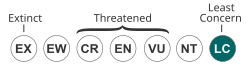
- IUCN SSC Global Tree Specialist Group.; Botanic Gardens Conservation International (BGCI). (2021). "Doryphora aromatica". IUCN Red List of Threatened Species. 2021 e.T192233434A192233436. doi:10.2305/IUCN.UK.2021-1.RLTS.T192233434A192233436.en. Retrieved 7 May 2026.
- "Doryphora aromatica". Australian Plant Census. Retrieved 16 May 2024.
- Foreman, Donald B.; Whiffin, Trevor J. "Doryphora aromatica". Flora of Australia. Australian Biological Resources Study, Department of Climate Change, Energy, the Environment and Water: Canberra. Retrieved 16 May 2024.
- "Doryphora aromatica". Australian Tropical Rainforest Plants. Retrieved 17 May 2024.
- "Daphnandra aromatica". Australian Plant Name Index (APNI). Centre for Plant Biodiversity Research, Australian Government. Retrieved 16 May 2024.
- Bailey, Frederick Manson (1886). "... Tribe ATHEROSPERMEǢ, DAPHNANDRA, Bent. D. aromatica (sp. nov.).". A synopsis of the Queensland flora, Supplement 1. Government Printer, Brisbane: James C. Beal. p. 46. Retrieved 17 May 2024.
- "Doryphora aromatica". Australian Plant Name Index (APNI). Centre for Plant Biodiversity Research, Australian Government. Retrieved 16 May 2024.
External links
External links
- "Doryphora aromatica (F.M.Bailey) L.S.Sm. — Grey Sassafras". Atlas of Living Australia.