| Dissopsalini Temporal range: Early—Late Miocene,
| |
|---|---|
| |
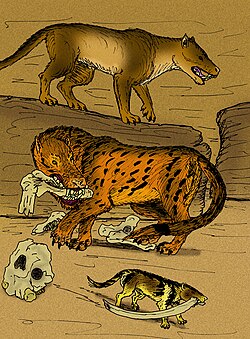
| Comparison of various Early to Middle Miocene hyaenodonts, including the hyainailurids Hyainailouros sulzeri (top) and Megistotherium osteothlastes (center), and teratodontid Dissopsalis carnifex (bottom) | |
Scientific classification 
| |
| Kingdom: | Animalia |
| Phylum: | Chordata |
| Class: | Mammalia |
| Infraclass: | Placentalia |
| Order: | †Hyaenodonta |
| Superfamily: | †Hyainailouroidea |
| Family: | †Teratodontidae |
| Subfamily: | †Teratodontinae |
| Tribe: | †Dissopsalini Morales & Pickford, 20171 |
| Type genus | |
| †Dissopsalis Pilgrim, 1910
| |
| Genera | |
| |
Dissopsalini ("double scissors") is an extinct tribe of hyaenodonts from extinct family Teratodontidae. Fossil remains of these mammals are known from early to late Miocene deposits in Asia and Africa.12
Etymology
The name of the family translates as "monstrous teeth" (from Ancient Greek τέρας (téras) 'monster', from Ancient Greek ὀδών (odon) 'tooth' and taxonomic suffix "-idae".
Classification and phylogeny
Taxonomy
|
References
References
- Jorge Morales; Martin Pickford (2017). "New hyaenodonts (Ferae, Mammalia) from the Early Miocene of Napak (Uganda), Koru (Kenya) and Grillental (Namibia)" (PDF). Fossil Imprint. 73 (3–4): 332–359. doi:10.2478/if-2017-0019. S2CID 31350436.
- Barry, John C. (January 2025). "Siwalik Creodonts and Carnivorans". At the Foot of the Himalayas: Paleontology and Ecosystem Dynamics of the Siwalik Record. ISBN 978-1421450278.